

384
9 Topologic Optimization of Vibrations of Size-Dependent Beams
(ii) simple support
u = w| x=0, 1 = 0,
1
λ 2 k 2
u , x +
1
2
w , x
2
−
1
λ 2
k 3 + k 4 l
2
0
w , xx − M T = 0
x=0, 1
.
(9.103)
9.7.3 Results and Discussions
The numerical study concerns a thermoelastic beam with λ = 40 and made from
steel (E 0 = 200 MPa, α 0 = 12.3 · 10
−6 1/K, ρ 0 = 7800 kg/m
3 , ν = 0.3). In order to
simplify the carried out numerical investigation, we take f (x, t) = 0, C (x, t) = 0,
b 1 = 0, b 2 = 0. The optimal topology of the beam microstructure is obtained based
on the solution to the plane problems of thermoelasticity by using FEM and the
method of moving asymptotes [54]. Examples of the optimal topology of the material
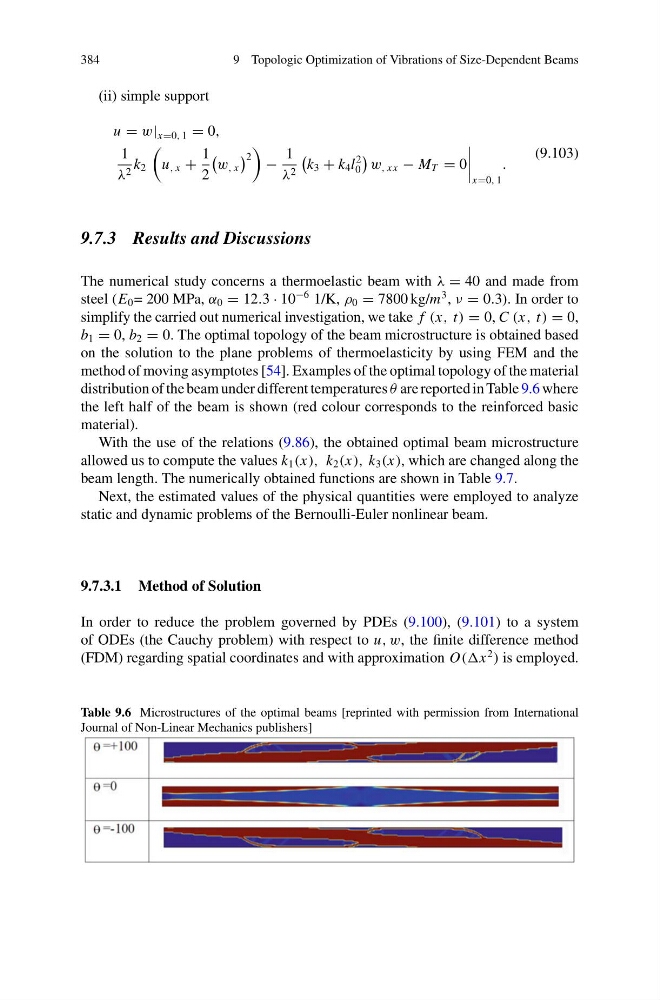
distribution of the beam under different temperatures θ are reported in Table 9.6 where
the left half of the beam is shown (red colour corresponds to the reinforced basic
material).
With the use of the relations (9.86), the obtained optimal beam microstructure
allowed us to compute the values k 1 (x), k 2 (x), k 3 (x), which are changed along the
beam length. The numerically obtained functions are shown in Table 9.7.
Next, the estimated values of the physical quantities were employed to analyze
static and dynamic problems of the Bernoulli-Euler nonlinear beam.
9.7.3.1 Method of Solution
In order to reduce the problem governed by PDEs (9.100), (9.101) to a system
of ODEs (the Cauchy problem) with respect to u, w, the finite difference method
(FDM) regarding spatial coordinates and with approximation O((x
2
) is employed.
Table 9.6 Microstructures of the optimal beams [reprinted with permission from International
Journal of Non-Linear Mechanics publishers]
9 Topologic Optimization of Vibrations of Size-Dependent Beams
(ii) simple support
u = w| x=0, 1 = 0,
1
λ 2 k 2
u , x +
1
2
w , x
2
−
1
λ 2
k 3 + k 4 l
2
0
w , xx − M T = 0
x=0, 1
.
(9.103)
9.7.3 Results and Discussions
The numerical study concerns a thermoelastic beam with λ = 40 and made from
steel (E 0 = 200 MPa, α 0 = 12.3 · 10
−6 1/K, ρ 0 = 7800 kg/m
3 , ν = 0.3). In order to
simplify the carried out numerical investigation, we take f (x, t) = 0, C (x, t) = 0,
b 1 = 0, b 2 = 0. The optimal topology of the beam microstructure is obtained based
on the solution to the plane problems of thermoelasticity by using FEM and the
method of moving asymptotes [54]. Examples of the optimal topology of the material
distribution of the beam under different temperatures θ are reported in Table 9.6 where
the left half of the beam is shown (red colour corresponds to the reinforced basic
material).
With the use of the relations (9.86), the obtained optimal beam microstructure
allowed us to compute the values k 1 (x), k 2 (x), k 3 (x), which are changed along the
beam length. The numerically obtained functions are shown in Table 9.7.
Next, the estimated values of the physical quantities were employed to analyze
static and dynamic problems of the Bernoulli-Euler nonlinear beam.
9.7.3.1 Method of Solution
In order to reduce the problem governed by PDEs (9.100), (9.101) to a system
of ODEs (the Cauchy problem) with respect to u, w, the finite difference method
(FDM) regarding spatial coordinates and with approximation O((x
2
) is employed.
Table 9.6 Microstructures of the optimal beams [reprinted with permission from International
Journal of Non-Linear Mechanics publishers]