

9.6 Topological Optimization with Maximized Stiffness and Heat Transfer
361
¯
σ i j = C
e
i jkl ¯
ε kl ,
(9.51)
and C
e
i jkl depends on the volume fraction of the filler and the microstructure of the
elementary cell.
We introduce the local coordinate system (Y ) to describe the rapid changes in
properties of the microstructure of the material in the global coordinate system (X )
in the macro scale. The local coordinate y can be considered as a fast coordinate
which is coupled with x through the relation y = x/ε (ε << 1). The displacement
of an arbitrary material point in an elastic body can be approximated using two-scale
asymptotic series [112, 113]
u
ε
(x) = u
0
(x, y) + εu
1
(x, y) + ε
2 u
2
(x, y) + · · ·
(9.52)
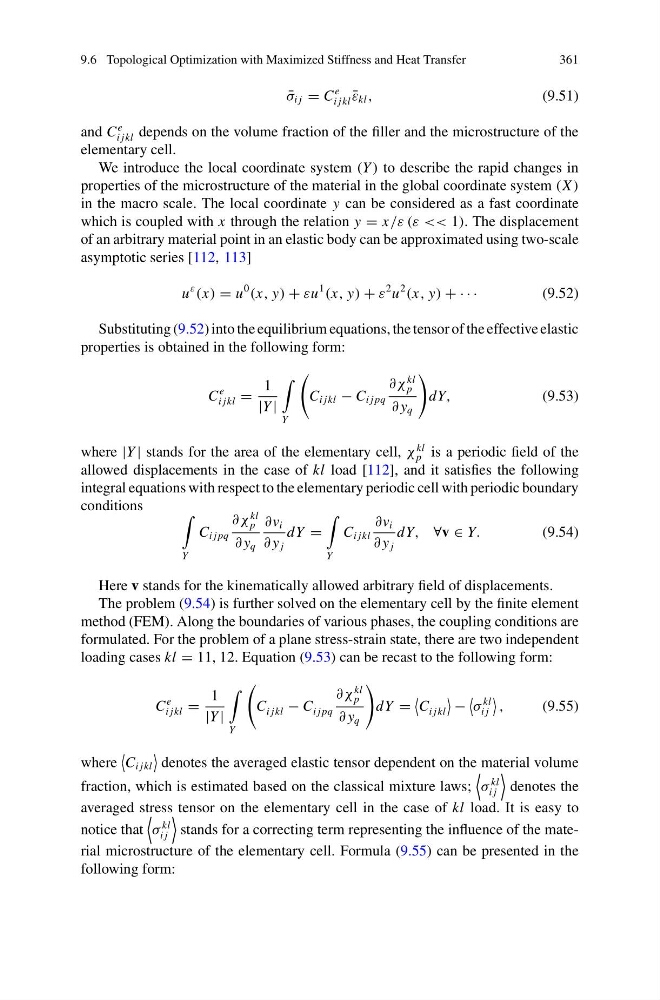
Substituting (9.52) into the equilibrium equations, the tensor of the effective elastic
properties is obtained in the following form:
C
e
i jkl =
1
|Y |
Y
C i jkl − C i jpq
∂χ
kl
p
∂ y q
dY,
(9.53)
where |Y | stands for the area of the elementary cell, χ
kl
p is a periodic field of the
allowed displacements in the case of kl load [112], and it satisfies the following
integral equations with respect to the elementary periodic cell with periodic boundary
conditions
Y
C i jpq
∂χ
kl
p
∂ y q
∂v i
∂ y j
dY =
Y
C i jkl
∂v i
∂ y j
dY, ∀v ∈ Y.
(9.54)
Here v stands for the kinematically allowed arbitrary field of displacements.
The problem (9.54) is further solved on the elementary cell by the finite element
method (FEM). Along the boundaries of various phases, the coupling conditions are
formulated. For the problem of a plane stress-strain state, there are two independent
loading cases kl = 11, 12. Equation (9.53) can be recast to the following form:
C
e
i jkl =
1
|Y |
Y
C i jkl − C i jpq
∂χ
kl
p
∂ y q
dY =
C i jkl
−
σ
kl
i j
,
(9.55)
where
C i jkl
denotes the averaged elastic tensor dependent on the material volume
fraction, which is estimated based on the classical mixture laws;
σ
kl
i j
denotes the
averaged stress tensor on the elementary cell in the case of kl load. It is easy to
notice that
σ
kl
i j
stands for a correcting term representing the influence of the material microstructure of the elementary cell. Formula (9.55) can be presented in the
following form:
361
¯
σ i j = C
e
i jkl ¯
ε kl ,
(9.51)
and C
e
i jkl depends on the volume fraction of the filler and the microstructure of the
elementary cell.
We introduce the local coordinate system (Y ) to describe the rapid changes in
properties of the microstructure of the material in the global coordinate system (X )
in the macro scale. The local coordinate y can be considered as a fast coordinate
which is coupled with x through the relation y = x/ε (ε << 1). The displacement
of an arbitrary material point in an elastic body can be approximated using two-scale
asymptotic series [112, 113]
u
ε
(x) = u
0
(x, y) + εu
1
(x, y) + ε
2 u
2
(x, y) + · · ·
(9.52)
Substituting (9.52) into the equilibrium equations, the tensor of the effective elastic
properties is obtained in the following form:
C
e
i jkl =
1
|Y |
Y
C i jkl − C i jpq
∂χ
kl
p
∂ y q
dY,
(9.53)
where |Y | stands for the area of the elementary cell, χ
kl
p is a periodic field of the
allowed displacements in the case of kl load [112], and it satisfies the following
integral equations with respect to the elementary periodic cell with periodic boundary
conditions
Y
C i jpq
∂χ
kl
p
∂ y q
∂v i
∂ y j
dY =
Y
C i jkl
∂v i
∂ y j
dY, ∀v ∈ Y.
(9.54)
Here v stands for the kinematically allowed arbitrary field of displacements.
The problem (9.54) is further solved on the elementary cell by the finite element
method (FEM). Along the boundaries of various phases, the coupling conditions are
formulated. For the problem of a plane stress-strain state, there are two independent
loading cases kl = 11, 12. Equation (9.53) can be recast to the following form:
C
e
i jkl =
1
|Y |
Y
C i jkl − C i jpq
∂χ
kl
p
∂ y q
dY =
C i jkl
−
σ
kl
i j
,
(9.55)
where
C i jkl
denotes the averaged elastic tensor dependent on the material volume
fraction, which is estimated based on the classical mixture laws;
σ
kl
i j
denotes the
averaged stress tensor on the elementary cell in the case of kl load. It is easy to
notice that
σ
kl
i j
stands for a correcting term representing the influence of the material microstructure of the elementary cell. Formula (9.55) can be presented in the
following form: