

356
9 Topologic Optimization of Vibrations of Size-Dependent Beams
resist the applied load F
a . In other words, the obtained construction should be stable
with respect to deformation in direction of the applied load, and it should possess
very small stiffness in the remaining directions. The mentioned loads should imitate
reactive loads implied by thermal expansion.
It seems intuitive that the described approach may generate constructions being
close to the optimal ones assuming that the artificial loads are chosen properly. In
practice, the thermoelastic characteristics of the obtained constructions are sensitive
to the way how the artificial loads are put to the computational model. Different
configurations of the artificial load yield different thermoelastic characteristics. In
spite of the mentioned drawback, the presented approach is still attractive owing to
its simplicity.
9.5.2.3 Simultaneous Action of Mechanical and Thermal Load
The terminal formulation of the optimization procedure stands for extension of the
previous method of artificial mechanical load, where in addition to the reactive load
obtained in Sect. 9.4.1 and yielded by thermal load in the points of construction
fixation, the additional constraints are supplemented. In order to achieve minimum
flexibility of a target function and due to the lack of the thermal load, the artificial
load is applied to the investigated structure. The thermoelastic analysis for the given
temperature fields is carried out separately. Then reaction forces which appear in the
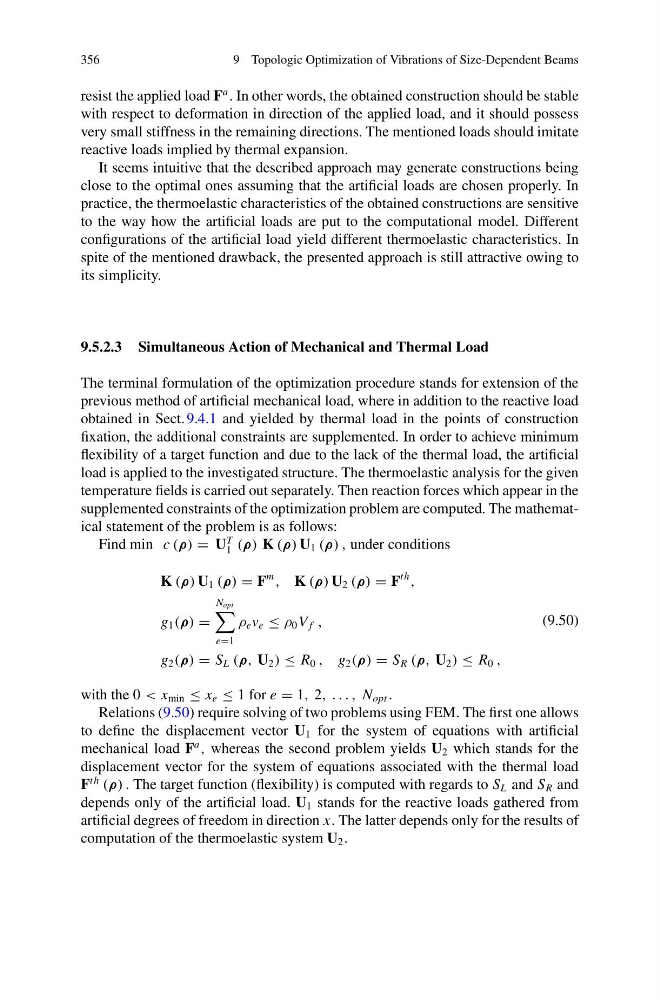
supplemented constraints of the optimization problem are computed. The mathematical statement of the problem is as follows:
Find min c (ρ) = U
T
1 (ρ) K (ρ) U 1 (ρ) , under conditions
K (ρ) U 1 (ρ) = F
m
, K (ρ) U 2 (ρ) = F
th
,
g 1 (ρ) =
N opt
e=1
ρ e v e ≤ ρ 0 V f ,
g 2 (ρ) = S L (ρ, U 2 ) ≤ R 0 , g 2 (ρ) = S R (ρ, U 2 ) ≤ R 0 ,
(9.50)
with the 0 < x min ≤ x e ≤ 1 for e = 1, 2, . . . , N opt .
Relations (9.50) require solving of two problems using FEM. The first one allows
to define the displacement vector U 1 for the system of equations with artificial
mechanical load F
a
, whereas the second problem yields U 2 which stands for the
displacement vector for the system of equations associated with the thermal load
F
th
(ρ) . The target function (flexibility) is computed with regards to S L and S R and
depends only of the artificial load. U 1 stands for the reactive loads gathered from
artificial degrees of freedom in direction x. The latter depends only for the results of
computation of the thermoelastic system U 2 .
9 Topologic Optimization of Vibrations of Size-Dependent Beams
resist the applied load F
a . In other words, the obtained construction should be stable
with respect to deformation in direction of the applied load, and it should possess
very small stiffness in the remaining directions. The mentioned loads should imitate
reactive loads implied by thermal expansion.
It seems intuitive that the described approach may generate constructions being
close to the optimal ones assuming that the artificial loads are chosen properly. In
practice, the thermoelastic characteristics of the obtained constructions are sensitive
to the way how the artificial loads are put to the computational model. Different
configurations of the artificial load yield different thermoelastic characteristics. In
spite of the mentioned drawback, the presented approach is still attractive owing to
its simplicity.
9.5.2.3 Simultaneous Action of Mechanical and Thermal Load
The terminal formulation of the optimization procedure stands for extension of the
previous method of artificial mechanical load, where in addition to the reactive load
obtained in Sect. 9.4.1 and yielded by thermal load in the points of construction
fixation, the additional constraints are supplemented. In order to achieve minimum
flexibility of a target function and due to the lack of the thermal load, the artificial
load is applied to the investigated structure. The thermoelastic analysis for the given
temperature fields is carried out separately. Then reaction forces which appear in the
supplemented constraints of the optimization problem are computed. The mathematical statement of the problem is as follows:
Find min c (ρ) = U
T
1 (ρ) K (ρ) U 1 (ρ) , under conditions
K (ρ) U 1 (ρ) = F
m
, K (ρ) U 2 (ρ) = F
th
,
g 1 (ρ) =
N opt
e=1
ρ e v e ≤ ρ 0 V f ,
g 2 (ρ) = S L (ρ, U 2 ) ≤ R 0 , g 2 (ρ) = S R (ρ, U 2 ) ≤ R 0 ,
(9.50)
with the 0 < x min ≤ x e ≤ 1 for e = 1, 2, . . . , N opt .
Relations (9.50) require solving of two problems using FEM. The first one allows
to define the displacement vector U 1 for the system of equations with artificial
mechanical load F
a
, whereas the second problem yields U 2 which stands for the
displacement vector for the system of equations associated with the thermal load
F
th
(ρ) . The target function (flexibility) is computed with regards to S L and S R and
depends only of the artificial load. U 1 stands for the reactive loads gathered from
artificial degrees of freedom in direction x. The latter depends only for the results of
computation of the thermoelastic system U 2 .