

9.5 Reactions on Boundary
353
9.5 Reactions on Boundary
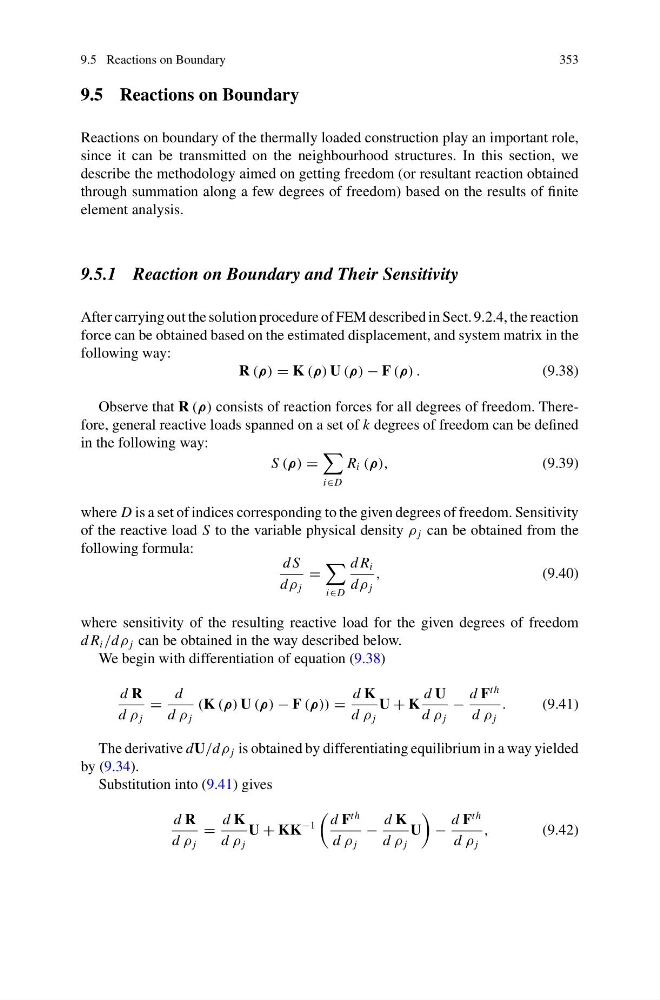
Reactions on boundary of the thermally loaded construction play an important role,
since it can be transmitted on the neighbourhood structures. In this section, we
describe the methodology aimed on getting freedom (or resultant reaction obtained
through summation along a few degrees of freedom) based on the results of finite
element analysis.
9.5.1 Reaction on Boundary and Their Sensitivity
After carrying out the solution procedure of FEM described in Sect. 9.2.4, the reaction
force can be obtained based on the estimated displacement, and system matrix in the
following way:
R (ρ) = K (ρ) U (ρ) − F (ρ) .
(9.38)
Observe that R (ρ) consists of reaction forces for all degrees of freedom. Therefore, general reactive loads spanned on a set of k degrees of freedom can be defined
in the following way:
S (ρ) =
i∈D
R i (ρ),
(9.39)
where D is a set of indices corresponding to the given degrees of freedom. Sensitivity
of the reactive load S to the variable physical density ρ j can be obtained from the
following formula:
d S
dρ j
=
i∈D
d R i
dρ j
,
(9.40)
where sensitivity of the resulting reactive load for the given degrees of freedom
d R i /dρ j can be obtained in the way described below.
We begin with differentiation of equation (9.38)
d R
d ρ j
=
d
d ρ j
(K (ρ) U (ρ) − F (ρ)) =
d K
d ρ j
U + K
d U
d ρ j
−
d F
th
d ρ j
.
(9.41)
The derivative dU/dρ j is obtained by differentiating equilibrium in a way yielded
by (9.34).
Substitution into (9.41) gives
d R
d ρ j
=
d K
d ρ j
U + KK
−1
d F
th
d ρ j
−
d K
d ρ j
U
−
d F
th
d ρ j
,
(9.42)
353
9.5 Reactions on Boundary
Reactions on boundary of the thermally loaded construction play an important role,
since it can be transmitted on the neighbourhood structures. In this section, we
describe the methodology aimed on getting freedom (or resultant reaction obtained
through summation along a few degrees of freedom) based on the results of finite
element analysis.
9.5.1 Reaction on Boundary and Their Sensitivity
After carrying out the solution procedure of FEM described in Sect. 9.2.4, the reaction
force can be obtained based on the estimated displacement, and system matrix in the
following way:
R (ρ) = K (ρ) U (ρ) − F (ρ) .
(9.38)
Observe that R (ρ) consists of reaction forces for all degrees of freedom. Therefore, general reactive loads spanned on a set of k degrees of freedom can be defined
in the following way:
S (ρ) =
i∈D
R i (ρ),
(9.39)
where D is a set of indices corresponding to the given degrees of freedom. Sensitivity
of the reactive load S to the variable physical density ρ j can be obtained from the
following formula:
d S
dρ j
=
i∈D
d R i
dρ j
,
(9.40)
where sensitivity of the resulting reactive load for the given degrees of freedom
d R i /dρ j can be obtained in the way described below.
We begin with differentiation of equation (9.38)
d R
d ρ j
=
d
d ρ j
(K (ρ) U (ρ) − F (ρ)) =
d K
d ρ j
U + K
d U
d ρ j
−
d F
th
d ρ j
.
(9.41)
The derivative dU/dρ j is obtained by differentiating equilibrium in a way yielded
by (9.34).
Substitution into (9.41) gives
d R
d ρ j
=
d K
d ρ j
U + KK
−1
d F
th
d ρ j
−
d K
d ρ j
U
−
d F
th
d ρ j
,
(9.42)