

8.4 Quality Factor of the Resonator with Thermoelastic Damping
309
where four constants G i are as follows:
G 1 ≡
A
f 1 (z) d A, G 2 ≡ −
A
∂
2 f 1 (z)
∂ z 2 d A ,
G 3 ≡
A
z f 2 (z) d A, G 4 ≡ −
A
z
∂
2 f 2 (z)
∂ z 2 d A.
(8.34)
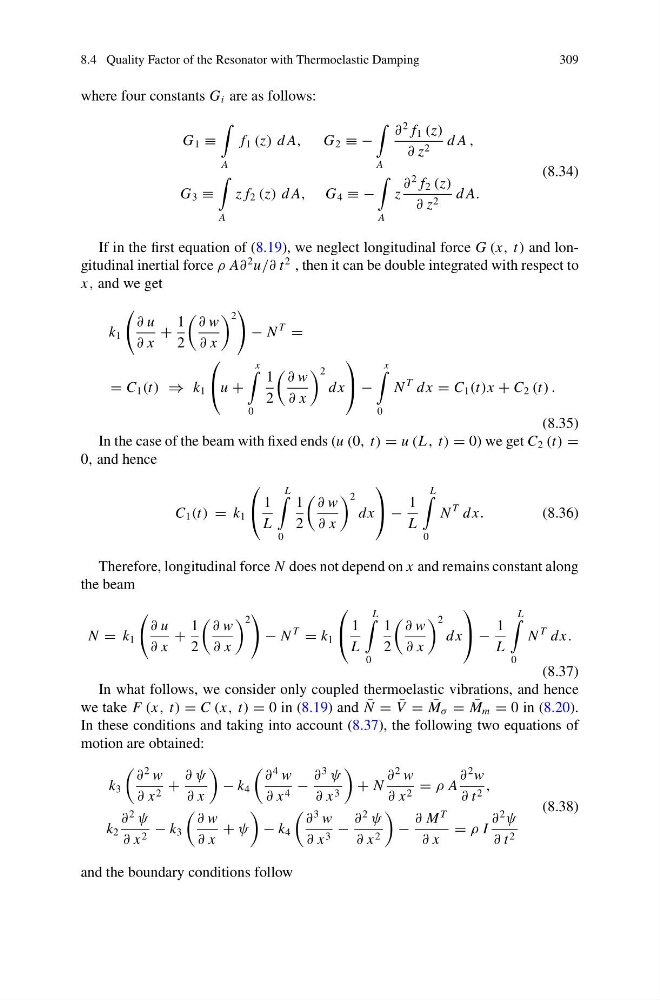
If in the first equation of (8.19), we neglect longitudinal force G (x, t) and longitudinal inertial force ρ A∂
2 u/∂ t
2 , then it can be double integrated with respect to
x, and we get
k 1
∂ u
∂ x
+
1
2
∂ w
∂ x
2
− N
T
=
= C 1 (t) ⇒ k 1
⎛
⎝ u +
x
0
1
2
∂ w
∂ x
2
dx
⎞
⎠ −
x
0
N
T dx = C 1 (t)x + C 2 (t) .
(8.35)
In the case of the beam with fixed ends (u (0, t) = u (L , t) = 0) we get C 2 (t) =
0, and hence
C 1 (t) = k 1
⎛
⎝ 1
L
L
0
1
2
∂ w
∂ x
2
dx
⎞
⎠ −
1
L
L
0
N
T dx.
(8.36)
Therefore, longitudinal force N does not depend on x and remains constant along
the beam
N = k 1
∂ u
∂ x
+
1
2
∂ w
∂ x
2
− N
T
= k 1
⎛
⎝ 1
L
L
0
1
2
∂ w
∂ x
2
dx
⎞
⎠ −
1
L
L
0
N
T dx.
(8.37)
In what follows, we consider only coupled thermoelastic vibrations, and hence
we take F (x, t) = C (x, t) = 0 in (8.19) and ¯
N = ¯
V = ¯
M σ = ¯
M m = 0 in (8.20).
In these conditions and taking into account (8.37), the following two equations of
motion are obtained:
k 3
∂
2 w
∂ x 2 +
∂ ψ
∂ x
− k 4
∂
4 w
∂ x 4 −
∂
3
ψ
∂ x 3
+ N
∂
2 w
∂ x 2 = ρ A
∂
2 w
∂ t 2 ,
k 2
∂
2
ψ
∂ x 2 − k 3
∂ w
∂ x
+ ψ
− k 4
∂
3 w
∂ x 3 −
∂
2
ψ
∂ x 2
−
∂ M
T
∂ x
= ρ I
∂
2
ψ
∂ t 2
(8.38)
and the boundary conditions follow
309
where four constants G i are as follows:
G 1 ≡
A
f 1 (z) d A, G 2 ≡ −
A
∂
2 f 1 (z)
∂ z 2 d A ,
G 3 ≡
A
z f 2 (z) d A, G 4 ≡ −
A
z
∂
2 f 2 (z)
∂ z 2 d A.
(8.34)
If in the first equation of (8.19), we neglect longitudinal force G (x, t) and longitudinal inertial force ρ A∂
2 u/∂ t
2 , then it can be double integrated with respect to
x, and we get
k 1
∂ u
∂ x
+
1
2
∂ w
∂ x
2
− N
T
=
= C 1 (t) ⇒ k 1
⎛
⎝ u +
x
0
1
2
∂ w
∂ x
2
dx
⎞
⎠ −
x
0
N
T dx = C 1 (t)x + C 2 (t) .
(8.35)
In the case of the beam with fixed ends (u (0, t) = u (L , t) = 0) we get C 2 (t) =
0, and hence
C 1 (t) = k 1
⎛
⎝ 1
L
L
0
1
2
∂ w
∂ x
2
dx
⎞
⎠ −
1
L
L
0
N
T dx.
(8.36)
Therefore, longitudinal force N does not depend on x and remains constant along
the beam
N = k 1
∂ u
∂ x
+
1
2
∂ w
∂ x
2
− N
T
= k 1
⎛
⎝ 1
L
L
0
1
2
∂ w
∂ x
2
dx
⎞
⎠ −
1
L
L
0
N
T dx.
(8.37)
In what follows, we consider only coupled thermoelastic vibrations, and hence
we take F (x, t) = C (x, t) = 0 in (8.19) and ¯
N = ¯
V = ¯
M σ = ¯
M m = 0 in (8.20).
In these conditions and taking into account (8.37), the following two equations of
motion are obtained:
k 3
∂
2 w
∂ x 2 +
∂ ψ
∂ x
− k 4
∂
4 w
∂ x 4 −
∂
3
ψ
∂ x 3
+ N
∂
2 w
∂ x 2 = ρ A
∂
2 w
∂ t 2 ,
k 2
∂
2
ψ
∂ x 2 − k 3
∂ w
∂ x
+ ψ
− k 4
∂
3 w
∂ x 3 −
∂
2
ψ
∂ x 2
−
∂ M
T
∂ x
= ρ I
∂
2
ψ
∂ t 2
(8.38)
and the boundary conditions follow