

308
8 Thermoelastic Vibrations of Timoshenko Microbeams
As boundary conditions for PDEs (8.24) and (8.27), we take the thermal isolation
condition with regard to the upper and lower microbeam surfaces, i.e. ∂ θ/∂ z = 0
for z = ±h/2 .
8.4 Quality Factor of the Resonator with Thermoelastic
Damping
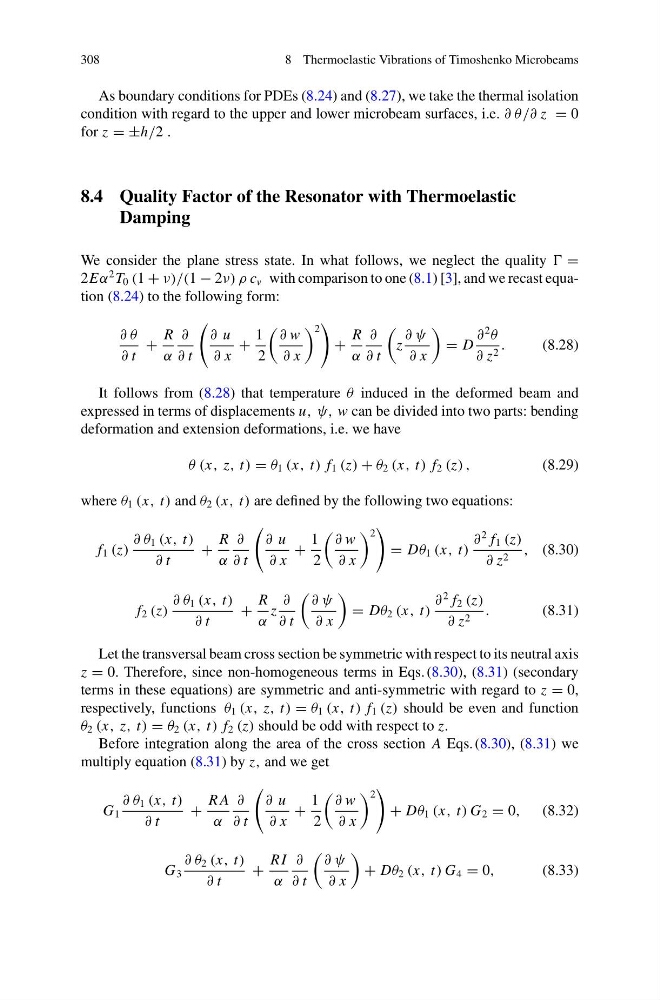
We consider the plane stress state. In what follows, we neglect the quality =
2Eα
2 T 0 (1 + ν)/(1 − 2ν) ρ c v with comparison to one (8.1) [3], and we recast equation (8.24) to the following form:
∂ θ
∂ t
+
R
α
∂
∂ t
∂ u
∂ x
+
1
2
∂ w
∂ x
2
+
R
α
∂
∂ t
z
∂ ψ
∂ x
= D
∂
2
θ
∂ z 2 .
(8.28)
It follows from (8.28) that temperature θ induced in the deformed beam and
expressed in terms of displacements u, ψ, w can be divided into two parts: bending
deformation and extension deformations, i.e. we have
θ (x, z, t) = θ 1 (x, t) f 1 (z) + θ 2 (x, t) f 2 (z) ,
(8.29)
where θ 1 (x, t) and θ 2 (x, t) are defined by the following two equations:
f 1 (z)
∂ θ 1 (x, t)
∂ t
+
R
α
∂
∂ t
∂ u
∂ x
+
1
2
∂ w
∂ x
2
= Dθ 1 (x, t)
∂
2 f 1 (z)
∂ z 2 , (8.30)
f 2 (z)
∂ θ 1 (x, t)
∂ t
+
R
α
z
∂
∂ t
∂ ψ
∂ x
= Dθ 2 (x, t)
∂
2 f 2 (z)
∂ z 2 .
(8.31)
Let the transversal beam cross section be symmetric with respect to its neutral axis
z = 0. Therefore, since non-homogeneous terms in Eqs. (8.30), (8.31) (secondary
terms in these equations) are symmetric and anti-symmetric with regard to z = 0,
respectively, functions θ 1 (x, z, t) = θ 1 (x, t) f 1 (z) should be even and function
θ 2 (x, z, t) = θ 2 (x, t) f 2 (z) should be odd with respect to z.
Before integration along the area of the cross section A Eqs. (8.30), (8.31) we
multiply equation (8.31) by z, and we get
G 1
∂ θ 1 (x, t)
∂ t
+
R A
α
∂
∂ t
∂ u
∂ x
+
1
2
∂ w
∂ x
2
+ Dθ 1 (x, t) G 2 = 0, (8.32)
G 3
∂ θ 2 (x, t)
∂ t
+
R I
α
∂
∂ t
∂ ψ
∂ x
+ Dθ 2 (x, t) G 4 = 0,
(8.33)
8 Thermoelastic Vibrations of Timoshenko Microbeams
As boundary conditions for PDEs (8.24) and (8.27), we take the thermal isolation
condition with regard to the upper and lower microbeam surfaces, i.e. ∂ θ/∂ z = 0
for z = ±h/2 .
8.4 Quality Factor of the Resonator with Thermoelastic
Damping
We consider the plane stress state. In what follows, we neglect the quality =
2Eα
2 T 0 (1 + ν)/(1 − 2ν) ρ c v with comparison to one (8.1) [3], and we recast equation (8.24) to the following form:
∂ θ
∂ t
+
R
α
∂
∂ t
∂ u
∂ x
+
1
2
∂ w
∂ x
2
+
R
α
∂
∂ t
z
∂ ψ
∂ x
= D
∂
2
θ
∂ z 2 .
(8.28)
It follows from (8.28) that temperature θ induced in the deformed beam and
expressed in terms of displacements u, ψ, w can be divided into two parts: bending
deformation and extension deformations, i.e. we have
θ (x, z, t) = θ 1 (x, t) f 1 (z) + θ 2 (x, t) f 2 (z) ,
(8.29)
where θ 1 (x, t) and θ 2 (x, t) are defined by the following two equations:
f 1 (z)
∂ θ 1 (x, t)
∂ t
+
R
α
∂
∂ t
∂ u
∂ x
+
1
2
∂ w
∂ x
2
= Dθ 1 (x, t)
∂
2 f 1 (z)
∂ z 2 , (8.30)
f 2 (z)
∂ θ 1 (x, t)
∂ t
+
R
α
z
∂
∂ t
∂ ψ
∂ x
= Dθ 2 (x, t)
∂
2 f 2 (z)
∂ z 2 .
(8.31)
Let the transversal beam cross section be symmetric with respect to its neutral axis
z = 0. Therefore, since non-homogeneous terms in Eqs. (8.30), (8.31) (secondary
terms in these equations) are symmetric and anti-symmetric with regard to z = 0,
respectively, functions θ 1 (x, z, t) = θ 1 (x, t) f 1 (z) should be even and function
θ 2 (x, z, t) = θ 2 (x, t) f 2 (z) should be odd with respect to z.
Before integration along the area of the cross section A Eqs. (8.30), (8.31) we
multiply equation (8.31) by z, and we get
G 1
∂ θ 1 (x, t)
∂ t
+
R A
α
∂
∂ t
∂ u
∂ x
+
1
2
∂ w
∂ x
2
+ Dθ 1 (x, t) G 2 = 0, (8.32)
G 3
∂ θ 2 (x, t)
∂ t
+
R I
α
∂
∂ t
∂ ψ
∂ x
+ Dθ 2 (x, t) G 4 = 0,
(8.33)