

7.7 Mathematical Model of Three-Layer Micro- and Nano-Beams
275
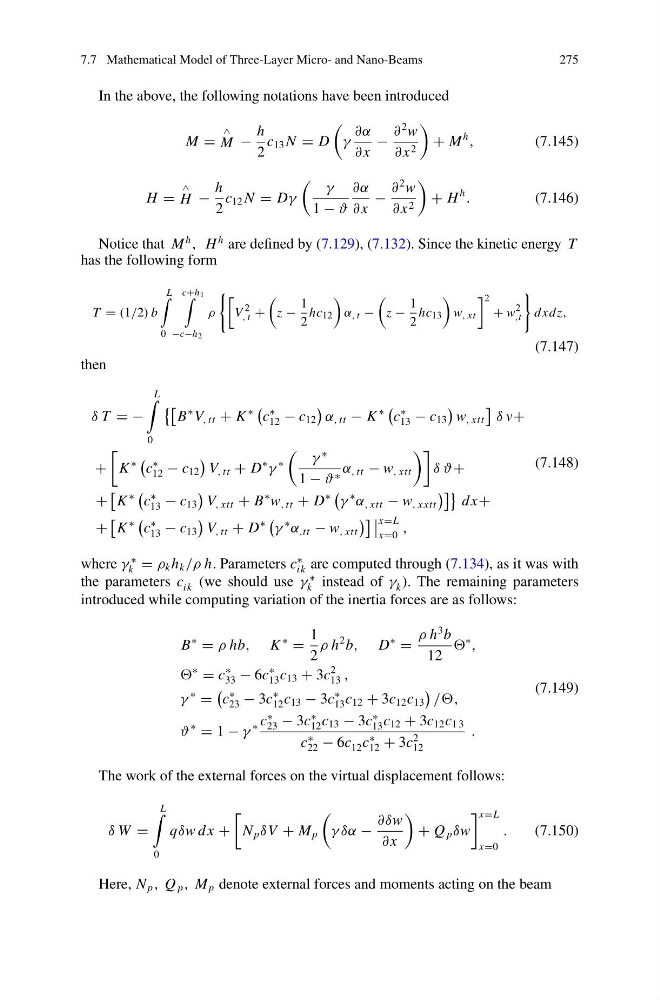
In the above, the following notations have been introduced
M =
∧
M −
h
2
c 13 N = D
γ
∂α
∂ x
−
∂
2 w
∂ x 2
+ M
h
,
(7.145)
H =
∧
H −
h
2
c 12 N = Dγ
γ
1 − ϑ
∂α
∂ x
−
∂
2 w
∂ x 2
+ H
h
.
(7.146)
Notice that M
h
, H
h are defined by (7.129), (7.132). Since the kinetic energy T
has the following form
T = (1/2) b
L
0
c+h 1
−c−h 2
ρ
V
2
, t +
z −
1
2
hc 12
α , t −
z −
1
2
hc 13
w , xt
2
+ w
2
,t
dxdz,
(7.147)
then
δ T = −
L
0
B
∗ V , tt + K
∗
c
∗
12 − c 12
α , tt − K
∗
c
∗
13 − c 13
w , xtt
δ v+
+
K
∗
c
∗
12 − c 12
V , tt + D
∗
γ
∗
γ
∗
1 − ϑ ∗ α , tt − w , xtt
δ ϑ+
+
K
∗
c
∗
13 − c 13
V , xtt + B
∗ w , tt + D
∗
γ
∗
α , xtt − w , xxtt
dx+
+
K
∗
c
∗
13 − c 13
V , tt + D
∗
γ
∗
α ,tt − w , xtt
x=L
x=0
,
(7.148)
where γ
∗
k = ρ k h k /ρ h. Parameters c
∗
ik are computed through (7.134), as it was with
the parameters c ik (we should use γ
∗
k instead of γ k ). The remaining parameters
introduced while computing variation of the inertia forces are as follows:
B
∗
= ρ hb, K
∗
=
1
2
ρ h
2 b, D
∗
=
ρ h
3 b
12
∗
,
∗
= c
∗
33 − 6c
∗
13 c 13 + 3c
2
13 ,
γ
∗
=
c
∗
23 − 3c
∗
12 c 13 − 3c
∗
13 c 12 + 3c 12 c 13
//,
ϑ
∗
= 1 − γ
∗ c
∗
23 − 3c
∗
12 c 13 − 3c
∗
13 c 12 + 3c 12 c 1 3
c
∗
22 − 6c 12 c
∗
12 + 3c
2
12
.
(7.149)
The work of the external forces on the virtual displacement follows:
δ W =
L
0
qδw dx +
N p δV + M p
γ δα −
∂δw
∂ x
+ Q p δw
x=L
x=0
.
(7.150)
Here, N p , Q p , M p denote external forces and moments acting on the beam
275
In the above, the following notations have been introduced
M =
∧
M −
h
2
c 13 N = D
γ
∂α
∂ x
−
∂
2 w
∂ x 2
+ M
h
,
(7.145)
H =
∧
H −
h
2
c 12 N = Dγ
γ
1 − ϑ
∂α
∂ x
−
∂
2 w
∂ x 2
+ H
h
.
(7.146)
Notice that M
h
, H
h are defined by (7.129), (7.132). Since the kinetic energy T
has the following form
T = (1/2) b
L
0
c+h 1
−c−h 2
ρ
V
2
, t +
z −
1
2
hc 12
α , t −
z −
1
2
hc 13
w , xt
2
+ w
2
,t
dxdz,
(7.147)
then
δ T = −
L
0
B
∗ V , tt + K
∗
c
∗
12 − c 12
α , tt − K
∗
c
∗
13 − c 13
w , xtt
δ v+
+
K
∗
c
∗
12 − c 12
V , tt + D
∗
γ
∗
γ
∗
1 − ϑ ∗ α , tt − w , xtt
δ ϑ+
+
K
∗
c
∗
13 − c 13
V , xtt + B
∗ w , tt + D
∗
γ
∗
α , xtt − w , xxtt
dx+
+
K
∗
c
∗
13 − c 13
V , tt + D
∗
γ
∗
α ,tt − w , xtt
x=L
x=0
,
(7.148)
where γ
∗
k = ρ k h k /ρ h. Parameters c
∗
ik are computed through (7.134), as it was with
the parameters c ik (we should use γ
∗
k instead of γ k ). The remaining parameters
introduced while computing variation of the inertia forces are as follows:
B
∗
= ρ hb, K
∗
=
1
2
ρ h
2 b, D
∗
=
ρ h
3 b
12
∗
,
∗
= c
∗
33 − 6c
∗
13 c 13 + 3c
2
13 ,
γ
∗
=
c
∗
23 − 3c
∗
12 c 13 − 3c
∗
13 c 12 + 3c 12 c 13
//,
ϑ
∗
= 1 − γ
∗ c
∗
23 − 3c
∗
12 c 13 − 3c
∗
13 c 12 + 3c 12 c 1 3
c
∗
22 − 6c 12 c
∗
12 + 3c
2
12
.
(7.149)
The work of the external forces on the virtual displacement follows:
δ W =
L
0
qδw dx +
N p δV + M p
γ δα −
∂δw
∂ x
+ Q p δw
x=L
x=0
.
(7.150)
Here, N p , Q p , M p denote external forces and moments acting on the beam