

7.7 Mathematical Model of Three-Layer Micro- and Nano-Beams
269
i.e.
α 1 =
∂u 1
∂z
+
∂w
∂ x
= 0, (c ≤ z ≤ c + h 1 ) ,
α 2 =
∂u 2
∂z
+
∂w
∂ x
= 0, (−c − h 2 ≤ z ≤ −c) .
(7.108)
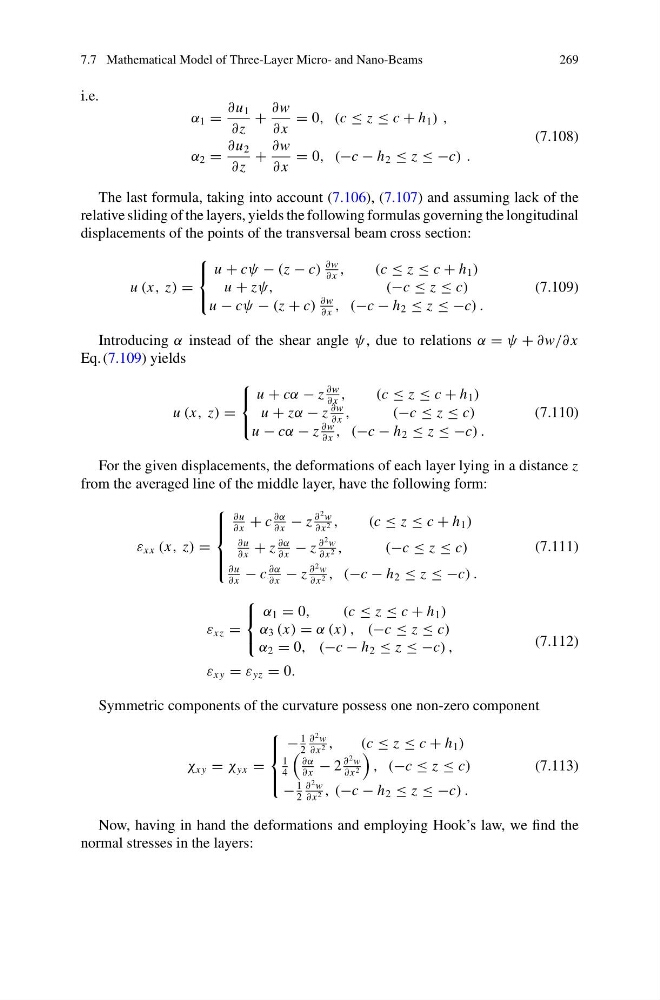
The last formula, taking into account (7.106), (7.107) and assuming lack of the
relative sliding of the layers, yields the following formulas governing the longitudinal
displacements of the points of the transversal beam cross section:
u (x, z) =
⎧
⎨
⎩
u + cψ − (z − c)
∂w
∂ x
,
(c ≤ z ≤ c + h 1 )
u + zψ,
(−c ≤ z ≤ c)
u − cψ − (z + c)
∂w
∂ x
, (−c − h 2 ≤ z ≤ −c) .
(7.109)
Introducing α instead of the shear angle ψ, due to relations α = ψ + ∂w/∂ x
Eq. (7.109) yields
u (x, z) =
⎧
⎨
⎩
u + cα − z
∂w
∂ x
,
(c ≤ z ≤ c + h 1 )
u + zα − z
∂w
∂ x
,
(−c ≤ z ≤ c)
u − cα − z
∂w
∂ x
, (−c − h 2 ≤ z ≤ −c) .
(7.110)
For the given displacements, the deformations of each layer lying in a distance z
from the averaged line of the middle layer, have the following form:
ε xx (x, z) =
⎧
⎪ ⎪ ⎨
⎪ ⎪ ⎩
∂u
∂ x
+ c
∂α
∂ x
− z
∂
2 w
∂ x 2 ,
(c ≤ z ≤ c + h 1 )
∂u
∂ x
+ z
∂α
∂ x
− z
∂
2 w
∂ x 2 ,
(−c ≤ z ≤ c)
∂u
∂ x
− c
∂α
∂ x
− z
∂
2 w
∂ x 2 , (−c − h 2 ≤ z ≤ −c) .
(7.111)
ε xz =
⎧
⎨
⎩
α 1 = 0,
(c ≤ z ≤ c + h 1 )
α 3 (x) = α (x) , (−c ≤ z ≤ c)
α 2 = 0, (−c − h 2 ≤ z ≤ −c) ,
ε xy = ε yz = 0.
(7.112)
Symmetric components of the curvature possess one non-zero component
χ xy = χ yx =
⎧
⎪ ⎨
⎪ ⎩
−
1
2
∂
2 w
∂ x 2 ,
(c ≤ z ≤ c + h 1 )
1
4
∂α
∂ x
− 2
∂
2 w
∂ x 2
, (−c ≤ z ≤ c)
−
1
2
∂
2 w
∂ x 2 , (−c − h 2 ≤ z ≤ −c) .
(7.113)
Now, having in hand the deformations and employing Hook’s law, we find the
normal stresses in the layers:
269
i.e.
α 1 =
∂u 1
∂z
+
∂w
∂ x
= 0, (c ≤ z ≤ c + h 1 ) ,
α 2 =
∂u 2
∂z
+
∂w
∂ x
= 0, (−c − h 2 ≤ z ≤ −c) .
(7.108)
The last formula, taking into account (7.106), (7.107) and assuming lack of the
relative sliding of the layers, yields the following formulas governing the longitudinal
displacements of the points of the transversal beam cross section:
u (x, z) =
⎧
⎨
⎩
u + cψ − (z − c)
∂w
∂ x
,
(c ≤ z ≤ c + h 1 )
u + zψ,
(−c ≤ z ≤ c)
u − cψ − (z + c)
∂w
∂ x
, (−c − h 2 ≤ z ≤ −c) .
(7.109)
Introducing α instead of the shear angle ψ, due to relations α = ψ + ∂w/∂ x
Eq. (7.109) yields
u (x, z) =
⎧
⎨
⎩
u + cα − z
∂w
∂ x
,
(c ≤ z ≤ c + h 1 )
u + zα − z
∂w
∂ x
,
(−c ≤ z ≤ c)
u − cα − z
∂w
∂ x
, (−c − h 2 ≤ z ≤ −c) .
(7.110)
For the given displacements, the deformations of each layer lying in a distance z
from the averaged line of the middle layer, have the following form:
ε xx (x, z) =
⎧
⎪ ⎪ ⎨
⎪ ⎪ ⎩
∂u
∂ x
+ c
∂α
∂ x
− z
∂
2 w
∂ x 2 ,
(c ≤ z ≤ c + h 1 )
∂u
∂ x
+ z
∂α
∂ x
− z
∂
2 w
∂ x 2 ,
(−c ≤ z ≤ c)
∂u
∂ x
− c
∂α
∂ x
− z
∂
2 w
∂ x 2 , (−c − h 2 ≤ z ≤ −c) .
(7.111)
ε xz =
⎧
⎨
⎩
α 1 = 0,
(c ≤ z ≤ c + h 1 )
α 3 (x) = α (x) , (−c ≤ z ≤ c)
α 2 = 0, (−c − h 2 ≤ z ≤ −c) ,
ε xy = ε yz = 0.
(7.112)
Symmetric components of the curvature possess one non-zero component
χ xy = χ yx =
⎧
⎪ ⎨
⎪ ⎩
−
1
2
∂
2 w
∂ x 2 ,
(c ≤ z ≤ c + h 1 )
1
4
∂α
∂ x
− 2
∂
2 w
∂ x 2
, (−c ≤ z ≤ c)
−
1
2
∂
2 w
∂ x 2 , (−c − h 2 ≤ z ≤ −c) .
(7.113)
Now, having in hand the deformations and employing Hook’s law, we find the
normal stresses in the layers: