

268
7 Mathematical Models of Functionally Graded Beams in Temperature Field
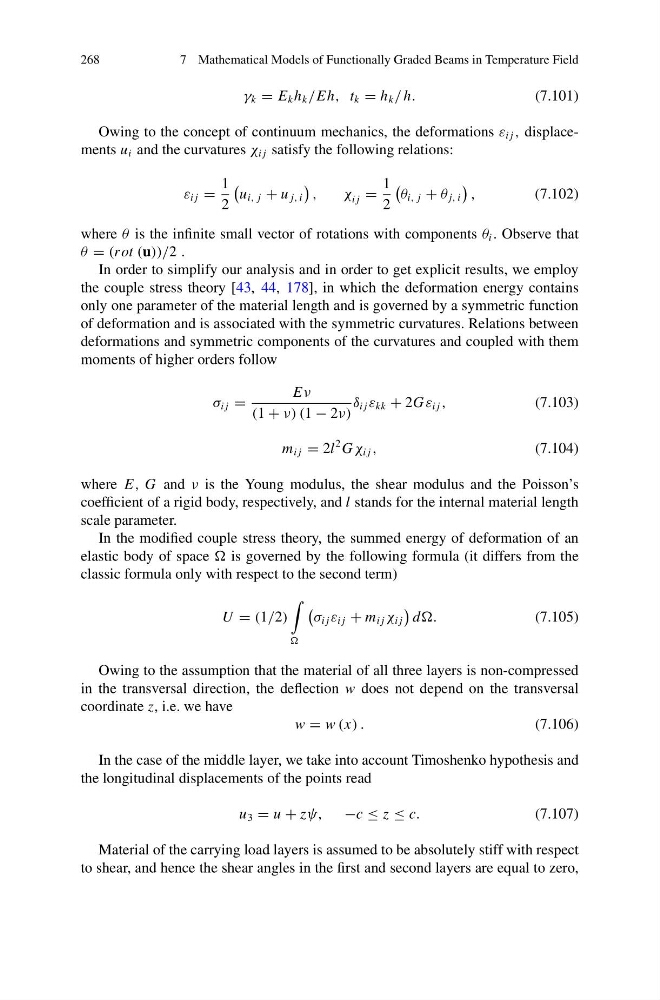
γ k = E k h k /Eh, t k = h k / h.
(7.101)
Owing to the concept of continuum mechanics, the deformations ε i j , displacements u i and the curvatures χ i j satisfy the following relations:
ε i j =
1
2
u i, j + u j, i
,
χ i j =
1
2
θ i, j + θ j, i
,
(7.102)
where θ is the infinite small vector of rotations with components θ i . Observe that
θ = (rot (u))/2 .
In order to simplify our analysis and in order to get explicit results, we employ
the couple stress theory [43, 44, 178], in which the deformation energy contains
only one parameter of the material length and is governed by a symmetric function
of deformation and is associated with the symmetric curvatures. Relations between
deformations and symmetric components of the curvatures and coupled with them
moments of higher orders follow
σ i j =
Eν
(1 + ν) (1 − 2ν)
δ i j ε kk + 2G ε i j ,
(7.103)
m i j = 2l
2 G χ i j ,
(7.104)
where E, G and ν is the Young modulus, the shear modulus and the Poisson’s
coefficient of a rigid body, respectively, and l stands for the internal material length
scale parameter.
In the modified couple stress theory, the summed energy of deformation of an
elastic body of space is governed by the following formula (it differs from the
classic formula only with respect to the second term)
U = (1/2)
σ i j ε i j + m i j χ i j
d.
(7.105)
Owing to the assumption that the material of all three layers is non-compressed
in the transversal direction, the deflection w does not depend on the transversal
coordinate z, i.e. we have
w = w (x) .
(7.106)
In the case of the middle layer, we take into account Timoshenko hypothesis and
the longitudinal displacements of the points read
u 3 = u + zψ, −c ≤ z ≤ c.
(7.107)
Material of the carrying load layers is assumed to be absolutely stiff with respect
to shear, and hence the shear angles in the first and second layers are equal to zero,
7 Mathematical Models of Functionally Graded Beams in Temperature Field
γ k = E k h k /Eh, t k = h k / h.
(7.101)
Owing to the concept of continuum mechanics, the deformations ε i j , displacements u i and the curvatures χ i j satisfy the following relations:
ε i j =
1
2
u i, j + u j, i
,
χ i j =
1
2
θ i, j + θ j, i
,
(7.102)
where θ is the infinite small vector of rotations with components θ i . Observe that
θ = (rot (u))/2 .
In order to simplify our analysis and in order to get explicit results, we employ
the couple stress theory [43, 44, 178], in which the deformation energy contains
only one parameter of the material length and is governed by a symmetric function
of deformation and is associated with the symmetric curvatures. Relations between
deformations and symmetric components of the curvatures and coupled with them
moments of higher orders follow
σ i j =
Eν
(1 + ν) (1 − 2ν)
δ i j ε kk + 2G ε i j ,
(7.103)
m i j = 2l
2 G χ i j ,
(7.104)
where E, G and ν is the Young modulus, the shear modulus and the Poisson’s
coefficient of a rigid body, respectively, and l stands for the internal material length
scale parameter.
In the modified couple stress theory, the summed energy of deformation of an
elastic body of space is governed by the following formula (it differs from the
classic formula only with respect to the second term)
U = (1/2)
σ i j ε i j + m i j χ i j
d.
(7.105)
Owing to the assumption that the material of all three layers is non-compressed
in the transversal direction, the deflection w does not depend on the transversal
coordinate z, i.e. we have
w = w (x) .
(7.106)
In the case of the middle layer, we take into account Timoshenko hypothesis and
the longitudinal displacements of the points read
u 3 = u + zψ, −c ≤ z ≤ c.
(7.107)
Material of the carrying load layers is assumed to be absolutely stiff with respect
to shear, and hence the shear angles in the first and second layers are equal to zero,