

250
7 Mathematical Models of Functionally Graded Beams in Temperature Field
are axial forces and bending moments, respectively (T refers to thermal force and
bending moment).
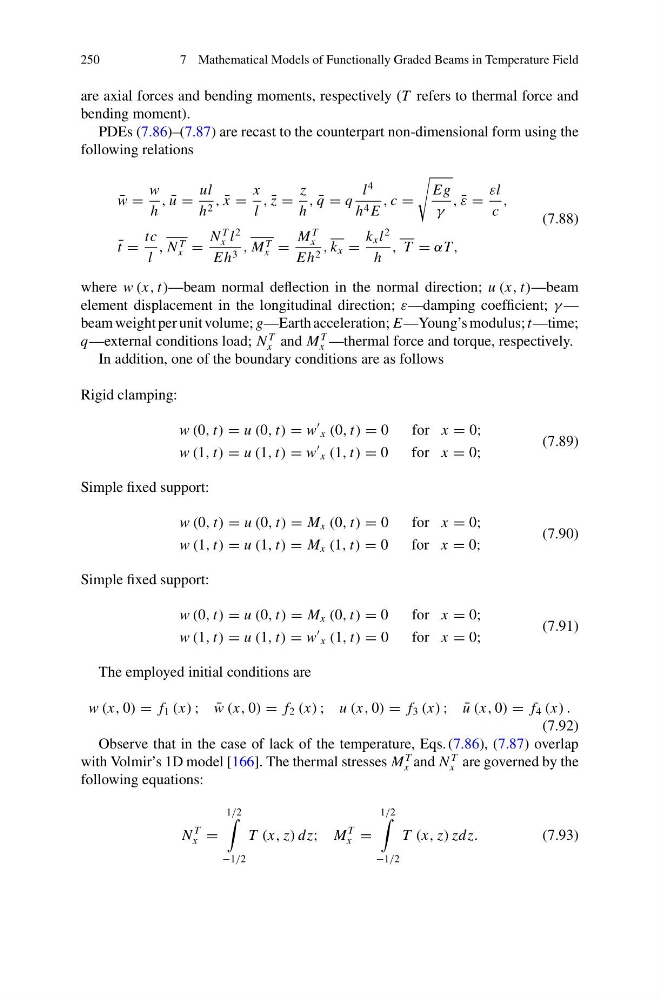
PDEs (7.86)–(7.87) are recast to the counterpart non-dimensional form using the
following relations
¯
w =
w
h
, ¯
u =
ul
h 2 , ¯
x =
x
l
, ¯
z =
z
h
, ¯
q = q
l
4
h 4 E
, c =
Eg
γ
, ¯
ε =
εl
c
,
¯
t =
tc
l
, N T
x =
N
T
x l
2
Eh 3 , M T
x =
M
T
x
Eh 2 , k x =
k x l
2
h
, T = αT,
(7.88)
where w (x, t)—beam normal deflection in the normal direction; u (x, t)—beam
element displacement in the longitudinal direction; ε—damping coefficient; γ —
beam weight per unit volume; g—Earth acceleration; E—Young’s modulus; t—time;
q—external conditions load; N
T
x and M
T
x —thermal force and torque, respectively.
In addition, one of the boundary conditions are as follows
Rigid clamping:
w (0, t) = u (0, t) = w
x (0, t) = 0
for x = 0;
w (1, t) = u (1, t) = w
x (1, t) = 0
for x = 0;
(7.89)
Simple fixed support:
w (0, t) = u (0, t) = M x (0, t) = 0
for x = 0;
w (1, t) = u (1, t) = M x (1, t) = 0
for x = 0;
(7.90)
Simple fixed support:
w (0, t) = u (0, t) = M x (0, t) = 0
for x = 0;
w (1, t) = u (1, t) = w
x (1, t) = 0
for x = 0;
(7.91)
The employed initial conditions are
w (x, 0) = f 1 (x) ; ¯
w (x, 0) = f 2 (x) ; u (x, 0) = f 3 (x) ; ¯
u (x, 0) = f 4 (x) .
(7.92)
Observe that in the case of lack of the temperature, Eqs. (7.86), (7.87) overlap
with Volmir’s 1D model [166]. The thermal stresses M
T
x and N
T
x are governed by the
following equations:
N
T
x =
1/2
−1/2
T (x, z) dz; M
T
x =
1/2
−1/2
T (x, z) zdz.
(7.93)
7 Mathematical Models of Functionally Graded Beams in Temperature Field
are axial forces and bending moments, respectively (T refers to thermal force and
bending moment).
PDEs (7.86)–(7.87) are recast to the counterpart non-dimensional form using the
following relations
¯
w =
w
h
, ¯
u =
ul
h 2 , ¯
x =
x
l
, ¯
z =
z
h
, ¯
q = q
l
4
h 4 E
, c =
Eg
γ
, ¯
ε =
εl
c
,
¯
t =
tc
l
, N T
x =
N
T
x l
2
Eh 3 , M T
x =
M
T
x
Eh 2 , k x =
k x l
2
h
, T = αT,
(7.88)
where w (x, t)—beam normal deflection in the normal direction; u (x, t)—beam
element displacement in the longitudinal direction; ε—damping coefficient; γ —
beam weight per unit volume; g—Earth acceleration; E—Young’s modulus; t—time;
q—external conditions load; N
T
x and M
T
x —thermal force and torque, respectively.
In addition, one of the boundary conditions are as follows
Rigid clamping:
w (0, t) = u (0, t) = w
x (0, t) = 0
for x = 0;
w (1, t) = u (1, t) = w
x (1, t) = 0
for x = 0;
(7.89)
Simple fixed support:
w (0, t) = u (0, t) = M x (0, t) = 0
for x = 0;
w (1, t) = u (1, t) = M x (1, t) = 0
for x = 0;
(7.90)
Simple fixed support:
w (0, t) = u (0, t) = M x (0, t) = 0
for x = 0;
w (1, t) = u (1, t) = w
x (1, t) = 0
for x = 0;
(7.91)
The employed initial conditions are
w (x, 0) = f 1 (x) ; ¯
w (x, 0) = f 2 (x) ; u (x, 0) = f 3 (x) ; ¯
u (x, 0) = f 4 (x) .
(7.92)
Observe that in the case of lack of the temperature, Eqs. (7.86), (7.87) overlap
with Volmir’s 1D model [166]. The thermal stresses M
T
x and N
T
x are governed by the
following equations:
N
T
x =
1/2
−1/2
T (x, z) dz; M
T
x =
1/2
−1/2
T (x, z) zdz.
(7.93)