

7.5 Stability of the Size-Dependent Graded Curvilinear Timoshenko Beams
241
100
50
q
0 0
100
200
300
q=30
q=100
q=160
1
0.5
1.5
2
w
q=160
q=100
q=30
t
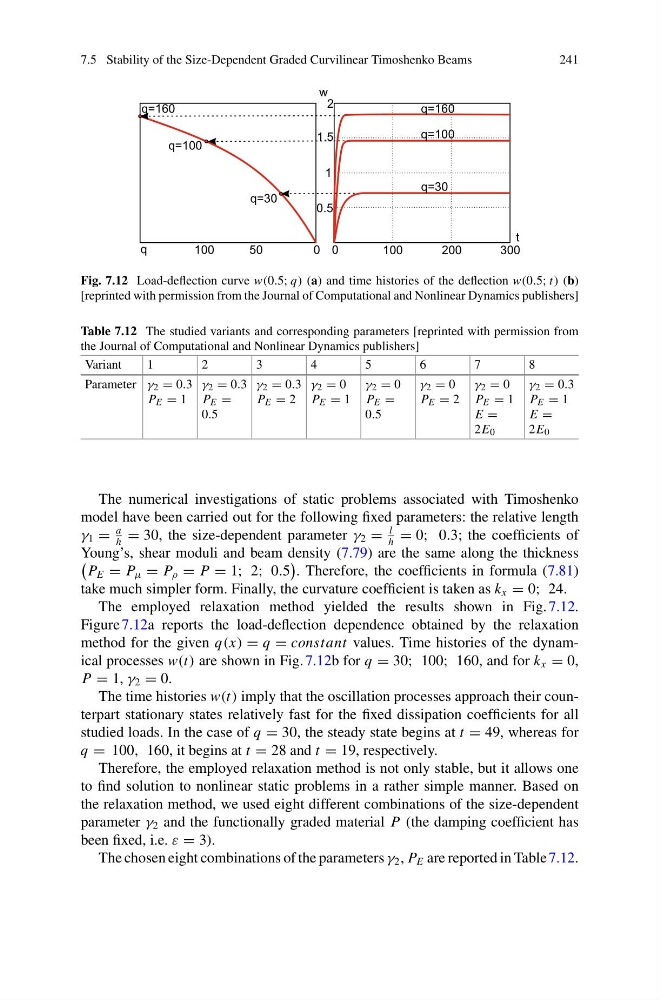
Fig. 7.12 Load-deflection curve w(0.5; q) (a) and time histories of the deflection w(0.5; t) (b)
[reprinted with permission from the Journal of Computational and Nonlinear Dynamics publishers]
Table 7.12 The studied variants and corresponding parameters [reprinted with permission from
the Journal of Computational and Nonlinear Dynamics publishers]
Variant
1
2
3
4
5
6
7
8
Parameter γ 2 = 0.3
P E = 1
γ 2 = 0.3
P E =
0.5
γ 2 = 0.3
P E = 2
γ 2 = 0
P E = 1
γ 2 = 0
P E =
0.5
γ 2 = 0
P E = 2
γ 2 = 0
P E = 1
E =
2E 0
γ 2 = 0.3
P E = 1
E =
2E 0
The numerical investigations of static problems associated with Timoshenko
model have been carried out for the following fixed parameters: the relative length
γ 1 =
a
h
= 30, the size-dependent parameter γ 2 =
l
h
= 0; 0.3; the coefficients of
Young’s, shear moduli and beam density (7.79) are the same along the thickness
P E = P μ = P ρ = P = 1; 2; 0.5
. Therefore, the coefficients in formula (7.81)
take much simpler form. Finally, the curvature coefficient is taken as k x = 0; 24.
The employed relaxation method yielded the results shown in Fig. 7.12.
Figure 7.12a reports the load-deflection dependence obtained by the relaxation
method for the given q(x) = q = constant values. Time histories of the dynamical processes w(t) are shown in Fig. 7.12b for q = 30; 100; 160, and for k x = 0,
P = 1, γ 2 = 0.
The time histories w(t) imply that the oscillation processes approach their counterpart stationary states relatively fast for the fixed dissipation coefficients for all
studied loads. In the case of q = 30, the steady state begins at t = 49, whereas for
q = 100, 160, it begins at t = 28 and t = 19, respectively.
Therefore, the employed relaxation method is not only stable, but it allows one
to find solution to nonlinear static problems in a rather simple manner. Based on
the relaxation method, we used eight different combinations of the size-dependent
parameter γ 2 and the functionally graded material P (the damping coefficient has
been fixed, i.e. ε = 3).
The chosen eight combinations of the parameters γ 2 , P E are reported in Table 7.12.
241
100
50
q
0 0
100
200
300
q=30
q=100
q=160
1
0.5
1.5
2
w
q=160
q=100
q=30
t
Fig. 7.12 Load-deflection curve w(0.5; q) (a) and time histories of the deflection w(0.5; t) (b)
[reprinted with permission from the Journal of Computational and Nonlinear Dynamics publishers]
Table 7.12 The studied variants and corresponding parameters [reprinted with permission from
the Journal of Computational and Nonlinear Dynamics publishers]
Variant
1
2
3
4
5
6
7
8
Parameter γ 2 = 0.3
P E = 1
γ 2 = 0.3
P E =
0.5
γ 2 = 0.3
P E = 2
γ 2 = 0
P E = 1
γ 2 = 0
P E =
0.5
γ 2 = 0
P E = 2
γ 2 = 0
P E = 1
E =
2E 0
γ 2 = 0.3
P E = 1
E =
2E 0
The numerical investigations of static problems associated with Timoshenko
model have been carried out for the following fixed parameters: the relative length
γ 1 =
a
h
= 30, the size-dependent parameter γ 2 =
l
h
= 0; 0.3; the coefficients of
Young’s, shear moduli and beam density (7.79) are the same along the thickness
P E = P μ = P ρ = P = 1; 2; 0.5
. Therefore, the coefficients in formula (7.81)
take much simpler form. Finally, the curvature coefficient is taken as k x = 0; 24.
The employed relaxation method yielded the results shown in Fig. 7.12.
Figure 7.12a reports the load-deflection dependence obtained by the relaxation
method for the given q(x) = q = constant values. Time histories of the dynamical processes w(t) are shown in Fig. 7.12b for q = 30; 100; 160, and for k x = 0,
P = 1, γ 2 = 0.
The time histories w(t) imply that the oscillation processes approach their counterpart stationary states relatively fast for the fixed dissipation coefficients for all
studied loads. In the case of q = 30, the steady state begins at t = 49, whereas for
q = 100, 160, it begins at t = 28 and t = 19, respectively.
Therefore, the employed relaxation method is not only stable, but it allows one
to find solution to nonlinear static problems in a rather simple manner. Based on
the relaxation method, we used eight different combinations of the size-dependent
parameter γ 2 and the functionally graded material P (the damping coefficient has
been fixed, i.e. ε = 3).
The chosen eight combinations of the parameters γ 2 , P E are reported in Table 7.12.