

212
7 Mathematical Models of Functionally Graded Beams in Temperature Field
The monograph [121] focuses on the computational analysis of nonlinear vibrations of structural members (beams as well as axially symmetric plates and shells),
where studying of dynamical problems can be reduced to considering one spatial
variable and time. The simplification is introduced based on a formal mathematical
approach aimed at reducing the problems with an infinite dimension to the problems
of a finite one. The process includes also a transition from governing nonlinear partial
differential equations to a set of a finite number of ordinary differential equations.
We report the influence of the length scale parameter and the grading parameter
on the vibration characteristics and supplement it by a scenario of transition from
regular to chaotic vibrations. As a result, it has been shown that beams modelled by
the classical theory of continuum have less normalized deflection in comparison to
the models yielded by the modified stress couple theory, independently of the material
distribution along the beam thickness. It has been observed that the beam dynamics
is most essentially influenced by the coefficient describing the heterogeneity of the
material.
Finally, we have found that, for a set of fixed values of the parameters including the
size and material grading parameters, regular vibrations of the beam tend to chaotic
vibrations, following Ruelle-Takens-Newhouse scenario.
7.4.2 Mathematical Background
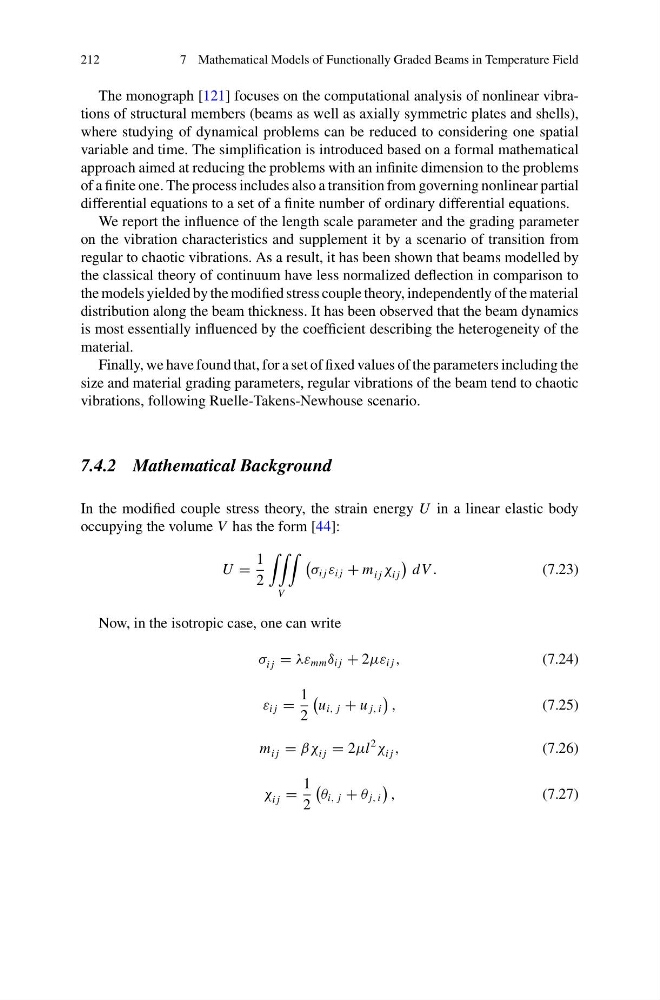
In the modified couple stress theory, the strain energy U in a linear elastic body
occupying the volume V has the form [44]:
U =
1
2
V
σ i j ε i j + m i j χ i j
dV .
(7.23)
Now, in the isotropic case, one can write
σ i j = λε mm δ i j + 2με i j ,
(7.24)
ε i j =
1
2
u i, j + u j, i
,
(7.25)
m i j = βχ i j = 2μl
2
χ i j ,
(7.26)
χ i j =
1
2
θ i, j + θ j, i
,
(7.27)
7 Mathematical Models of Functionally Graded Beams in Temperature Field
The monograph [121] focuses on the computational analysis of nonlinear vibrations of structural members (beams as well as axially symmetric plates and shells),
where studying of dynamical problems can be reduced to considering one spatial
variable and time. The simplification is introduced based on a formal mathematical
approach aimed at reducing the problems with an infinite dimension to the problems
of a finite one. The process includes also a transition from governing nonlinear partial
differential equations to a set of a finite number of ordinary differential equations.
We report the influence of the length scale parameter and the grading parameter
on the vibration characteristics and supplement it by a scenario of transition from
regular to chaotic vibrations. As a result, it has been shown that beams modelled by
the classical theory of continuum have less normalized deflection in comparison to
the models yielded by the modified stress couple theory, independently of the material
distribution along the beam thickness. It has been observed that the beam dynamics
is most essentially influenced by the coefficient describing the heterogeneity of the
material.
Finally, we have found that, for a set of fixed values of the parameters including the
size and material grading parameters, regular vibrations of the beam tend to chaotic
vibrations, following Ruelle-Takens-Newhouse scenario.
7.4.2 Mathematical Background
In the modified couple stress theory, the strain energy U in a linear elastic body
occupying the volume V has the form [44]:
U =
1
2
V
σ i j ε i j + m i j χ i j
dV .
(7.23)
Now, in the isotropic case, one can write
σ i j = λε mm δ i j + 2με i j ,
(7.24)
ε i j =
1
2
u i, j + u j, i
,
(7.25)
m i j = βχ i j = 2μl
2
χ i j ,
(7.26)
χ i j =
1
2
θ i, j + θ j, i
,
(7.27)