

190
6 Mathematical Models of Micro- and Nano-cylindrical Panels in Temperature Field
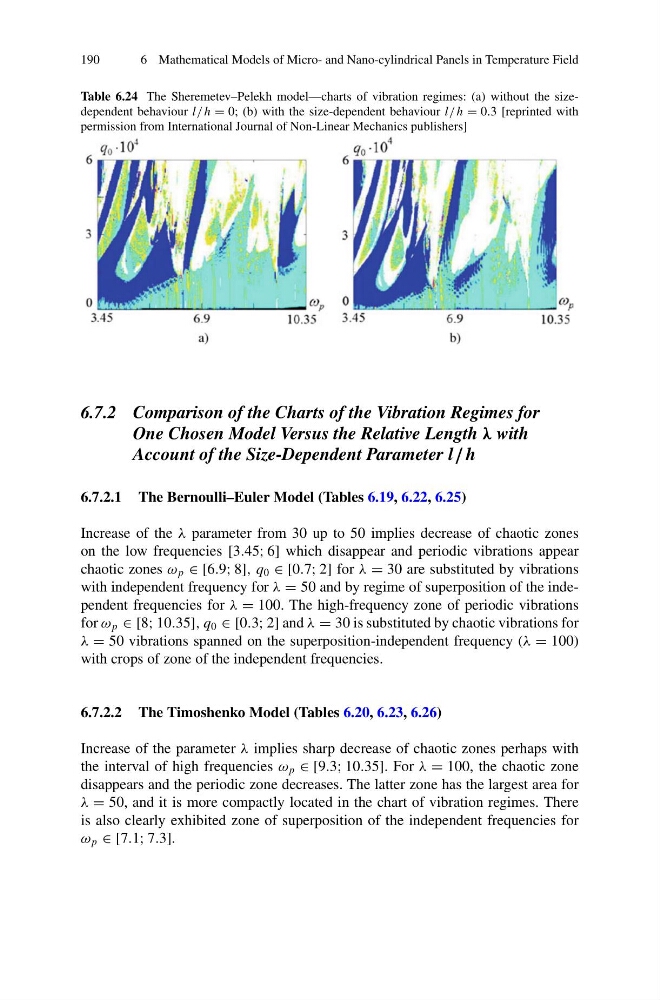
Table 6.24 The Sheremetev–Pelekh model—charts of vibration regimes: (a) without the sizedependent behaviour l/ h = 0; (b) with the size-dependent behaviour l/ h = 0.3 [reprinted with
permission from International Journal of Non-Linear Mechanics publishers]
6.7.2 Comparison of the Charts of the Vibration Regimes for
One Chosen Model Versus the Relative Length λ with
Account of the Size-Dependent Parameter l/ h
6.7.2.1 The Bernoulli–Euler Model (Tables 6.19, 6.22, 6.25)
Increase of the λ parameter from 30 up to 50 implies decrease of chaotic zones
on the low frequencies [3.45; 6] which disappear and periodic vibrations appear
chaotic zones ω p ∈ [6.9; 8], q 0 ∈ [0.7; 2] for λ = 30 are substituted by vibrations
with independent frequency for λ = 50 and by regime of superposition of the independent frequencies for λ = 100. The high-frequency zone of periodic vibrations
for ω p ∈ [8; 10.35], q 0 ∈ [0.3; 2] and λ = 30 is substituted by chaotic vibrations for
λ = 50 vibrations spanned on the superposition-independent frequency (λ = 100)
with crops of zone of the independent frequencies.
6.7.2.2 The Timoshenko Model (Tables 6.20, 6.23, 6.26)
Increase of the parameter λ implies sharp decrease of chaotic zones perhaps with
the interval of high frequencies ω p ∈ [9.3; 10.35]. For λ = 100, the chaotic zone
disappears and the periodic zone decreases. The latter zone has the largest area for
λ = 50, and it is more compactly located in the chart of vibration regimes. There
is also clearly exhibited zone of superposition of the independent frequencies for
ω p ∈ [7.1; 7.3].
6 Mathematical Models of Micro- and Nano-cylindrical Panels in Temperature Field
Table 6.24 The Sheremetev–Pelekh model—charts of vibration regimes: (a) without the sizedependent behaviour l/ h = 0; (b) with the size-dependent behaviour l/ h = 0.3 [reprinted with
permission from International Journal of Non-Linear Mechanics publishers]
6.7.2 Comparison of the Charts of the Vibration Regimes for
One Chosen Model Versus the Relative Length λ with
Account of the Size-Dependent Parameter l/ h
6.7.2.1 The Bernoulli–Euler Model (Tables 6.19, 6.22, 6.25)
Increase of the λ parameter from 30 up to 50 implies decrease of chaotic zones
on the low frequencies [3.45; 6] which disappear and periodic vibrations appear
chaotic zones ω p ∈ [6.9; 8], q 0 ∈ [0.7; 2] for λ = 30 are substituted by vibrations
with independent frequency for λ = 50 and by regime of superposition of the independent frequencies for λ = 100. The high-frequency zone of periodic vibrations
for ω p ∈ [8; 10.35], q 0 ∈ [0.3; 2] and λ = 30 is substituted by chaotic vibrations for
λ = 50 vibrations spanned on the superposition-independent frequency (λ = 100)
with crops of zone of the independent frequencies.
6.7.2.2 The Timoshenko Model (Tables 6.20, 6.23, 6.26)
Increase of the parameter λ implies sharp decrease of chaotic zones perhaps with
the interval of high frequencies ω p ∈ [9.3; 10.35]. For λ = 100, the chaotic zone
disappears and the periodic zone decreases. The latter zone has the largest area for
λ = 50, and it is more compactly located in the chart of vibration regimes. There
is also clearly exhibited zone of superposition of the independent frequencies for
ω p ∈ [7.1; 7.3].