

6.6 Chaotic Dynamics of the Size-Dependent Flexible Beams
177
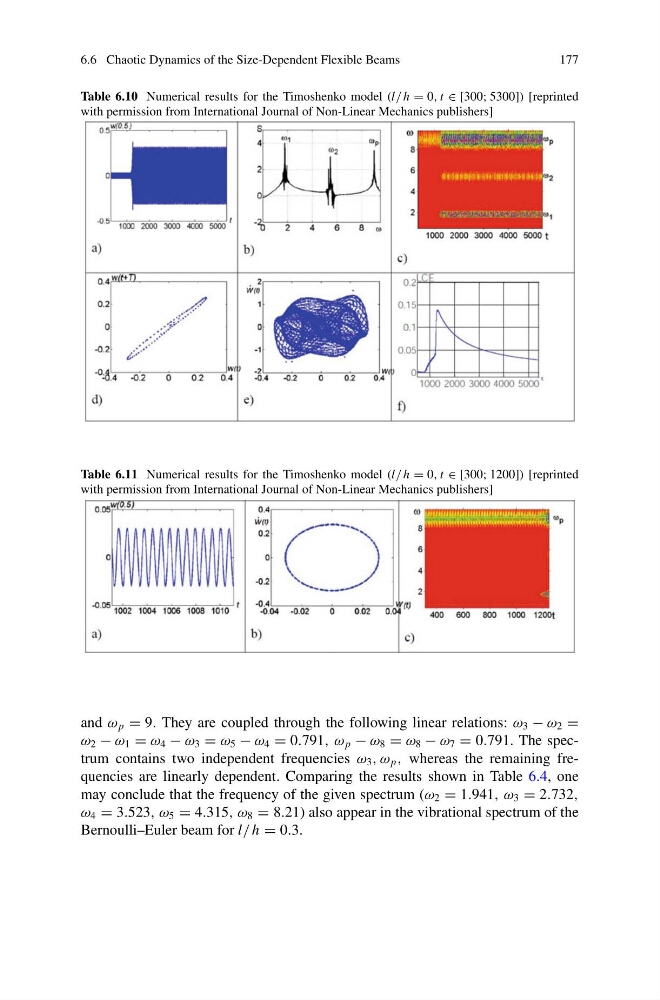
Table 6.10 Numerical results for the Timoshenko model (l/ h = 0, t ∈ [300; 5300]) [reprinted
with permission from International Journal of Non-Linear Mechanics publishers]
Table 6.11 Numerical results for the Timoshenko model (l/ h = 0, t ∈ [300; 1200]) [reprinted
with permission from International Journal of Non-Linear Mechanics publishers]
and ω p = 9. They are coupled through the following linear relations: ω 3 − ω 2 =
ω 2 − ω 1 = ω 4 − ω 3 = ω 5 − ω 4 = 0.791, ω p − ω 8 = ω 8 − ω 7 = 0.791. The spectrum contains two independent frequencies ω 3 , ω p , whereas the remaining frequencies are linearly dependent. Comparing the results shown in Table 6.4, one
may conclude that the frequency of the given spectrum (ω 2 = 1.941, ω 3 = 2.732,
ω 4 = 3.523, ω 5 = 4.315, ω 8 = 8.21) also appear in the vibrational spectrum of the
Bernoulli–Euler beam for l/ h = 0.3.
177
Table 6.10 Numerical results for the Timoshenko model (l/ h = 0, t ∈ [300; 5300]) [reprinted
with permission from International Journal of Non-Linear Mechanics publishers]
Table 6.11 Numerical results for the Timoshenko model (l/ h = 0, t ∈ [300; 1200]) [reprinted
with permission from International Journal of Non-Linear Mechanics publishers]
and ω p = 9. They are coupled through the following linear relations: ω 3 − ω 2 =
ω 2 − ω 1 = ω 4 − ω 3 = ω 5 − ω 4 = 0.791, ω p − ω 8 = ω 8 − ω 7 = 0.791. The spectrum contains two independent frequencies ω 3 , ω p , whereas the remaining frequencies are linearly dependent. Comparing the results shown in Table 6.4, one
may conclude that the frequency of the given spectrum (ω 2 = 1.941, ω 3 = 2.732,
ω 4 = 3.523, ω 5 = 4.315, ω 8 = 8.21) also appear in the vibrational spectrum of the
Bernoulli–Euler beam for l/ h = 0.3.