

102
4 Reliability of Chaotic Vibrations of Euler-Bernoulli Beams with Clearance
The obtained system of nonlinear PDEs is reduced to ODEs using the FDM
with the approximation O(c
2
). The beam clearance equals h k = 0.1. First, estimation of convergence of the FDM is conducted. For this purpose, the signals of both
beams were compared employing different kinds of Runge-Kutta methods: fourthand second-order Runge-Kutta methods, Runge-Kutta-Fehlberg method, the fourthorder Cash-Karp method, the eighth-order Runge-Kutta Prince-Dormand method
as well as the implicit fourth- and second-order Runge-Kutta methods. According
to the obtained results, all the above-mentioned methods ensure good convergence.
In further computations, the eighth-order Runge-Kutta method keeping the PrinceDormand accuracy is used.
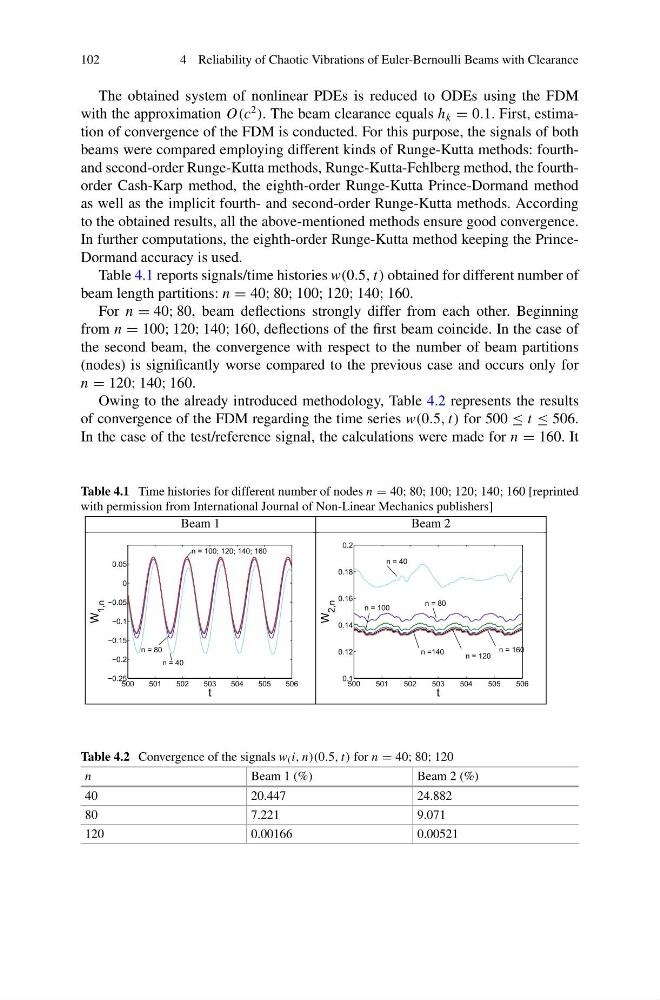
Table 4.1 reports signals/time histories w(0.5, t) obtained for different number of
beam length partitions: n = 40; 80; 100; 120; 140; 160.
For n = 40; 80, beam deflections strongly differ from each other. Beginning
from n = 100; 120; 140; 160, deflections of the first beam coincide. In the case of
the second beam, the convergence with respect to the number of beam partitions
(nodes) is significantly worse compared to the previous case and occurs only for
n = 120; 140; 160.
Owing to the already introduced methodology, Table 4.2 represents the results
of convergence of the FDM regarding the time series w(0.5, t) for 500 ≤ t ≤ 506.
In the case of the test/reference signal, the calculations were made for n = 160. It
Table 4.1 Time histories for different number of nodes n = 40; 80; 100; 120; 140; 160 [reprinted
with permission from International Journal of Non-Linear Mechanics publishers]
Table 4.2 Convergence of the signals w ( i, n)(0.5, t) for n = 40; 80; 120
n
Beam 1 (%)
Beam 2 (%)
40
20.447
24.882
80
7.221
9.071
120
0.00166
0.00521
4 Reliability of Chaotic Vibrations of Euler-Bernoulli Beams with Clearance
The obtained system of nonlinear PDEs is reduced to ODEs using the FDM
with the approximation O(c
2
). The beam clearance equals h k = 0.1. First, estimation of convergence of the FDM is conducted. For this purpose, the signals of both
beams were compared employing different kinds of Runge-Kutta methods: fourthand second-order Runge-Kutta methods, Runge-Kutta-Fehlberg method, the fourthorder Cash-Karp method, the eighth-order Runge-Kutta Prince-Dormand method
as well as the implicit fourth- and second-order Runge-Kutta methods. According
to the obtained results, all the above-mentioned methods ensure good convergence.
In further computations, the eighth-order Runge-Kutta method keeping the PrinceDormand accuracy is used.
Table 4.1 reports signals/time histories w(0.5, t) obtained for different number of
beam length partitions: n = 40; 80; 100; 120; 140; 160.
For n = 40; 80, beam deflections strongly differ from each other. Beginning
from n = 100; 120; 140; 160, deflections of the first beam coincide. In the case of
the second beam, the convergence with respect to the number of beam partitions
(nodes) is significantly worse compared to the previous case and occurs only for
n = 120; 140; 160.
Owing to the already introduced methodology, Table 4.2 represents the results
of convergence of the FDM regarding the time series w(0.5, t) for 500 ≤ t ≤ 506.
In the case of the test/reference signal, the calculations were made for n = 160. It
Table 4.1 Time histories for different number of nodes n = 40; 80; 100; 120; 140; 160 [reprinted
with permission from International Journal of Non-Linear Mechanics publishers]
Table 4.2 Convergence of the signals w ( i, n)(0.5, t) for n = 40; 80; 120
n
Beam 1 (%)
Beam 2 (%)
40
20.447
24.882
80
7.221
9.071
120
0.00166
0.00521