

72
P. K. Nanavati et al.
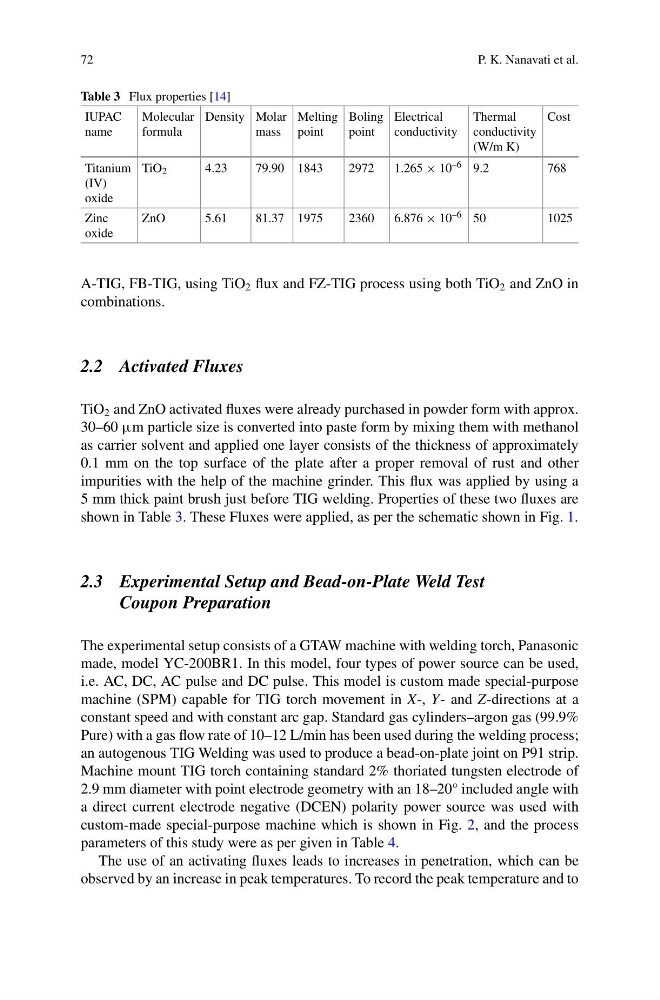
Table 3 Flux properties [14]
IUPAC
name
Molecular
formula
Density Molar
mass
Melting
point
Boling
point
Electrical
conductivity
Thermal
conductivity
(W/m K)
Cost
Titanium
(IV)
oxide
TiO 2
4.23
79.90 1843
2972
1.265 × 10 –6 9.2
768
Zinc
oxide
ZnO
5.61
81.37 1975
2360
6.876 × 10 –6 50
1025
A-TIG, FB-TIG, using TiO 2 flux and FZ-TIG process using both TiO 2 and ZnO in
combinations.
2.2 Activated Fluxes
TiO 2 and ZnO activated fluxes were already purchased in powder form with approx.
30–60 µm particle size is converted into paste form by mixing them with methanol
as carrier solvent and applied one layer consists of the thickness of approximately
0.1 mm on the top surface of the plate after a proper removal of rust and other
impurities with the help of the machine grinder. This flux was applied by using a
5 mm thick paint brush just before TIG welding. Properties of these two fluxes are
shown in Table 3. These Fluxes were applied, as per the schematic shown in Fig. 1.
2.3 Experimental Setup and Bead-on-Plate Weld Test
Coupon Preparation
The experimental setup consists of a GTAW machine with welding torch, Panasonic
made, model YC-200BR1. In this model, four types of power source can be used,
i.e. AC, DC, AC pulse and DC pulse. This model is custom made special-purpose
machine (SPM) capable for TIG torch movement in X-, Y- and Z-directions at a
constant speed and with constant arc gap. Standard gas cylinders–argon gas (99.9%
Pure) with a gas flow rate of 10–12 L/min has been used during the welding process;
an autogenous TIG Welding was used to produce a bead-on-plate joint on P91 strip.
Machine mount TIG torch containing standard 2% thoriated tungsten electrode of
2.9 mm diameter with point electrode geometry with an 18–20° included angle with
a direct current electrode negative (DCEN) polarity power source was used with
custom-made special-purpose machine which is shown in Fig. 2, and the process
parameters of this study were as per given in Table 4.
The use of an activating fluxes leads to increases in penetration, which can be
observed by an increase in peak temperatures. To record the peak temperature and to
P. K. Nanavati et al.
Table 3 Flux properties [14]
IUPAC
name
Molecular
formula
Density Molar
mass
Melting
point
Boling
point
Electrical
conductivity
Thermal
conductivity
(W/m K)
Cost
Titanium
(IV)
oxide
TiO 2
4.23
79.90 1843
2972
1.265 × 10 –6 9.2
768
Zinc
oxide
ZnO
5.61
81.37 1975
2360
6.876 × 10 –6 50
1025
A-TIG, FB-TIG, using TiO 2 flux and FZ-TIG process using both TiO 2 and ZnO in
combinations.
2.2 Activated Fluxes
TiO 2 and ZnO activated fluxes were already purchased in powder form with approx.
30–60 µm particle size is converted into paste form by mixing them with methanol
as carrier solvent and applied one layer consists of the thickness of approximately
0.1 mm on the top surface of the plate after a proper removal of rust and other
impurities with the help of the machine grinder. This flux was applied by using a
5 mm thick paint brush just before TIG welding. Properties of these two fluxes are
shown in Table 3. These Fluxes were applied, as per the schematic shown in Fig. 1.
2.3 Experimental Setup and Bead-on-Plate Weld Test
Coupon Preparation
The experimental setup consists of a GTAW machine with welding torch, Panasonic
made, model YC-200BR1. In this model, four types of power source can be used,
i.e. AC, DC, AC pulse and DC pulse. This model is custom made special-purpose
machine (SPM) capable for TIG torch movement in X-, Y- and Z-directions at a
constant speed and with constant arc gap. Standard gas cylinders–argon gas (99.9%
Pure) with a gas flow rate of 10–12 L/min has been used during the welding process;
an autogenous TIG Welding was used to produce a bead-on-plate joint on P91 strip.
Machine mount TIG torch containing standard 2% thoriated tungsten electrode of
2.9 mm diameter with point electrode geometry with an 18–20° included angle with
a direct current electrode negative (DCEN) polarity power source was used with
custom-made special-purpose machine which is shown in Fig. 2, and the process
parameters of this study were as per given in Table 4.
The use of an activating fluxes leads to increases in penetration, which can be
observed by an increase in peak temperatures. To record the peak temperature and to