

Rejection Rate Minimization of Cast Iron Components …
63
CE is 4.333 and 4.401 for grey and ductile cast iron, respectively, which is just
above eutectic composition. To maintain the optimum ductile to brittle transformation
temperature and brittleness of ductile cast iron, Si should be maintained 2.4–2.8 wt%
which can be observed in present ductile cast iron composition [2008Cah]. For ductile
cast iron, it is important to know the degree of saturation (Sc):
Sc =
%C
4.23 − 0.3(%Si + %P)
(2)
for formation of graphite. If Sc < 1, it induces primary dendrites and else promotes
formation of graphite. For ductile cast iron, Sc valve is 1.024 which confirms the
formation of nodular graphite.
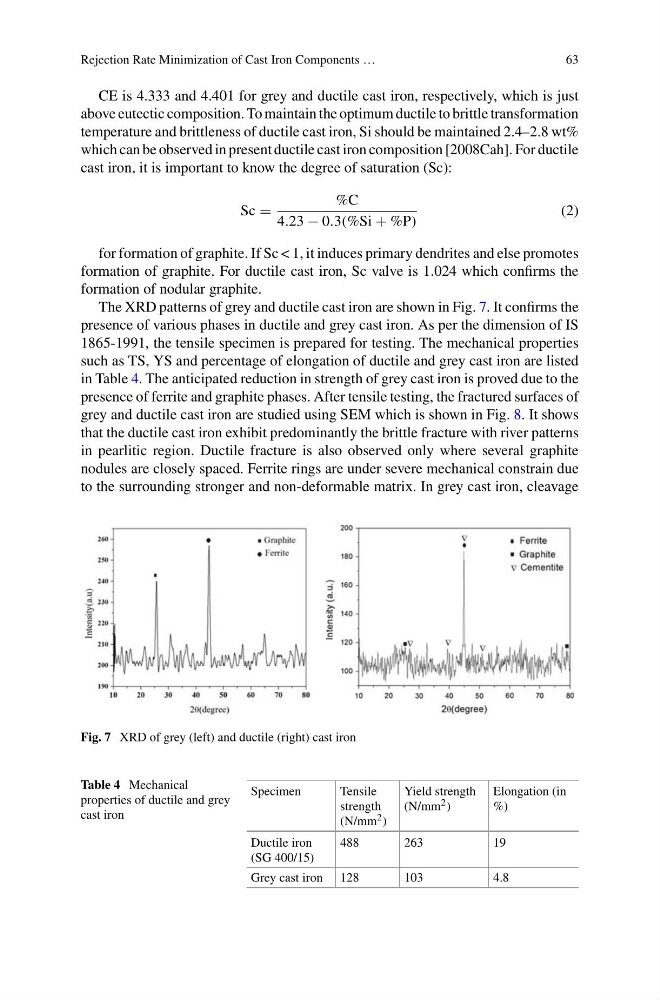
The XRD patterns of grey and ductile cast iron are shown in Fig. 7. It confirms the
presence of various phases in ductile and grey cast iron. As per the dimension of IS
1865-1991, the tensile specimen is prepared for testing. The mechanical properties
such as TS, YS and percentage of elongation of ductile and grey cast iron are listed
in Table 4. The anticipated reduction in strength of grey cast iron is proved due to the
presence of ferrite and graphite phases. After tensile testing, the fractured surfaces of
grey and ductile cast iron are studied using SEM which is shown in Fig. 8. It shows
that the ductile cast iron exhibit predominantly the brittle fracture with river patterns
in pearlitic region. Ductile fracture is also observed only where several graphite
nodules are closely spaced. Ferrite rings are under severe mechanical constrain due
to the surrounding stronger and non-deformable matrix. In grey cast iron, cleavage
Fig. 7 XRD of grey (left) and ductile (right) cast iron
Table 4 Mechanical
properties of ductile and grey
cast iron
Specimen
Tensile
strength
(N/mm 2 )
Yield strength
(N/mm 2 )
Elongation (in
%)
Ductile iron
(SG 400/15)
488
263
19
Grey cast iron 128
103
4.8
63
CE is 4.333 and 4.401 for grey and ductile cast iron, respectively, which is just
above eutectic composition. To maintain the optimum ductile to brittle transformation
temperature and brittleness of ductile cast iron, Si should be maintained 2.4–2.8 wt%
which can be observed in present ductile cast iron composition [2008Cah]. For ductile
cast iron, it is important to know the degree of saturation (Sc):
Sc =
%C
4.23 − 0.3(%Si + %P)
(2)
for formation of graphite. If Sc < 1, it induces primary dendrites and else promotes
formation of graphite. For ductile cast iron, Sc valve is 1.024 which confirms the
formation of nodular graphite.
The XRD patterns of grey and ductile cast iron are shown in Fig. 7. It confirms the
presence of various phases in ductile and grey cast iron. As per the dimension of IS
1865-1991, the tensile specimen is prepared for testing. The mechanical properties
such as TS, YS and percentage of elongation of ductile and grey cast iron are listed
in Table 4. The anticipated reduction in strength of grey cast iron is proved due to the
presence of ferrite and graphite phases. After tensile testing, the fractured surfaces of
grey and ductile cast iron are studied using SEM which is shown in Fig. 8. It shows
that the ductile cast iron exhibit predominantly the brittle fracture with river patterns
in pearlitic region. Ductile fracture is also observed only where several graphite
nodules are closely spaced. Ferrite rings are under severe mechanical constrain due
to the surrounding stronger and non-deformable matrix. In grey cast iron, cleavage
Fig. 7 XRD of grey (left) and ductile (right) cast iron
Table 4 Mechanical
properties of ductile and grey
cast iron
Specimen
Tensile
strength
(N/mm 2 )
Yield strength
(N/mm 2 )
Elongation (in
%)
Ductile iron
(SG 400/15)
488
263
19
Grey cast iron 128
103
4.8