

Rejection Rate Minimization of Cast Iron Components …
61
iron and grey cast iron used in the foundry is 1450–1500 °C and 1400–1450 °C,
respectively. The foundry uses a considerable amount of used green sand for moulds.
The refractoriness of sand continuously decreases due to repetitive use of the returned
green sand. Thus, if refractoriness lowers, the green sand may not be able to withstand
the pouring temperature of the molten alloy causing it to expand and loosen which
reduces the green compression strength resulting in sand crush, sand pour and run
out in products [11–13]. Due to the above consecutive usage, the green strength of
the green sand is evidently low. The green strength of ductile and grey cast iron
is 0.803 and 0.76 kg/cm
2 , respectively, which is less than the required limit (0.87–
0.94 kg/cm
2 ).
Addition of bentonite raises the green strength of moulding sand [14]. Swelling
of bentonite plays a vital role in binding of foundry sand. Swell test is conducted
for bentonite to know its potential to activate the clay content present in sand in
the presence of water. Instead of tap water, deionized water gives better swelling of
bentonite which leads better binding of sand with additives (normal water = 30%,
de-ionized water = 40%, mineral water = 48%). If the binding ability is low along
with improper mixing of green sand in muller, there is high chance for sand burn to
occur. This explains the reason for sand burn in grey cast iron (non-return valve).
To avoid the inoculant fade effects in grey cast iron, the inoculant ferrosilicon is
added in ladles. Within the limited time, inoculation process taking place in molten
metal which remain in the ladle. Due to this reason, foundry men limit the number
of ductile iron shots poured into the moulds within a specified time (7 min). If
this number of shots are increased or poured after the specified time, fluidity and
nucleation of nodules in the ductile iron are reduced. This explains the comparatively
porosity defect in harvester cup.
The composition of the ductile iron and grey cast iron is within the required limits
with very less to negligible amount of impurities which has no major impact. Certain
careless practices like improper molten metal pouring and improper clamping of the
cope and drag can result in veining defect and mismatch in the foundry components,
respectively. This is evident in the chain link with veining projection and non-return
valve with misaligned body.
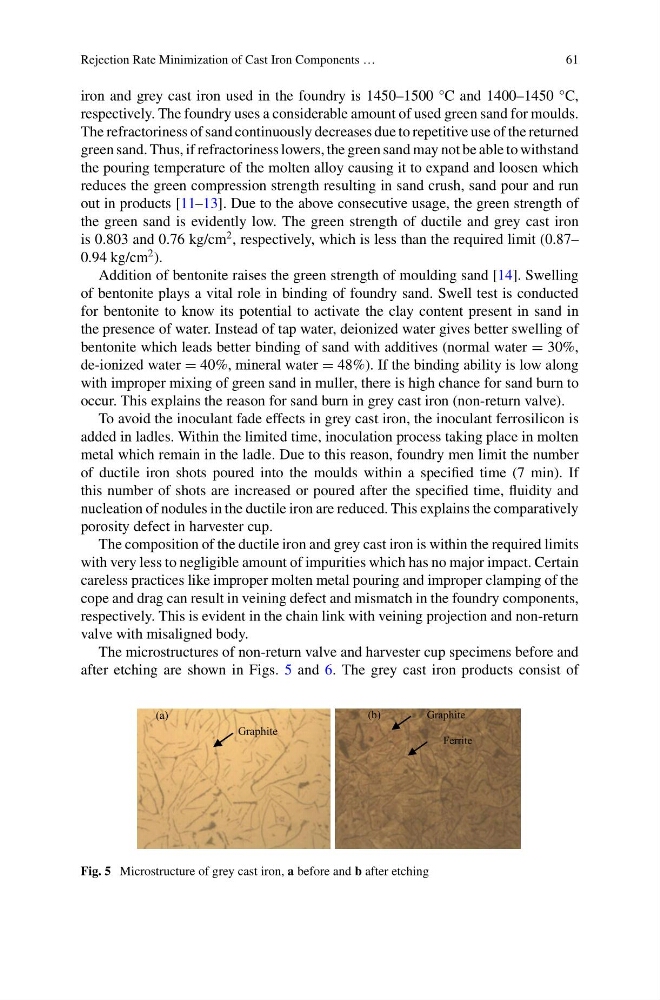
The microstructures of non-return valve and harvester cup specimens before and
after etching are shown in Figs. 5 and 6. The grey cast iron products consist of
Graphite
Graphite
Ferrite
(a)
(b)
Fig. 5 Microstructure of grey cast iron, a before and b after etching
61
iron and grey cast iron used in the foundry is 1450–1500 °C and 1400–1450 °C,
respectively. The foundry uses a considerable amount of used green sand for moulds.
The refractoriness of sand continuously decreases due to repetitive use of the returned
green sand. Thus, if refractoriness lowers, the green sand may not be able to withstand
the pouring temperature of the molten alloy causing it to expand and loosen which
reduces the green compression strength resulting in sand crush, sand pour and run
out in products [11–13]. Due to the above consecutive usage, the green strength of
the green sand is evidently low. The green strength of ductile and grey cast iron
is 0.803 and 0.76 kg/cm
2 , respectively, which is less than the required limit (0.87–
0.94 kg/cm
2 ).
Addition of bentonite raises the green strength of moulding sand [14]. Swelling
of bentonite plays a vital role in binding of foundry sand. Swell test is conducted
for bentonite to know its potential to activate the clay content present in sand in
the presence of water. Instead of tap water, deionized water gives better swelling of
bentonite which leads better binding of sand with additives (normal water = 30%,
de-ionized water = 40%, mineral water = 48%). If the binding ability is low along
with improper mixing of green sand in muller, there is high chance for sand burn to
occur. This explains the reason for sand burn in grey cast iron (non-return valve).
To avoid the inoculant fade effects in grey cast iron, the inoculant ferrosilicon is
added in ladles. Within the limited time, inoculation process taking place in molten
metal which remain in the ladle. Due to this reason, foundry men limit the number
of ductile iron shots poured into the moulds within a specified time (7 min). If
this number of shots are increased or poured after the specified time, fluidity and
nucleation of nodules in the ductile iron are reduced. This explains the comparatively
porosity defect in harvester cup.
The composition of the ductile iron and grey cast iron is within the required limits
with very less to negligible amount of impurities which has no major impact. Certain
careless practices like improper molten metal pouring and improper clamping of the
cope and drag can result in veining defect and mismatch in the foundry components,
respectively. This is evident in the chain link with veining projection and non-return
valve with misaligned body.
The microstructures of non-return valve and harvester cup specimens before and
after etching are shown in Figs. 5 and 6. The grey cast iron products consist of
Graphite
Graphite
Ferrite
(a)
(b)
Fig. 5 Microstructure of grey cast iron, a before and b after etching