

Feasibility of Joining Aluminum to Nylon Using Friction …
51
a
b
c
d
e
f
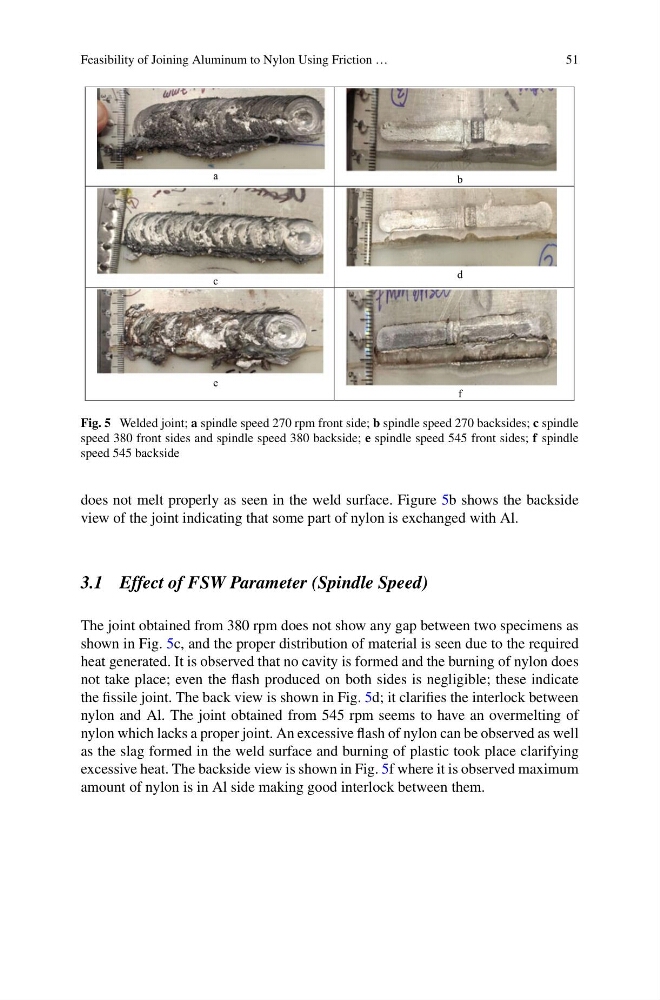
Fig. 5 Welded joint; a spindle speed 270 rpm front side; b spindle speed 270 backsides; c spindle
speed 380 front sides and spindle speed 380 backside; e spindle speed 545 front sides; f spindle
speed 545 backside
does not melt properly as seen in the weld surface. Figure 5b shows the backside
view of the joint indicating that some part of nylon is exchanged with Al.
3.1 Effect of FSW Parameter (Spindle Speed)
The joint obtained from 380 rpm does not show any gap between two specimens as
shown in Fig. 5c, and the proper distribution of material is seen due to the required
heat generated. It is observed that no cavity is formed and the burning of nylon does
not take place; even the flash produced on both sides is negligible; these indicate
the fissile joint. The back view is shown in Fig. 5d; it clarifies the interlock between
nylon and Al. The joint obtained from 545 rpm seems to have an overmelting of
nylon which lacks a proper joint. An excessive flash of nylon can be observed as well
as the slag formed in the weld surface and burning of plastic took place clarifying
excessive heat. The backside view is shown in Fig. 5f where it is observed maximum
amount of nylon is in Al side making good interlock between them.
51
a
b
c
d
e
f
Fig. 5 Welded joint; a spindle speed 270 rpm front side; b spindle speed 270 backsides; c spindle
speed 380 front sides and spindle speed 380 backside; e spindle speed 545 front sides; f spindle
speed 545 backside
does not melt properly as seen in the weld surface. Figure 5b shows the backside
view of the joint indicating that some part of nylon is exchanged with Al.
3.1 Effect of FSW Parameter (Spindle Speed)
The joint obtained from 380 rpm does not show any gap between two specimens as
shown in Fig. 5c, and the proper distribution of material is seen due to the required
heat generated. It is observed that no cavity is formed and the burning of nylon does
not take place; even the flash produced on both sides is negligible; these indicate
the fissile joint. The back view is shown in Fig. 5d; it clarifies the interlock between
nylon and Al. The joint obtained from 545 rpm seems to have an overmelting of
nylon which lacks a proper joint. An excessive flash of nylon can be observed as well
as the slag formed in the weld surface and burning of plastic took place clarifying
excessive heat. The backside view is shown in Fig. 5f where it is observed maximum
amount of nylon is in Al side making good interlock between them.