

Kinematic Analysis and Simulation of Industrial Robot …
481
RoboAnalyzer are found to be consistent with the analytical results. Similarly, Fig. 6
shows the position vector P = [0.48151 0.412951 0.415602]
T for joint variable q
= [40 90 60 20 10 350]
T . Figure 6 shows the final position of the robot, and the
results obtained from the RoboAnalyzer tool are also found to be consistent with the
analytical results. The comparison of the results is also shown in Table 2 for two
different joint values.
5 Inverse Kinematics Analysis
The inverse kinematic problem deals with the determining of different possible sets of
joint variables, which would attain the specified pose of the end-effector. The inverse
kinematic problem becomes complicated as the number of joint or link increases. The
joint variables are determined by squaring and adding the position equations. The
analytical solutions of the inverse kinematic problem are a time-consuming process
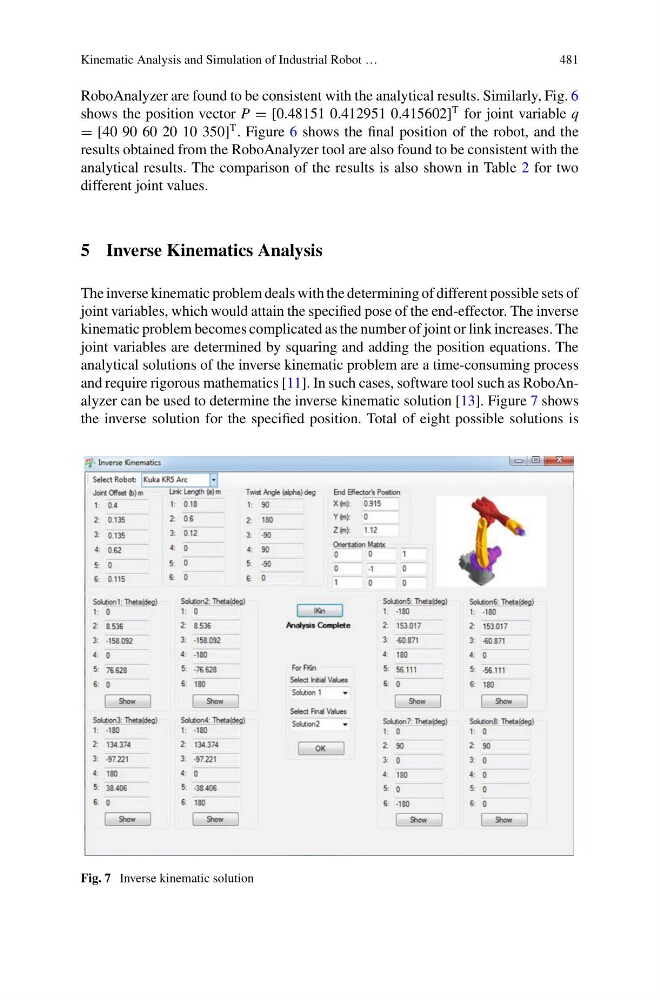
and require rigorous mathematics [11]. In such cases, software tool such as RoboAnalyzer can be used to determine the inverse kinematic solution [13]. Figure 7 shows
the inverse solution for the specified position. Total of eight possible solutions is
Fig. 7 Inverse kinematic solution
481
RoboAnalyzer are found to be consistent with the analytical results. Similarly, Fig. 6
shows the position vector P = [0.48151 0.412951 0.415602]
T for joint variable q
= [40 90 60 20 10 350]
T . Figure 6 shows the final position of the robot, and the
results obtained from the RoboAnalyzer tool are also found to be consistent with the
analytical results. The comparison of the results is also shown in Table 2 for two
different joint values.
5 Inverse Kinematics Analysis
The inverse kinematic problem deals with the determining of different possible sets of
joint variables, which would attain the specified pose of the end-effector. The inverse
kinematic problem becomes complicated as the number of joint or link increases. The
joint variables are determined by squaring and adding the position equations. The
analytical solutions of the inverse kinematic problem are a time-consuming process
and require rigorous mathematics [11]. In such cases, software tool such as RoboAnalyzer can be used to determine the inverse kinematic solution [13]. Figure 7 shows
the inverse solution for the specified position. Total of eight possible solutions is
Fig. 7 Inverse kinematic solution