

Kinematic Analysis and Simulation of Industrial Robot …
477
4 Forward Kinematics Analysis
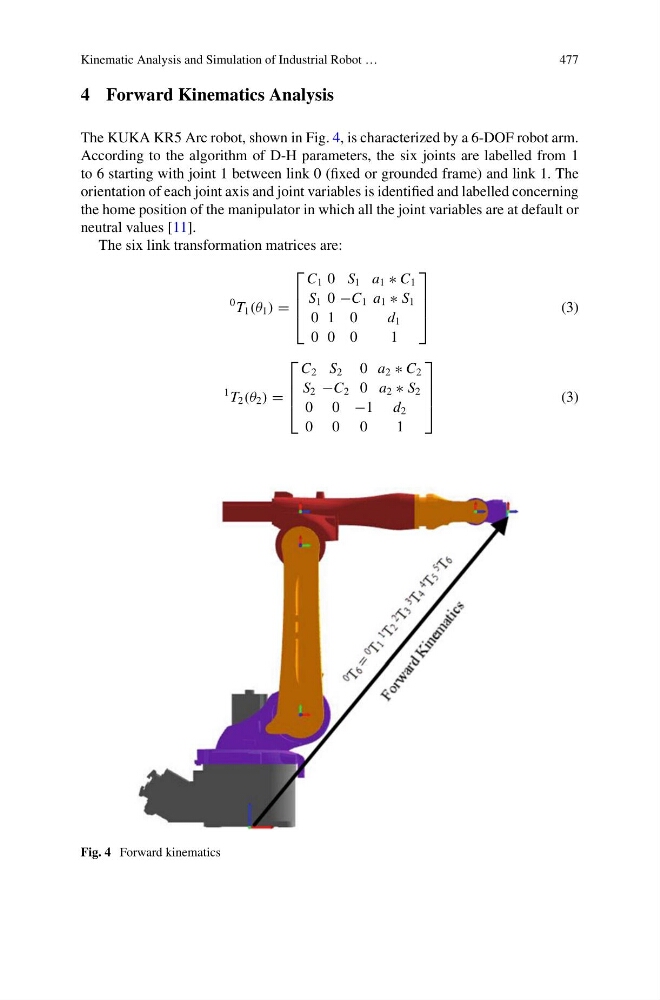
The KUKA KR5 Arc robot, shown in Fig. 4, is characterized by a 6-DOF robot arm.
According to the algorithm of D-H parameters, the six joints are labelled from 1
to 6 starting with joint 1 between link 0 (fixed or grounded frame) and link 1. The
orientation of each joint axis and joint variables is identified and labelled concerning
the home position of the manipulator in which all the joint variables are at default or
neutral values [11].
The six link transformation matrices are:
0 T 1 (θ 1 ) =
⎡
⎢
⎢
⎣
C 1 0 S 1 a 1 ∗ C 1
S 1 0 −C 1 a 1 ∗ S 1
0 1 0
d 1
0 0 0
1
⎤
⎥
⎥
⎦
(3)
1 T 2 (θ 2 ) =
⎡
⎢
⎢
⎣
C 2 S 2 0 a 2 ∗ C 2
S 2 −C 2 0 a 2 ∗ S 2
0 0 −1 d 2
0 0 0
1
⎤
⎥
⎥
⎦
(3)
Fig. 4 Forward kinematics
477
4 Forward Kinematics Analysis
The KUKA KR5 Arc robot, shown in Fig. 4, is characterized by a 6-DOF robot arm.
According to the algorithm of D-H parameters, the six joints are labelled from 1
to 6 starting with joint 1 between link 0 (fixed or grounded frame) and link 1. The
orientation of each joint axis and joint variables is identified and labelled concerning
the home position of the manipulator in which all the joint variables are at default or
neutral values [11].
The six link transformation matrices are:
0 T 1 (θ 1 ) =
⎡
⎢
⎢
⎣
C 1 0 S 1 a 1 ∗ C 1
S 1 0 −C 1 a 1 ∗ S 1
0 1 0
d 1
0 0 0
1
⎤
⎥
⎥
⎦
(3)
1 T 2 (θ 2 ) =
⎡
⎢
⎢
⎣
C 2 S 2 0 a 2 ∗ C 2
S 2 −C 2 0 a 2 ∗ S 2
0 0 −1 d 2
0 0 0
1
⎤
⎥
⎥
⎦
(3)
Fig. 4 Forward kinematics