

Kinematic Analysis and Simulation of Industrial Robot …
475
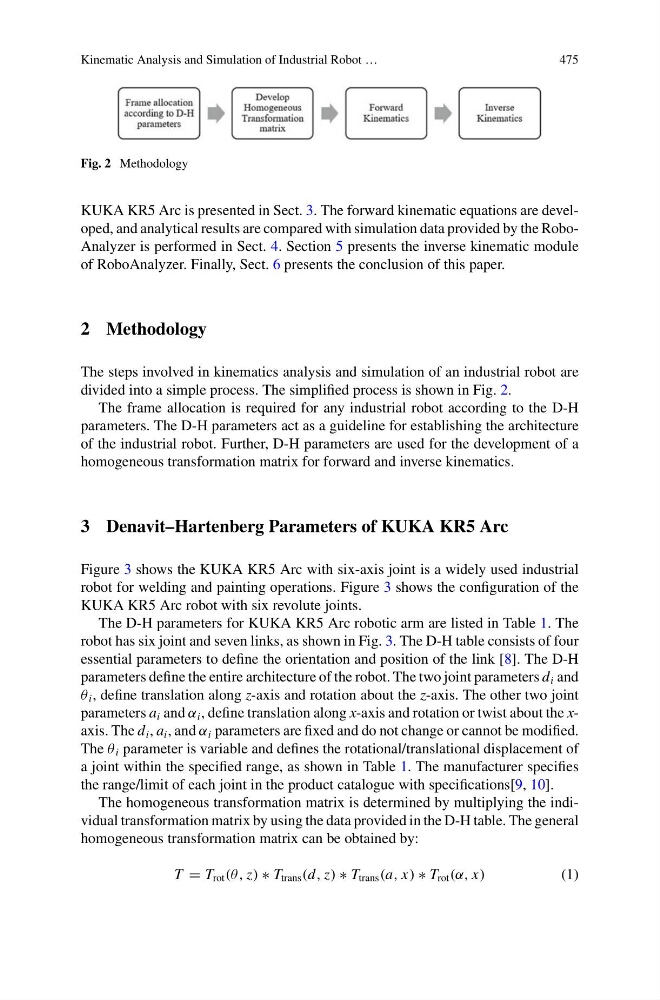
Fig. 2 Methodology
KUKA KR5 Arc is presented in Sect. 3. The forward kinematic equations are developed, and analytical results are compared with simulation data provided by the RoboAnalyzer is performed in Sect. 4. Section 5 presents the inverse kinematic module
of RoboAnalyzer. Finally, Sect. 6 presents the conclusion of this paper.
2 Methodology
The steps involved in kinematics analysis and simulation of an industrial robot are
divided into a simple process. The simplified process is shown in Fig. 2.
The frame allocation is required for any industrial robot according to the D-H
parameters. The D-H parameters act as a guideline for establishing the architecture
of the industrial robot. Further, D-H parameters are used for the development of a
homogeneous transformation matrix for forward and inverse kinematics.
3 Denavit–Hartenberg Parameters of KUKA KR5 Arc
Figure 3 shows the KUKA KR5 Arc with six-axis joint is a widely used industrial
robot for welding and painting operations. Figure 3 shows the configuration of the
KUKA KR5 Arc robot with six revolute joints.
The D-H parameters for KUKA KR5 Arc robotic arm are listed in Table 1. The
robot has six joint and seven links, as shown in Fig. 3. The D-H table consists of four
essential parameters to define the orientation and position of the link [8]. The D-H
parameters define the entire architecture of the robot. The two joint parameters d i and
θ i , define translation along z-axis and rotation about the z-axis. The other two joint
parameters a i and α i , define translation along x-axis and rotation or twist about the xaxis. The d i , a i , and α i parameters are fixed and do not change or cannot be modified.
The θ i parameter is variable and defines the rotational/translational displacement of
a joint within the specified range, as shown in Table 1. The manufacturer specifies
the range/limit of each joint in the product catalogue with specifications[9, 10].
The homogeneous transformation matrix is determined by multiplying the individual transformation matrix by using the data provided in the D-H table. The general
homogeneous transformation matrix can be obtained by:
T = T rot (θ, z) ∗ T trans (d, z) ∗ T trans (a, x) ∗ T rot (α, x)
(1)
475
Fig. 2 Methodology
KUKA KR5 Arc is presented in Sect. 3. The forward kinematic equations are developed, and analytical results are compared with simulation data provided by the RoboAnalyzer is performed in Sect. 4. Section 5 presents the inverse kinematic module
of RoboAnalyzer. Finally, Sect. 6 presents the conclusion of this paper.
2 Methodology
The steps involved in kinematics analysis and simulation of an industrial robot are
divided into a simple process. The simplified process is shown in Fig. 2.
The frame allocation is required for any industrial robot according to the D-H
parameters. The D-H parameters act as a guideline for establishing the architecture
of the industrial robot. Further, D-H parameters are used for the development of a
homogeneous transformation matrix for forward and inverse kinematics.
3 Denavit–Hartenberg Parameters of KUKA KR5 Arc
Figure 3 shows the KUKA KR5 Arc with six-axis joint is a widely used industrial
robot for welding and painting operations. Figure 3 shows the configuration of the
KUKA KR5 Arc robot with six revolute joints.
The D-H parameters for KUKA KR5 Arc robotic arm are listed in Table 1. The
robot has six joint and seven links, as shown in Fig. 3. The D-H table consists of four
essential parameters to define the orientation and position of the link [8]. The D-H
parameters define the entire architecture of the robot. The two joint parameters d i and
θ i , define translation along z-axis and rotation about the z-axis. The other two joint
parameters a i and α i , define translation along x-axis and rotation or twist about the xaxis. The d i , a i , and α i parameters are fixed and do not change or cannot be modified.
The θ i parameter is variable and defines the rotational/translational displacement of
a joint within the specified range, as shown in Table 1. The manufacturer specifies
the range/limit of each joint in the product catalogue with specifications[9, 10].
The homogeneous transformation matrix is determined by multiplying the individual transformation matrix by using the data provided in the D-H table. The general
homogeneous transformation matrix can be obtained by:
T = T rot (θ, z) ∗ T trans (d, z) ∗ T trans (a, x) ∗ T rot (α, x)
(1)