

Effect of Optimized Slip and Texture Zone …
439
0
1
2
3
4
5
6
7
8
0
2 0
4 0
6 0
8 0
1 0 0
Dimensionless load carrying
capacity
Dimensionless slip coefficient
Fortier and Salant [5]
Present work
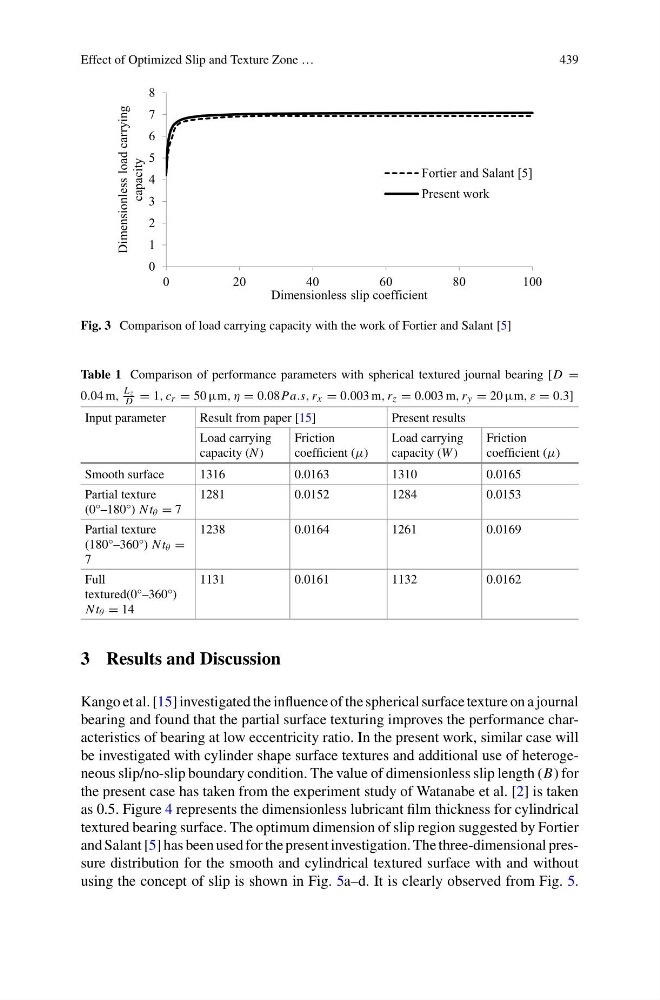
Fig. 3 Comparison of load carrying capacity with the work of Fortier and Salant [5]
Table 1 Comparison of performance parameters with spherical textured journal bearing [D =
0.04 m,
Lz
D = 1, c r = 50 µm, η = 0.08Pa.s, r x = 0.003 m, r z = 0.003 m, r y = 20 µm, ε = 0.3]
Input parameter
Result from paper [15]
Present results
Load carrying
capacity (N)
Friction
coefficient (μ)
Load carrying
capacity (W )
Friction
coefficient (μ)
Smooth surface
1316
0.0163
1310
0.0165
Partial texture
(0°–180°) N t θ = 7
1281
0.0152
1284
0.0153
Partial texture
(180°–360°) N t θ =
7
1238
0.0164
1261
0.0169
Full
textured(0°–360°)
N t θ = 14
1131
0.0161
1132
0.0162
3 Results and Discussion
Kango et al. [15] investigated the influence of the spherical surface texture on a journal
bearing and found that the partial surface texturing improves the performance characteristics of bearing at low eccentricity ratio. In the present work, similar case will
be investigated with cylinder shape surface textures and additional use of heterogeneous slip/no-slip boundary condition. The value of dimensionless slip length (B) for
the present case has taken from the experiment study of Watanabe et al. [2] is taken
as 0.5. Figure 4 represents the dimensionless lubricant film thickness for cylindrical
textured bearing surface. The optimum dimension of slip region suggested by Fortier
and Salant [5] has been used for the present investigation. The three-dimensional pressure distribution for the smooth and cylindrical textured surface with and without
using the concept of slip is shown in Fig. 5a–d. It is clearly observed from Fig. 5.
439
0
1
2
3
4
5
6
7
8
0
2 0
4 0
6 0
8 0
1 0 0
Dimensionless load carrying
capacity
Dimensionless slip coefficient
Fortier and Salant [5]
Present work
Fig. 3 Comparison of load carrying capacity with the work of Fortier and Salant [5]
Table 1 Comparison of performance parameters with spherical textured journal bearing [D =
0.04 m,
Lz
D = 1, c r = 50 µm, η = 0.08Pa.s, r x = 0.003 m, r z = 0.003 m, r y = 20 µm, ε = 0.3]
Input parameter
Result from paper [15]
Present results
Load carrying
capacity (N)
Friction
coefficient (μ)
Load carrying
capacity (W )
Friction
coefficient (μ)
Smooth surface
1316
0.0163
1310
0.0165
Partial texture
(0°–180°) N t θ = 7
1281
0.0152
1284
0.0153
Partial texture
(180°–360°) N t θ =
7
1238
0.0164
1261
0.0169
Full
textured(0°–360°)
N t θ = 14
1131
0.0161
1132
0.0162
3 Results and Discussion
Kango et al. [15] investigated the influence of the spherical surface texture on a journal
bearing and found that the partial surface texturing improves the performance characteristics of bearing at low eccentricity ratio. In the present work, similar case will
be investigated with cylinder shape surface textures and additional use of heterogeneous slip/no-slip boundary condition. The value of dimensionless slip length (B) for
the present case has taken from the experiment study of Watanabe et al. [2] is taken
as 0.5. Figure 4 represents the dimensionless lubricant film thickness for cylindrical
textured bearing surface. The optimum dimension of slip region suggested by Fortier
and Salant [5] has been used for the present investigation. The three-dimensional pressure distribution for the smooth and cylindrical textured surface with and without
using the concept of slip is shown in Fig. 5a–d. It is clearly observed from Fig. 5.