

438
M. Arif et al.
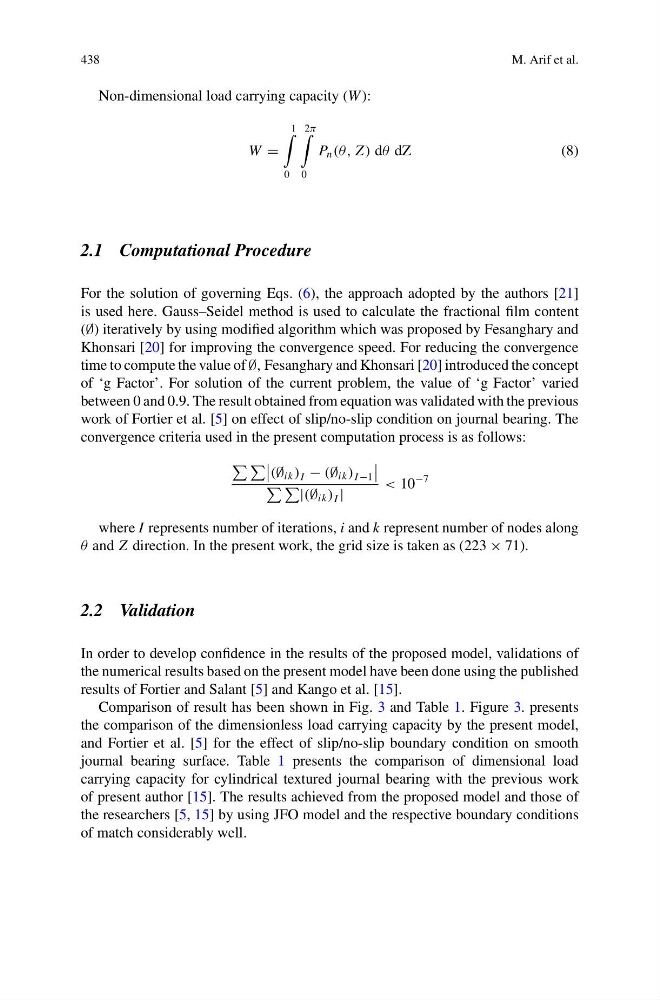
Non-dimensional load carrying capacity (W ):
W =
1
0
2π
0
P n (θ, Z ) dθ dZ
(8)
2.1 Computational Procedure
For the solution of governing Eqs. (6), the approach adopted by the authors [21]
is used here. Gauss–Seidel method is used to calculate the fractional film content
(∅) iteratively by using modified algorithm which was proposed by Fesanghary and
Khonsari [20] for improving the convergence speed. For reducing the convergence
time to compute the value of ∅, Fesanghary and Khonsari [20] introduced the concept
of ‘g Factor’. For solution of the current problem, the value of ‘g Factor’ varied
between 0 and 0.9. The result obtained from equation was validated with the previous
work of Fortier et al. [5] on effect of slip/no-slip condition on journal bearing. The
convergence criteria used in the present computation process is as follows:
(∅ ik ) I − (∅ ik ) I −1
|(∅ ik ) I |
< 10
−7
where I represents number of iterations, i and k represent number of nodes along
θ and Z direction. In the present work, the grid size is taken as (223 × 71).
2.2 Validation
In order to develop confidence in the results of the proposed model, validations of
the numerical results based on the present model have been done using the published
results of Fortier and Salant [5] and Kango et al. [15].
Comparison of result has been shown in Fig. 3 and Table 1. Figure 3. presents
the comparison of the dimensionless load carrying capacity by the present model,
and Fortier et al. [5] for the effect of slip/no-slip boundary condition on smooth
journal bearing surface. Table 1 presents the comparison of dimensional load
carrying capacity for cylindrical textured journal bearing with the previous work
of present author [15]. The results achieved from the proposed model and those of
the researchers [5, 15] by using JFO model and the respective boundary conditions
of match considerably well.
M. Arif et al.
Non-dimensional load carrying capacity (W ):
W =
1
0
2π
0
P n (θ, Z ) dθ dZ
(8)
2.1 Computational Procedure
For the solution of governing Eqs. (6), the approach adopted by the authors [21]
is used here. Gauss–Seidel method is used to calculate the fractional film content
(∅) iteratively by using modified algorithm which was proposed by Fesanghary and
Khonsari [20] for improving the convergence speed. For reducing the convergence
time to compute the value of ∅, Fesanghary and Khonsari [20] introduced the concept
of ‘g Factor’. For solution of the current problem, the value of ‘g Factor’ varied
between 0 and 0.9. The result obtained from equation was validated with the previous
work of Fortier et al. [5] on effect of slip/no-slip condition on journal bearing. The
convergence criteria used in the present computation process is as follows:
(∅ ik ) I − (∅ ik ) I −1
|(∅ ik ) I |
< 10
−7
where I represents number of iterations, i and k represent number of nodes along
θ and Z direction. In the present work, the grid size is taken as (223 × 71).
2.2 Validation
In order to develop confidence in the results of the proposed model, validations of
the numerical results based on the present model have been done using the published
results of Fortier and Salant [5] and Kango et al. [15].
Comparison of result has been shown in Fig. 3 and Table 1. Figure 3. presents
the comparison of the dimensionless load carrying capacity by the present model,
and Fortier et al. [5] for the effect of slip/no-slip boundary condition on smooth
journal bearing surface. Table 1 presents the comparison of dimensional load
carrying capacity for cylindrical textured journal bearing with the previous work
of present author [15]. The results achieved from the proposed model and those of
the researchers [5, 15] by using JFO model and the respective boundary conditions
of match considerably well.