

368
G. Kumar and H. Gupta
that enable researchers to work further. The performance of this technology is
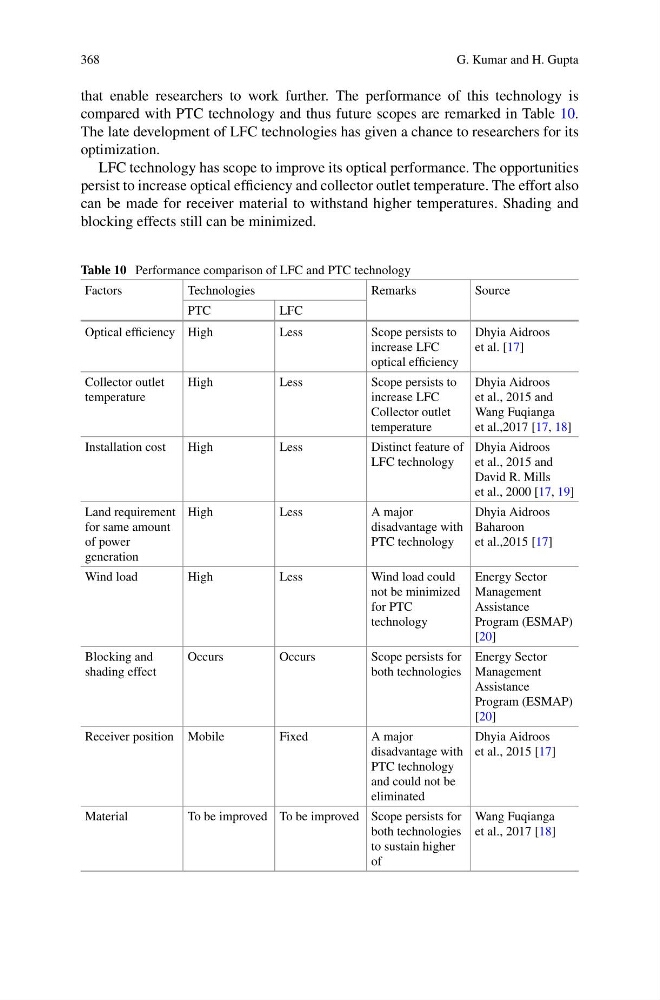
compared with PTC technology and thus future scopes are remarked in Table 10.
The late development of LFC technologies has given a chance to researchers for its
optimization.
LFC technology has scope to improve its optical performance. The opportunities
persist to increase optical efficiency and collector outlet temperature. The effort also
can be made for receiver material to withstand higher temperatures. Shading and
blocking effects still can be minimized.
Table 10 Performance comparison of LFC and PTC technology
Factors
Technologies
Remarks
Source
PTC
LFC
Optical efficiency High
Less
Scope persists to
increase LFC
optical efficiency
Dhyia Aidroos
et al. [17]
Collector outlet
temperature
High
Less
Scope persists to
increase LFC
Collector outlet
temperature
Dhyia Aidroos
et al., 2015 and
Wang Fuqianga
et al.,2017 [17, 18]
Installation cost
High
Less
Distinct feature of
LFC technology
Dhyia Aidroos
et al., 2015 and
David R. Mills
et al., 2000 [17, 19]
Land requirement
for same amount
of power
generation
High
Less
A major
disadvantage with
PTC technology
Dhyia Aidroos
Baharoon
et al.,2015 [17]
Wind load
High
Less
Wind load could
not be minimized
for PTC
technology
Energy Sector
Management
Assistance
Program (ESMAP)
[20]
Blocking and
shading effect
Occurs
Occurs
Scope persists for
both technologies
Energy Sector
Management
Assistance
Program (ESMAP)
[20]
Receiver position Mobile
Fixed
A major
disadvantage with
PTC technology
and could not be
eliminated
Dhyia Aidroos
et al., 2015 [17]
Material
To be improved To be improved Scope persists for
both technologies
to sustain higher
of
Wang Fuqianga
et al., 2017 [18]
G. Kumar and H. Gupta
that enable researchers to work further. The performance of this technology is
compared with PTC technology and thus future scopes are remarked in Table 10.
The late development of LFC technologies has given a chance to researchers for its
optimization.
LFC technology has scope to improve its optical performance. The opportunities
persist to increase optical efficiency and collector outlet temperature. The effort also
can be made for receiver material to withstand higher temperatures. Shading and
blocking effects still can be minimized.
Table 10 Performance comparison of LFC and PTC technology
Factors
Technologies
Remarks
Source
PTC
LFC
Optical efficiency High
Less
Scope persists to
increase LFC
optical efficiency
Dhyia Aidroos
et al. [17]
Collector outlet
temperature
High
Less
Scope persists to
increase LFC
Collector outlet
temperature
Dhyia Aidroos
et al., 2015 and
Wang Fuqianga
et al.,2017 [17, 18]
Installation cost
High
Less
Distinct feature of
LFC technology
Dhyia Aidroos
et al., 2015 and
David R. Mills
et al., 2000 [17, 19]
Land requirement
for same amount
of power
generation
High
Less
A major
disadvantage with
PTC technology
Dhyia Aidroos
Baharoon
et al.,2015 [17]
Wind load
High
Less
Wind load could
not be minimized
for PTC
technology
Energy Sector
Management
Assistance
Program (ESMAP)
[20]
Blocking and
shading effect
Occurs
Occurs
Scope persists for
both technologies
Energy Sector
Management
Assistance
Program (ESMAP)
[20]
Receiver position Mobile
Fixed
A major
disadvantage with
PTC technology
and could not be
eliminated
Dhyia Aidroos
et al., 2015 [17]
Material
To be improved To be improved Scope persists for
both technologies
to sustain higher
of
Wang Fuqianga
et al., 2017 [18]