

366
G. Kumar and H. Gupta
proved a better solution for improving efficiency. Incorporation of suitable optimization techniques can have an estimated increment around 12% in case of the initial
configuration in which all reflectors are identical and adjacent, and a full optimization
shows an increment of 4.5% over a simple uniform optimization [42].
3.3 Width and Shape of Reflectors
In the earlier research, it was concluded that the reflector width of the field alongside
reflector distances and reflector angles are significant variables [36]. Lots of research
have been done in the 1990s to find the optimum locations of the reflectors in the
transverse plane. Studies were also conducted to find the widths of reflectors in solar
fields [18, 35, 43]. Practically, consistent low concentration was found in the case
of flat reflectors fields. Flat reflectors limit the upper bound of the reflector width to
the beneficiary gap width just as prompting astigmatism or the off-axis variation in
the solar-based field, which decreases the solar concentration of the field [19]. With
slightly curved reflectors, LFC achieves better performances [32, 44, 45]. The idea
of using curved reflectors in LFC designs which are used is in prototypes as well as
commercial plants. For instance, it was introduced for a model in which a 3 m reflector
curvature radius was considered for the LFC plant where its absorber was located
1.5 m over the reflector plane [37]. Twenty-five slightly curved reflectors were used in
the FRESDEMO project, constructed in Plataforma Solar de Almeria (PSA) in Spain
[31]. The researcher claims that the use of slightly bent reflectors gives high focus
proportions. Also, it has the advantage of cost reduction over other CSP innovations.
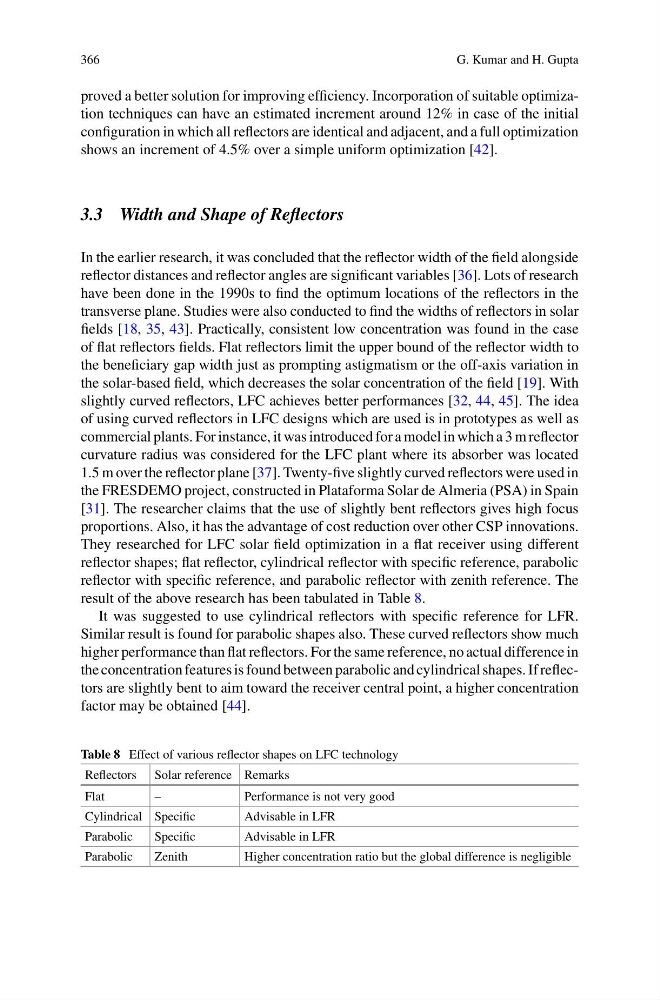
They researched for LFC solar field optimization in a flat receiver using different
reflector shapes; flat reflector, cylindrical reflector with specific reference, parabolic
reflector with specific reference, and parabolic reflector with zenith reference. The
result of the above research has been tabulated in Table 8.
It was suggested to use cylindrical reflectors with specific reference for LFR.
Similar result is found for parabolic shapes also. These curved reflectors show much
higher performance than flat reflectors. For the same reference, no actual difference in
the concentration features is found between parabolic and cylindrical shapes. If reflectors are slightly bent to aim toward the receiver central point, a higher concentration
factor may be obtained [44].
Table 8 Effect of various reflector shapes on LFC technology
Reflectors Solar reference Remarks
Flat
–
Performance is not very good
Cylindrical Specific
Advisable in LFR
Parabolic
Specific
Advisable in LFR
Parabolic
Zenith
Higher concentration ratio but the global difference is negligible
G. Kumar and H. Gupta
proved a better solution for improving efficiency. Incorporation of suitable optimization techniques can have an estimated increment around 12% in case of the initial
configuration in which all reflectors are identical and adjacent, and a full optimization
shows an increment of 4.5% over a simple uniform optimization [42].
3.3 Width and Shape of Reflectors
In the earlier research, it was concluded that the reflector width of the field alongside
reflector distances and reflector angles are significant variables [36]. Lots of research
have been done in the 1990s to find the optimum locations of the reflectors in the
transverse plane. Studies were also conducted to find the widths of reflectors in solar
fields [18, 35, 43]. Practically, consistent low concentration was found in the case
of flat reflectors fields. Flat reflectors limit the upper bound of the reflector width to
the beneficiary gap width just as prompting astigmatism or the off-axis variation in
the solar-based field, which decreases the solar concentration of the field [19]. With
slightly curved reflectors, LFC achieves better performances [32, 44, 45]. The idea
of using curved reflectors in LFC designs which are used is in prototypes as well as
commercial plants. For instance, it was introduced for a model in which a 3 m reflector
curvature radius was considered for the LFC plant where its absorber was located
1.5 m over the reflector plane [37]. Twenty-five slightly curved reflectors were used in
the FRESDEMO project, constructed in Plataforma Solar de Almeria (PSA) in Spain
[31]. The researcher claims that the use of slightly bent reflectors gives high focus
proportions. Also, it has the advantage of cost reduction over other CSP innovations.
They researched for LFC solar field optimization in a flat receiver using different
reflector shapes; flat reflector, cylindrical reflector with specific reference, parabolic
reflector with specific reference, and parabolic reflector with zenith reference. The
result of the above research has been tabulated in Table 8.
It was suggested to use cylindrical reflectors with specific reference for LFR.
Similar result is found for parabolic shapes also. These curved reflectors show much
higher performance than flat reflectors. For the same reference, no actual difference in
the concentration features is found between parabolic and cylindrical shapes. If reflectors are slightly bent to aim toward the receiver central point, a higher concentration
factor may be obtained [44].
Table 8 Effect of various reflector shapes on LFC technology
Reflectors Solar reference Remarks
Flat
–
Performance is not very good
Cylindrical Specific
Advisable in LFR
Parabolic
Specific
Advisable in LFR
Parabolic
Zenith
Higher concentration ratio but the global difference is negligible