

346
P. Sathavara et al.
while in this work Fletcher-Reeves expression is used
ϒ
i
=
t f
t=0 [S
i
(t)]
2 dt
t f
t=0 [S
i−1 (t)] 2 dt
with ϒ
0
= 0 for i = 0
(3c)
From Eq. (3b), when ϒ
i
= 0 for any i, the direction of descent d
i
(t) will be the
same as the directioof gradient, i.e., the ‘steepest descent’ method is achieved. We
can assure from the expression (3c) that the angle between negative gradient direction
and the direction of descent is less than 90°, so that the quantity S(t) is minimized
[16] which shows the convergence is guaranteed.
To carry out the iteration according to Eq. (3a), we need to calculate β
i and the
gradient of the quantity S(t). A sensitivity problem is solved to obtain β
i and S
i
(t).
An adjoint problem is solved to obtain S
i
(t). These two problems are derived in the
next sub-sections.
4.1 Sensitivity Problem and Search Step Size
For finding β
i and gradient, sensitivity problem needs to be solved. The solution can
be done by considering that the temperature T (x, t) is deviated by an amount T (x,
t), when the estimated quantity q(x, t) is deviated by q(x, t). Then, substituting
T (x, t) by [T (x, t) + T (x, t)] and q(x, t) by [q(x, t) + q(x, t)] in the Eq. (1a), and
then subtracting Eq. (1a) from the resulting equations, we obtained the sensitivity
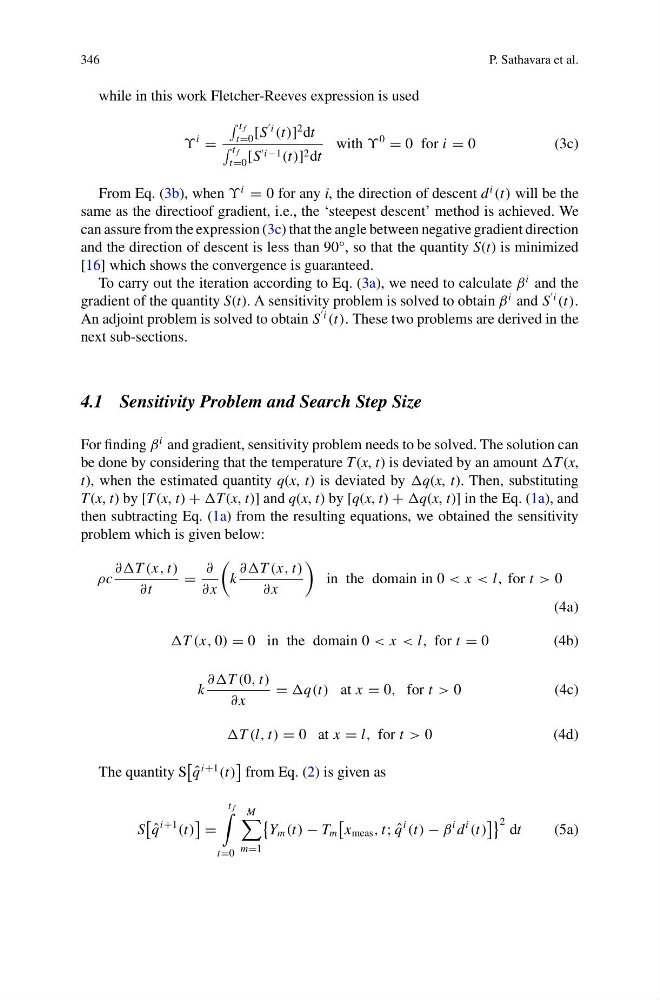
problem which is given below:
ρc
∂∂T (x, t)
∂t
=
∂
∂ x
k
∂∂T (x, t)
∂ x
in the domain in 0 < x < l, for t > 0
(4a)
T (x, 0) = 0 in the domain 0 < x < l, for t = 0
(4b)
k
∂∂T (0, t)
∂ x
= q(t) at x = 0, for t > 0
(4c)
T (l, t) = 0 at x = l, for t > 0
( 4 d )
The quantity S
ˆ
q
i+1
(t)
from Eq. (2) is given as
S
ˆ
q
i+1
(t)
=
t f
t=0
M
m=1
Y m (t) − T m
x meas , t; ˆ
q
i
(t) − β
i d
i
(t)
2 dt
(5a)
P. Sathavara et al.
while in this work Fletcher-Reeves expression is used
ϒ
i
=
t f
t=0 [S
i
(t)]
2 dt
t f
t=0 [S
i−1 (t)] 2 dt
with ϒ
0
= 0 for i = 0
(3c)
From Eq. (3b), when ϒ
i
= 0 for any i, the direction of descent d
i
(t) will be the
same as the directioof gradient, i.e., the ‘steepest descent’ method is achieved. We
can assure from the expression (3c) that the angle between negative gradient direction
and the direction of descent is less than 90°, so that the quantity S(t) is minimized
[16] which shows the convergence is guaranteed.
To carry out the iteration according to Eq. (3a), we need to calculate β
i and the
gradient of the quantity S(t). A sensitivity problem is solved to obtain β
i and S
i
(t).
An adjoint problem is solved to obtain S
i
(t). These two problems are derived in the
next sub-sections.
4.1 Sensitivity Problem and Search Step Size
For finding β
i and gradient, sensitivity problem needs to be solved. The solution can
be done by considering that the temperature T (x, t) is deviated by an amount T (x,
t), when the estimated quantity q(x, t) is deviated by q(x, t). Then, substituting
T (x, t) by [T (x, t) + T (x, t)] and q(x, t) by [q(x, t) + q(x, t)] in the Eq. (1a), and
then subtracting Eq. (1a) from the resulting equations, we obtained the sensitivity
problem which is given below:
ρc
∂∂T (x, t)
∂t
=
∂
∂ x
k
∂∂T (x, t)
∂ x
in the domain in 0 < x < l, for t > 0
(4a)
T (x, 0) = 0 in the domain 0 < x < l, for t = 0
(4b)
k
∂∂T (0, t)
∂ x
= q(t) at x = 0, for t > 0
(4c)
T (l, t) = 0 at x = l, for t > 0
( 4 d )
The quantity S
ˆ
q
i+1
(t)
from Eq. (2) is given as
S
ˆ
q
i+1
(t)
=
t f
t=0
M
m=1
Y m (t) − T m
x meas , t; ˆ
q
i
(t) − β
i d
i
(t)
2 dt
(5a)