

Emission and Performance Analysis of Four-Stroke Dual-Cylinder …
327
0.0000
0.0500
0.1000
0.1500
0.2000
0.2500
0.3000
0
1
2
3
4
5
6
7
8
9
Brake specific fuel consumpƟon
(gm/KW-s)
Brake power (KW)
B0
B05
B10
B10 (PLASTIC)
B20
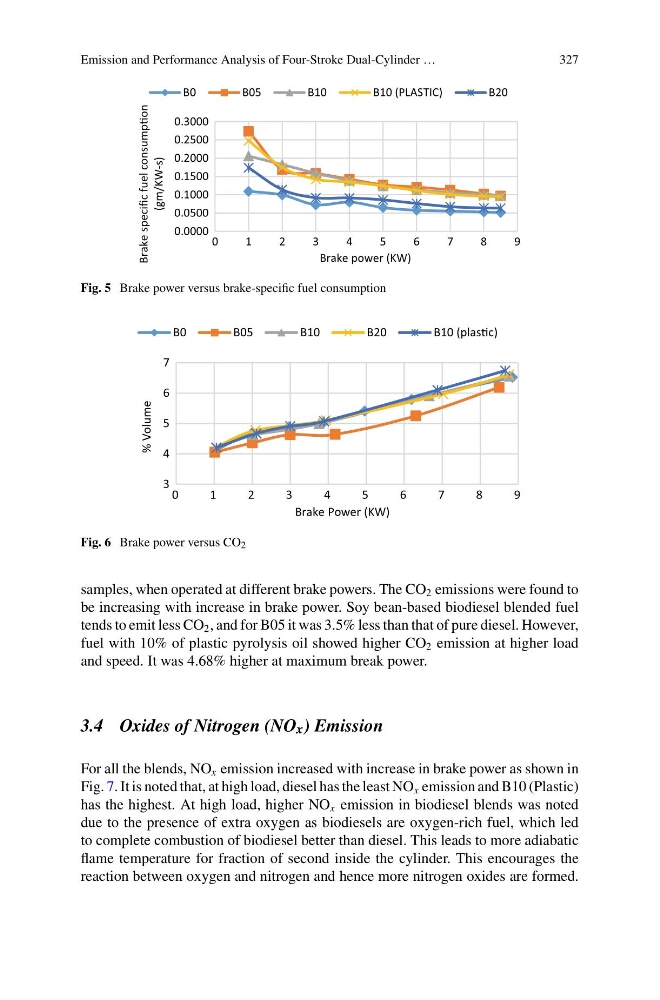
Fig. 5 Brake power versus brake-specific fuel consumption
3
4
5
6
7
0
1
2
3
4
5
6
7
8
9
% Volume
Brake Power (KW)
B0
B05
B10
B20
B10 (plasƟc)
Fig. 6 Brake power versus CO 2
samples, when operated at different brake powers. The CO 2 emissions were found to
be increasing with increase in brake power. Soy bean-based biodiesel blended fuel
tends to emit less CO 2 , and for B05 it was 3.5% less than that of pure diesel. However,
fuel with 10% of plastic pyrolysis oil showed higher CO 2 emission at higher load
and speed. It was 4.68% higher at maximum break power.
3.4 Oxides of Nitrogen (NO x ) Emission
For all the blends, NO x emission increased with increase in brake power as shown in
Fig. 7. It is noted that, at high load, diesel has the least NO x emission and B10 (Plastic)
has the highest. At high load, higher NO x emission in biodiesel blends was noted
due to the presence of extra oxygen as biodiesels are oxygen-rich fuel, which led
to complete combustion of biodiesel better than diesel. This leads to more adiabatic
flame temperature for fraction of second inside the cylinder. This encourages the
reaction between oxygen and nitrogen and hence more nitrogen oxides are formed.
327
0.0000
0.0500
0.1000
0.1500
0.2000
0.2500
0.3000
0
1
2
3
4
5
6
7
8
9
Brake specific fuel consumpƟon
(gm/KW-s)
Brake power (KW)
B0
B05
B10
B10 (PLASTIC)
B20
Fig. 5 Brake power versus brake-specific fuel consumption
3
4
5
6
7
0
1
2
3
4
5
6
7
8
9
% Volume
Brake Power (KW)
B0
B05
B10
B20
B10 (plasƟc)
Fig. 6 Brake power versus CO 2
samples, when operated at different brake powers. The CO 2 emissions were found to
be increasing with increase in brake power. Soy bean-based biodiesel blended fuel
tends to emit less CO 2 , and for B05 it was 3.5% less than that of pure diesel. However,
fuel with 10% of plastic pyrolysis oil showed higher CO 2 emission at higher load
and speed. It was 4.68% higher at maximum break power.
3.4 Oxides of Nitrogen (NO x ) Emission
For all the blends, NO x emission increased with increase in brake power as shown in
Fig. 7. It is noted that, at high load, diesel has the least NO x emission and B10 (Plastic)
has the highest. At high load, higher NO x emission in biodiesel blends was noted
due to the presence of extra oxygen as biodiesels are oxygen-rich fuel, which led
to complete combustion of biodiesel better than diesel. This leads to more adiabatic
flame temperature for fraction of second inside the cylinder. This encourages the
reaction between oxygen and nitrogen and hence more nitrogen oxides are formed.