

Estimation of Contact Conductance Between Two Dissimilar Metal …
319
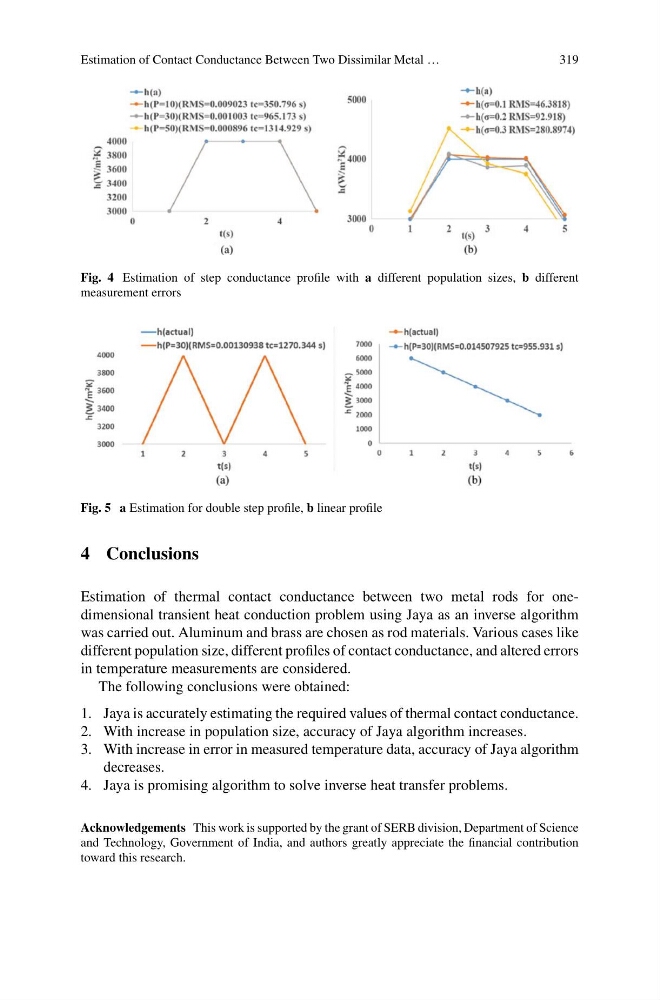
Fig. 4 Estimation of step conductance profile with a different population sizes, b different
measurement errors
Fig. 5 a Estimation for double step profile, b linear profile
4 Conclusions
Estimation of thermal contact conductance between two metal rods for onedimensional transient heat conduction problem using Jaya as an inverse algorithm
was carried out. Aluminum and brass are chosen as rod materials. Various cases like
different population size, different profiles of contact conductance, and altered errors
in temperature measurements are considered.
The following conclusions were obtained:
1. Jaya is accurately estimating the required values of thermal contact conductance.
2. With increase in population size, accuracy of Jaya algorithm increases.
3. With increase in error in measured temperature data, accuracy of Jaya algorithm
decreases.
4. Jaya is promising algorithm to solve inverse heat transfer problems.
Acknowledgements This work is supported by the grant of SERB division, Department of Science
and Technology, Government of India, and authors greatly appreciate the financial contribution
toward this research.
319
Fig. 4 Estimation of step conductance profile with a different population sizes, b different
measurement errors
Fig. 5 a Estimation for double step profile, b linear profile
4 Conclusions
Estimation of thermal contact conductance between two metal rods for onedimensional transient heat conduction problem using Jaya as an inverse algorithm
was carried out. Aluminum and brass are chosen as rod materials. Various cases like
different population size, different profiles of contact conductance, and altered errors
in temperature measurements are considered.
The following conclusions were obtained:
1. Jaya is accurately estimating the required values of thermal contact conductance.
2. With increase in population size, accuracy of Jaya algorithm increases.
3. With increase in error in measured temperature data, accuracy of Jaya algorithm
decreases.
4. Jaya is promising algorithm to solve inverse heat transfer problems.
Acknowledgements This work is supported by the grant of SERB division, Department of Science
and Technology, Government of India, and authors greatly appreciate the financial contribution
toward this research.