

300
A. A. Kadam et al.
2.1 Experimental Procedure
Bottled LPG fuel and zero-air grade (oxidizer) was procured and supplied to the
mixing chamber at ambient conditions. The pressure factor arising from domestic
LPG cylinder and the calibrated bottled LPG cylinder plays an important role from
operational point of view. The oxidizer (zero-air grade) had a built-in pressure of
100 bar, domestic LPG > 2 bar (for ≈ 26 m
3 capacity) and calibrated bottled LPG >
2 bar (for ≈ 2 m
3 capacity). Higher pressure levels of fuel and oxidizer cylinders was
reduced and regulated to near-ambient conditions by using a two-stage commercial
regulator. The fuel and air flow rates were set close to stoichiometric values obtained
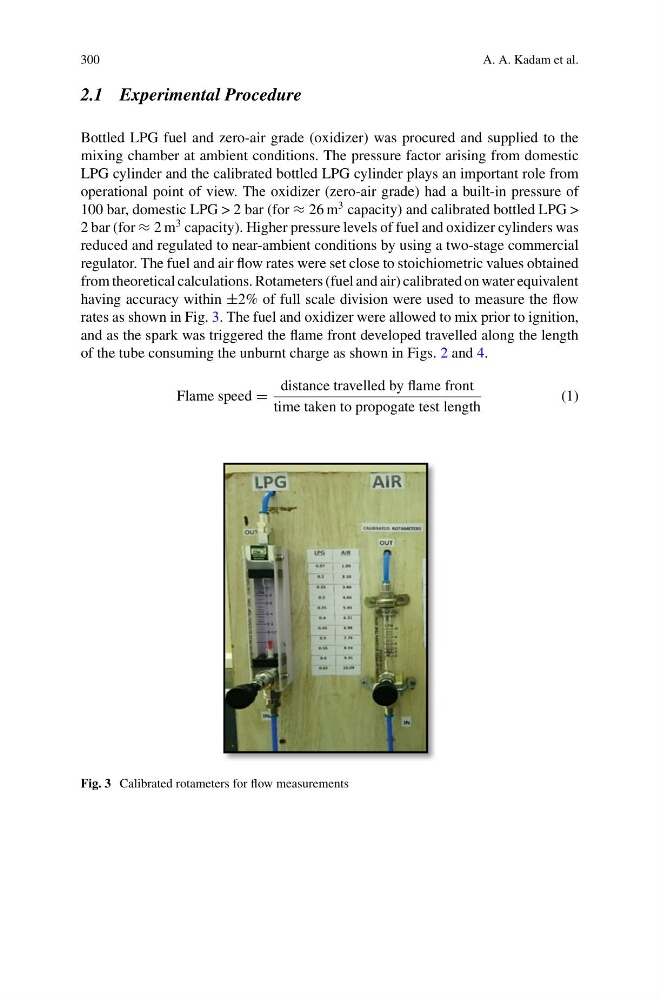
from theoretical calculations. Rotameters (fuel and air) calibrated on water equivalent
having accuracy within ±2% of full scale division were used to measure the flow
rates as shown in Fig. 3. The fuel and oxidizer were allowed to mix prior to ignition,
and as the spark was triggered the flame front developed travelled along the length
of the tube consuming the unburnt charge as shown in Figs. 2 and 4.
Flame speed =
distance travelled by flame front
time taken to propogate test length
(1)
Fig. 3 Calibrated rotameters for flow measurements
A. A. Kadam et al.
2.1 Experimental Procedure
Bottled LPG fuel and zero-air grade (oxidizer) was procured and supplied to the
mixing chamber at ambient conditions. The pressure factor arising from domestic
LPG cylinder and the calibrated bottled LPG cylinder plays an important role from
operational point of view. The oxidizer (zero-air grade) had a built-in pressure of
100 bar, domestic LPG > 2 bar (for ≈ 26 m
3 capacity) and calibrated bottled LPG >
2 bar (for ≈ 2 m
3 capacity). Higher pressure levels of fuel and oxidizer cylinders was
reduced and regulated to near-ambient conditions by using a two-stage commercial
regulator. The fuel and air flow rates were set close to stoichiometric values obtained
from theoretical calculations. Rotameters (fuel and air) calibrated on water equivalent
having accuracy within ±2% of full scale division were used to measure the flow
rates as shown in Fig. 3. The fuel and oxidizer were allowed to mix prior to ignition,
and as the spark was triggered the flame front developed travelled along the length
of the tube consuming the unburnt charge as shown in Figs. 2 and 4.
Flame speed =
distance travelled by flame front
time taken to propogate test length
(1)
Fig. 3 Calibrated rotameters for flow measurements