

Selection of Optimum Castor–Rapeseed Emulsified Fuel …
289
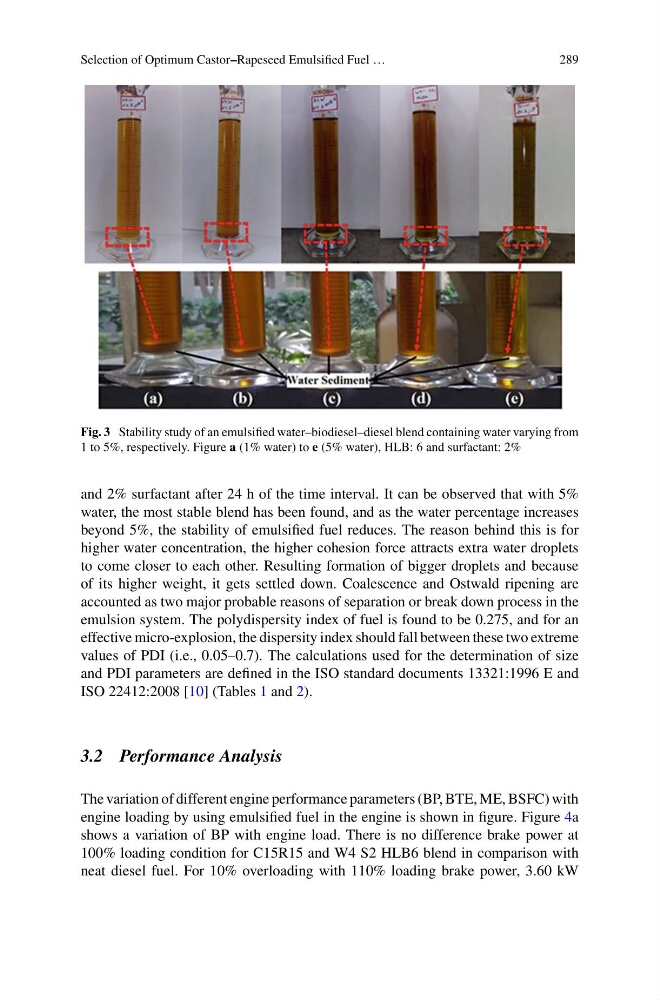
Fig. 3 Stability study of an emulsified water–biodiesel–diesel blend containing water varying from
1 to 5%, respectively. Figure a (1% water) to e (5% water), HLB: 6 and surfactant: 2%
and 2% surfactant after 24 h of the time interval. It can be observed that with 5%
water, the most stable blend has been found, and as the water percentage increases
beyond 5%, the stability of emulsified fuel reduces. The reason behind this is for
higher water concentration, the higher cohesion force attracts extra water droplets
to come closer to each other. Resulting formation of bigger droplets and because
of its higher weight, it gets settled down. Coalescence and Ostwald ripening are
accounted as two major probable reasons of separation or break down process in the
emulsion system. The polydispersity index of fuel is found to be 0.275, and for an
effective micro-explosion, the dispersity index should fall between these two extreme
values of PDI (i.e., 0.05–0.7). The calculations used for the determination of size
and PDI parameters are defined in the ISO standard documents 13321:1996 E and
ISO 22412:2008 [10] (Tables 1 and 2).
3.2 Performance Analysis
The variation of different engine performance parameters (BP, BTE, ME, BSFC) with
engine loading by using emulsified fuel in the engine is shown in figure. Figure 4a
shows a variation of BP with engine load. There is no difference brake power at
100% loading condition for C15R15 and W4 S2 HLB6 blend in comparison with
neat diesel fuel. For 10% overloading with 110% loading brake power, 3.60 kW
289
Fig. 3 Stability study of an emulsified water–biodiesel–diesel blend containing water varying from
1 to 5%, respectively. Figure a (1% water) to e (5% water), HLB: 6 and surfactant: 2%
and 2% surfactant after 24 h of the time interval. It can be observed that with 5%
water, the most stable blend has been found, and as the water percentage increases
beyond 5%, the stability of emulsified fuel reduces. The reason behind this is for
higher water concentration, the higher cohesion force attracts extra water droplets
to come closer to each other. Resulting formation of bigger droplets and because
of its higher weight, it gets settled down. Coalescence and Ostwald ripening are
accounted as two major probable reasons of separation or break down process in the
emulsion system. The polydispersity index of fuel is found to be 0.275, and for an
effective micro-explosion, the dispersity index should fall between these two extreme
values of PDI (i.e., 0.05–0.7). The calculations used for the determination of size
and PDI parameters are defined in the ISO standard documents 13321:1996 E and
ISO 22412:2008 [10] (Tables 1 and 2).
3.2 Performance Analysis
The variation of different engine performance parameters (BP, BTE, ME, BSFC) with
engine loading by using emulsified fuel in the engine is shown in figure. Figure 4a
shows a variation of BP with engine load. There is no difference brake power at
100% loading condition for C15R15 and W4 S2 HLB6 blend in comparison with
neat diesel fuel. For 10% overloading with 110% loading brake power, 3.60 kW