

Experimental Investigation of Heat Sinks with and Without …
277
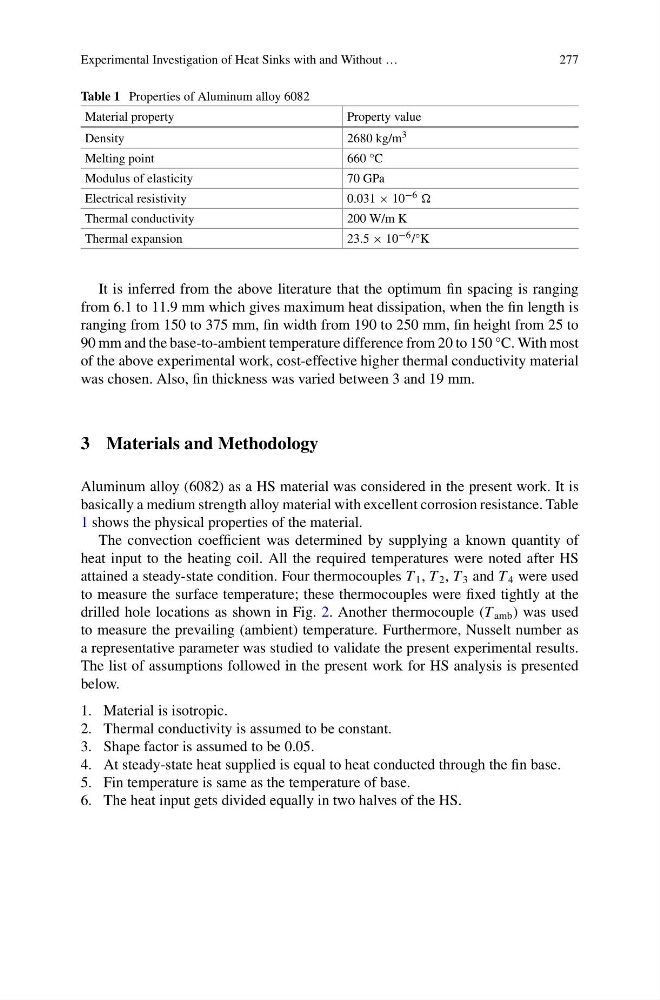
Table 1 Properties of Aluminum alloy 6082
Material property
Property value
Density
2680 kg/m 3
Melting point
660 °C
Modulus of elasticity
70 GPa
Electrical resistivity
0.031 × 10 −6
Thermal conductivity
200 W/m K
Thermal expansion
23.5 × 10 −6 /°K
It is inferred from the above literature that the optimum fin spacing is ranging
from 6.1 to 11.9 mm which gives maximum heat dissipation, when the fin length is
ranging from 150 to 375 mm, fin width from 190 to 250 mm, fin height from 25 to
90 mm and the base-to-ambient temperature difference from 20 to 150 °C. With most
of the above experimental work, cost-effective higher thermal conductivity material
was chosen. Also, fin thickness was varied between 3 and 19 mm.
3 Materials and Methodology
Aluminum alloy (6082) as a HS material was considered in the present work. It is
basically a medium strength alloy material with excellent corrosion resistance. Table
1 shows the physical properties of the material.
The convection coefficient was determined by supplying a known quantity of
heat input to the heating coil. All the required temperatures were noted after HS
attained a steady-state condition. Four thermocouples T 1 , T 2 , T 3 and T 4 were used
to measure the surface temperature; these thermocouples were fixed tightly at the
drilled hole locations as shown in Fig. 2. Another thermocouple (T amb ) was used
to measure the prevailing (ambient) temperature. Furthermore, Nusselt number as
a representative parameter was studied to validate the present experimental results.
The list of assumptions followed in the present work for HS analysis is presented
below.
1. Material is isotropic.
2. Thermal conductivity is assumed to be constant.
3. Shape factor is assumed to be 0.05.
4. At steady-state heat supplied is equal to heat conducted through the fin base.
5. Fin temperature is same as the temperature of base.
6. The heat input gets divided equally in two halves of the HS.
277
Table 1 Properties of Aluminum alloy 6082
Material property
Property value
Density
2680 kg/m 3
Melting point
660 °C
Modulus of elasticity
70 GPa
Electrical resistivity
0.031 × 10 −6
Thermal conductivity
200 W/m K
Thermal expansion
23.5 × 10 −6 /°K
It is inferred from the above literature that the optimum fin spacing is ranging
from 6.1 to 11.9 mm which gives maximum heat dissipation, when the fin length is
ranging from 150 to 375 mm, fin width from 190 to 250 mm, fin height from 25 to
90 mm and the base-to-ambient temperature difference from 20 to 150 °C. With most
of the above experimental work, cost-effective higher thermal conductivity material
was chosen. Also, fin thickness was varied between 3 and 19 mm.
3 Materials and Methodology
Aluminum alloy (6082) as a HS material was considered in the present work. It is
basically a medium strength alloy material with excellent corrosion resistance. Table
1 shows the physical properties of the material.
The convection coefficient was determined by supplying a known quantity of
heat input to the heating coil. All the required temperatures were noted after HS
attained a steady-state condition. Four thermocouples T 1 , T 2 , T 3 and T 4 were used
to measure the surface temperature; these thermocouples were fixed tightly at the
drilled hole locations as shown in Fig. 2. Another thermocouple (T amb ) was used
to measure the prevailing (ambient) temperature. Furthermore, Nusselt number as
a representative parameter was studied to validate the present experimental results.
The list of assumptions followed in the present work for HS analysis is presented
below.
1. Material is isotropic.
2. Thermal conductivity is assumed to be constant.
3. Shape factor is assumed to be 0.05.
4. At steady-state heat supplied is equal to heat conducted through the fin base.
5. Fin temperature is same as the temperature of base.
6. The heat input gets divided equally in two halves of the HS.