

Numerical Study of Slot Jet Impingement on a Cylinder …
259
Imraan and Sharma [10] carried out experimental as well as numerical studies
on a turbulent slot jet impingement on heated cylinder placed in a confined passage.
They considered this geometry for the design configuration of frost-free refrigerator.
They varied the non-dimensional width of confined passage, H/D from 2 to 22 while
maintaining the non-dimensional parameters at D/S = 1 for h/S = 5 and Re D varying
from 10,000 to 12,000. However, their comparison with the free stream case shows
that jet impingement with flow confinement gives higher rate of the heat transfer.
The objective of the present work is to demonstrate that accurate flow feature as well
as heat transfer characteristics can be obtained from turbulence slot jet impingement
on a heated cylinder obtained appropriate two-equation turbulence models.
2 Problem Statement and Computational Model
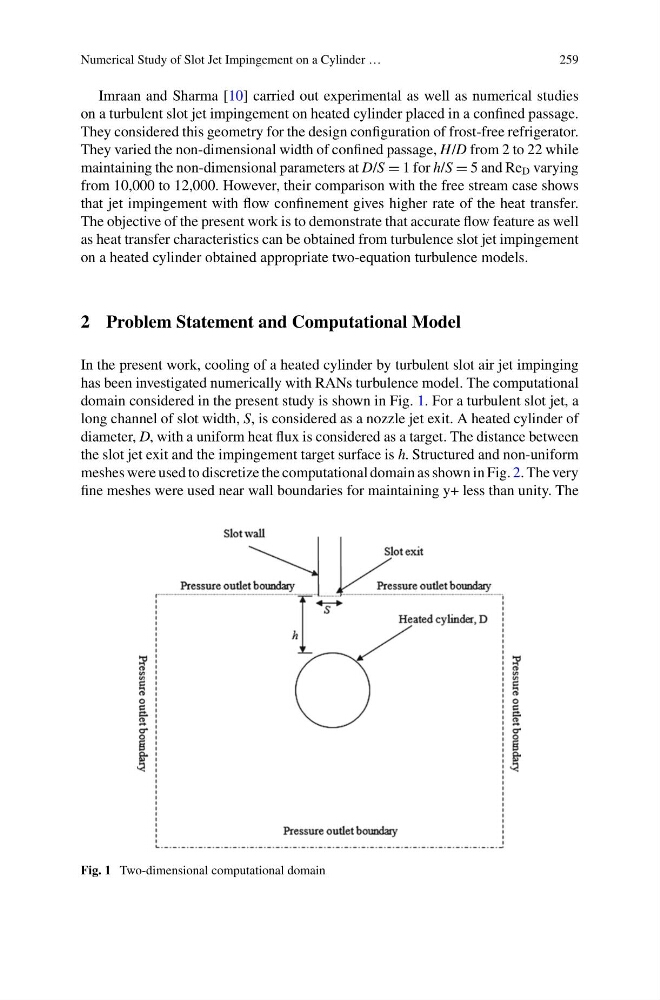
In the present work, cooling of a heated cylinder by turbulent slot air jet impinging
has been investigated numerically with RANs turbulence model. The computational
domain considered in the present study is shown in Fig. 1. For a turbulent slot jet, a
long channel of slot width, S, is considered as a nozzle jet exit. A heated cylinder of
diameter, D, with a uniform heat flux is considered as a target. The distance between
the slot jet exit and the impingement target surface is h. Structured and non-uniform
meshes were used to discretize the computational domain as shown in Fig. 2. The very
fine meshes were used near wall boundaries for maintaining y+ less than unity. The
Fig. 1 Two-dimensional computational domain
259
Imraan and Sharma [10] carried out experimental as well as numerical studies
on a turbulent slot jet impingement on heated cylinder placed in a confined passage.
They considered this geometry for the design configuration of frost-free refrigerator.
They varied the non-dimensional width of confined passage, H/D from 2 to 22 while
maintaining the non-dimensional parameters at D/S = 1 for h/S = 5 and Re D varying
from 10,000 to 12,000. However, their comparison with the free stream case shows
that jet impingement with flow confinement gives higher rate of the heat transfer.
The objective of the present work is to demonstrate that accurate flow feature as well
as heat transfer characteristics can be obtained from turbulence slot jet impingement
on a heated cylinder obtained appropriate two-equation turbulence models.
2 Problem Statement and Computational Model
In the present work, cooling of a heated cylinder by turbulent slot air jet impinging
has been investigated numerically with RANs turbulence model. The computational
domain considered in the present study is shown in Fig. 1. For a turbulent slot jet, a
long channel of slot width, S, is considered as a nozzle jet exit. A heated cylinder of
diameter, D, with a uniform heat flux is considered as a target. The distance between
the slot jet exit and the impingement target surface is h. Structured and non-uniform
meshes were used to discretize the computational domain as shown in Fig. 2. The very
fine meshes were used near wall boundaries for maintaining y+ less than unity. The
Fig. 1 Two-dimensional computational domain