

Design Improvement of a Vertically Oriented Thermal …
247
[1]. Due to early melting of PCM at the top region of the TES system, this zone
continues to store sensible energy instead of effectively contributing to the latent
heat storage by not allowing melting of PCM in the bottom zone of the TES system.
This is one of the reasons for the prolonged total melting time of PCM and limits
the fast storage rate of the TES system as a whole. It is thus aimed in the present
work to obtain an optimized geometric configuration (location and orientation of
partition) of TES system which can minimize the delay in storing energy as per the
capacity and avoid non-uniform melting of PCM. The objective is to maintain almost
comparable total melting time of both the zones (top and bottom regions) separated
by partition. Enhancement in the rate of energy storage with this method and physics
of it is discussed in terms of phase front propagation, total melting time and melt
fraction of the PCM.
2 Problem Statement
Vertically oriented shell- and tube-type latent heat-based TES system where PCM is
placed in the shell and HTF (water) flows in a tube is studied in the present work.
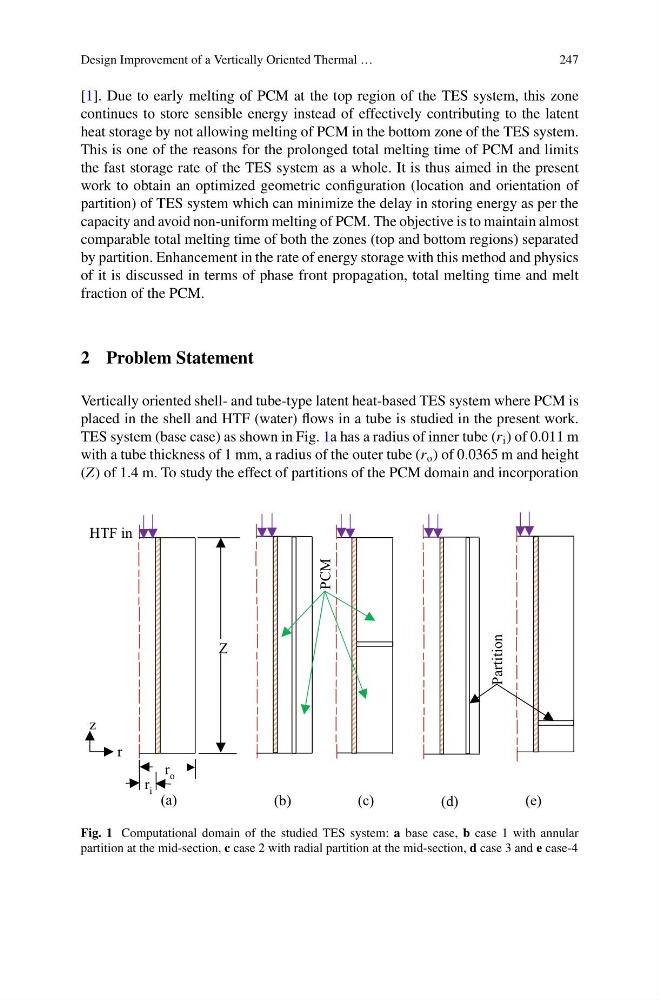
TES system (base case) as shown in Fig. 1a has a radius of inner tube (r i ) of 0.011 m
with a tube thickness of 1 mm, a radius of the outer tube (r o ) of 0.0365 m and height
(Z) of 1.4 m. To study the effect of partitions of the PCM domain and incorporation
r o
Z
r i
HTF in
z
r
PCM
Partition
(a)
(b)
(c)
(d)
(e)
Fig. 1 Computational domain of the studied TES system: a base case, b case 1 with annular
partition at the mid-section, c case 2 with radial partition at the mid-section, d case 3 and e case-4
247
[1]. Due to early melting of PCM at the top region of the TES system, this zone
continues to store sensible energy instead of effectively contributing to the latent
heat storage by not allowing melting of PCM in the bottom zone of the TES system.
This is one of the reasons for the prolonged total melting time of PCM and limits
the fast storage rate of the TES system as a whole. It is thus aimed in the present
work to obtain an optimized geometric configuration (location and orientation of
partition) of TES system which can minimize the delay in storing energy as per the
capacity and avoid non-uniform melting of PCM. The objective is to maintain almost
comparable total melting time of both the zones (top and bottom regions) separated
by partition. Enhancement in the rate of energy storage with this method and physics
of it is discussed in terms of phase front propagation, total melting time and melt
fraction of the PCM.
2 Problem Statement
Vertically oriented shell- and tube-type latent heat-based TES system where PCM is
placed in the shell and HTF (water) flows in a tube is studied in the present work.
TES system (base case) as shown in Fig. 1a has a radius of inner tube (r i ) of 0.011 m
with a tube thickness of 1 mm, a radius of the outer tube (r o ) of 0.0365 m and height
(Z) of 1.4 m. To study the effect of partitions of the PCM domain and incorporation
r o
Z
r i
HTF in
z
r
PCM
Partition
(a)
(b)
(c)
(d)
(e)
Fig. 1 Computational domain of the studied TES system: a base case, b case 1 with annular
partition at the mid-section, c case 2 with radial partition at the mid-section, d case 3 and e case-4