

238
F. de Monte and G. D’Alessandro
θ f (0) = 0
( 1 f )
where the Biot number Bi L simulates the insulating material on the sample backside
in contact with a fluid at T ∞ temperature, while the dimensionless variables are
defined as:
θ =
T − T in
q
f,0 L/k
, ˜
q
=
q
q
f,0
, ˜
x =
x
L
, ˜
t =
αt
L 2 , ˜
t h =
αt h
L 2 , θ ∞ =
T ∞ − T in
q
f,0 L/k
θ f =
T f − T in
q
f,0 L/k
, ˜
q
f =
q
f
q
f,0
, C R =
C f L f
C L
, ˜
R c =
R c
L/k
, Bi L =
h L
k/L
(2)
Equations (1b) and (1c) represent the BC of the 6th kind, where the former is
derived by applying the first law of thermodynamics to the heater; while the latter
takes into account the contact resistance at the interface thin heater/specimen. When
the sample is characterized by a very high thermal conductivity, for example, is a
metallic material, it results in k/L h L . In such a case, the Biot number tends to zero
and the 3rd kind BC defined by Eq. (1d) reduces to a perfect insulated condition
−
∂θ
∂ ˜
x
˜
x=1
= 0
˜
t > 0
(2a)
Then, using the numbering system proposed in [11, Chap. 2, 12], the above
problem may be indicated as X62B50T00. In detail, this number denotes a transient heat diffusion problem regarding a 1D rectangular finite body (by the “X”),
subject to a BC of the 6th kind at x = 0 (by the “6” in X62) with a time step change
in the applied surface heat flux (by the “5” in B50), and having a thermally insulated
boundary at x = L (type 2 BC by the “2” in X62, and zero heat flux by the “0” in
B50); also, T00 indicates a zero initial temperature for the two layers.
3.1 Temperature Solution
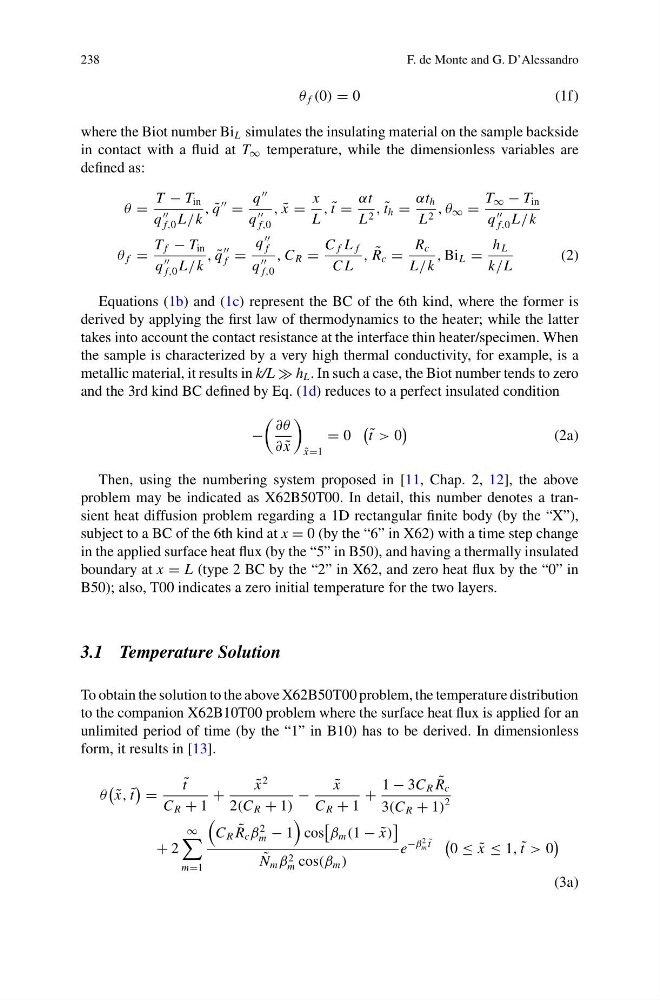
To obtain the solution to the above X62B50T00 problem, the temperature distribution
to the companion X62B10T00 problem where the surface heat flux is applied for an
unlimited period of time (by the “1” in B10) has to be derived. In dimensionless
form, it results in [13].
θ
˜
x, ˜
t
=
˜
t
C R + 1
+
˜
x
2
2(C R + 1)
−
˜
x
C R + 1
+
1 − 3C R ˜
R c
3(C R + 1)
2
+ 2
∞
m=1
C R ˜
R c β
2
m − 1
cos
β m (1 − ˜
x)
˜
N m β 2
m cos(β m )
e
−β
2
m
˜
t
0 ≤ ˜
x ≤ 1, ˜
t > 0
(3a)
F. de Monte and G. D’Alessandro
θ f (0) = 0
( 1 f )
where the Biot number Bi L simulates the insulating material on the sample backside
in contact with a fluid at T ∞ temperature, while the dimensionless variables are
defined as:
θ =
T − T in
q
f,0 L/k
, ˜
q
=
q
q
f,0
, ˜
x =
x
L
, ˜
t =
αt
L 2 , ˜
t h =
αt h
L 2 , θ ∞ =
T ∞ − T in
q
f,0 L/k
θ f =
T f − T in
q
f,0 L/k
, ˜
q
f =
q
f
q
f,0
, C R =
C f L f
C L
, ˜
R c =
R c
L/k
, Bi L =
h L
k/L
(2)
Equations (1b) and (1c) represent the BC of the 6th kind, where the former is
derived by applying the first law of thermodynamics to the heater; while the latter
takes into account the contact resistance at the interface thin heater/specimen. When
the sample is characterized by a very high thermal conductivity, for example, is a
metallic material, it results in k/L h L . In such a case, the Biot number tends to zero
and the 3rd kind BC defined by Eq. (1d) reduces to a perfect insulated condition
−
∂θ
∂ ˜
x
˜
x=1
= 0
˜
t > 0
(2a)
Then, using the numbering system proposed in [11, Chap. 2, 12], the above
problem may be indicated as X62B50T00. In detail, this number denotes a transient heat diffusion problem regarding a 1D rectangular finite body (by the “X”),
subject to a BC of the 6th kind at x = 0 (by the “6” in X62) with a time step change
in the applied surface heat flux (by the “5” in B50), and having a thermally insulated
boundary at x = L (type 2 BC by the “2” in X62, and zero heat flux by the “0” in
B50); also, T00 indicates a zero initial temperature for the two layers.
3.1 Temperature Solution
To obtain the solution to the above X62B50T00 problem, the temperature distribution
to the companion X62B10T00 problem where the surface heat flux is applied for an
unlimited period of time (by the “1” in B10) has to be derived. In dimensionless
form, it results in [13].
θ
˜
x, ˜
t
=
˜
t
C R + 1
+
˜
x
2
2(C R + 1)
−
˜
x
C R + 1
+
1 − 3C R ˜
R c
3(C R + 1)
2
+ 2
∞
m=1
C R ˜
R c β
2
m − 1
cos
β m (1 − ˜
x)
˜
N m β 2
m cos(β m )
e
−β
2
m
˜
t
0 ≤ ˜
x ≤ 1, ˜
t > 0
(3a)