

236
F. de Monte and G. D’Alessandro
Also, transient measurement methods are much faster than the corresponding
steady state ones and allow both conductivity and capacity (or conductivity/diffusivity and capacity/diffusivity) to be measured simultaneously [4].
In this paper, particular attention is focused on the plane source method [5–7],
whose experimental apparatus consists of a thin electrical heater sandwiched between
two identical samples. In particular, the heater is so thin that can be modelled as a
lumped body along the heat diffusion direction and, hence, by using a boundary
condition (BC) of the fourth or sixth kind at the heated surface of the specimen. The
backside boundary of the sample is thermally insulated. In detail, a BC of the 4th
kind or Carslaw type accounts for the heater heat capacity, while the one of the 6th
kind considers also the imperfect contact between heater and sample. The BC of the
6th kind is in general ignored in the specialized literature. Exceptions are Ref. [8,
p. 22] (where the boundary condition is not termed) and [9] (where it is termed as
“sixth kind” on p. 160).
Once the temperature distribution of the specimen is known through the use of
Laplace transform and principle of superposition (the latter only for finite heating
duration times during the experiment), the sensitivity coefficients of temperature with
respect to the parameters involved in the model can be computed. These sensitivity
coefficients appear not only in the iterative equation for estimating simultaneously k
and C but also in the D-optimum procedure here used when designing the optimal
experiment. This procedure is in fact based on the maximization of the X
T X determinant (where X denotes the sensitivity matrix) that allows the hypervolume of
the estimates confidence region to be minimized [1, Chap. 8]. Also, the standard
deviations of conductivity and capacity are computed.
2 Experimental Apparatus
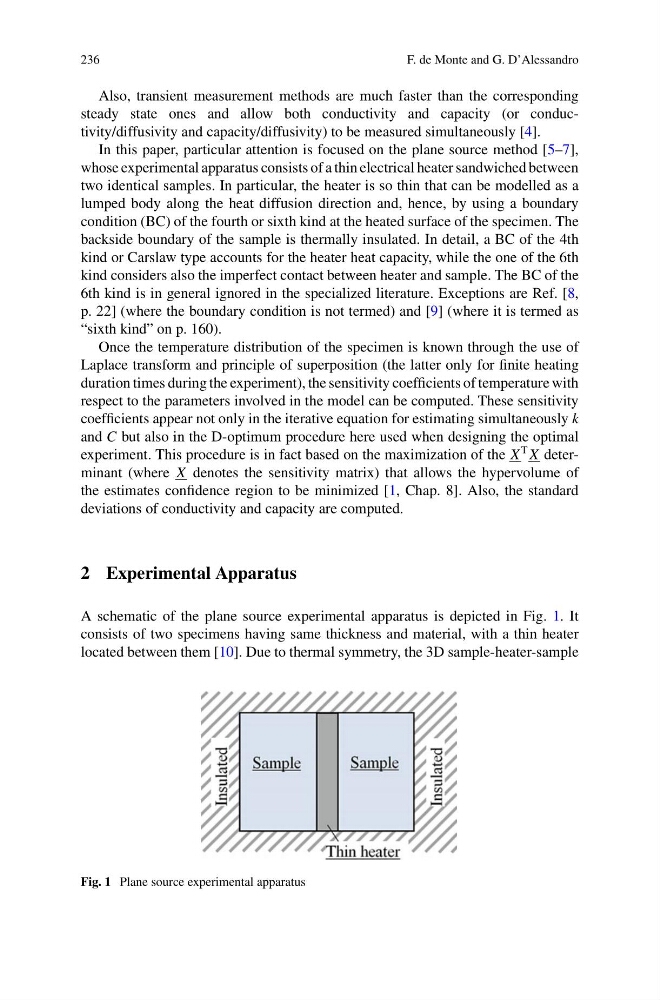
A schematic of the plane source experimental apparatus is depicted in Fig. 1. It
consists of two specimens having same thickness and material, with a thin heater
located between them [10]. Due to thermal symmetry, the 3D sample-heater-sample
Fig. 1 Plane source experimental apparatus
F. de Monte and G. D’Alessandro
Also, transient measurement methods are much faster than the corresponding
steady state ones and allow both conductivity and capacity (or conductivity/diffusivity and capacity/diffusivity) to be measured simultaneously [4].
In this paper, particular attention is focused on the plane source method [5–7],
whose experimental apparatus consists of a thin electrical heater sandwiched between
two identical samples. In particular, the heater is so thin that can be modelled as a
lumped body along the heat diffusion direction and, hence, by using a boundary
condition (BC) of the fourth or sixth kind at the heated surface of the specimen. The
backside boundary of the sample is thermally insulated. In detail, a BC of the 4th
kind or Carslaw type accounts for the heater heat capacity, while the one of the 6th
kind considers also the imperfect contact between heater and sample. The BC of the
6th kind is in general ignored in the specialized literature. Exceptions are Ref. [8,
p. 22] (where the boundary condition is not termed) and [9] (where it is termed as
“sixth kind” on p. 160).
Once the temperature distribution of the specimen is known through the use of
Laplace transform and principle of superposition (the latter only for finite heating
duration times during the experiment), the sensitivity coefficients of temperature with
respect to the parameters involved in the model can be computed. These sensitivity
coefficients appear not only in the iterative equation for estimating simultaneously k
and C but also in the D-optimum procedure here used when designing the optimal
experiment. This procedure is in fact based on the maximization of the X
T X determinant (where X denotes the sensitivity matrix) that allows the hypervolume of
the estimates confidence region to be minimized [1, Chap. 8]. Also, the standard
deviations of conductivity and capacity are computed.
2 Experimental Apparatus
A schematic of the plane source experimental apparatus is depicted in Fig. 1. It
consists of two specimens having same thickness and material, with a thin heater
located between them [10]. Due to thermal symmetry, the 3D sample-heater-sample
Fig. 1 Plane source experimental apparatus