

224
H. H. Jadav et al.
1 Introduction
Engineering applications in aerospace, automobile, marine and shipbuilding demand
for better fuel economy, reduced environmental pollution and recyclability. This has
resulted in increased usage of aluminum and magnesium alloys. Aluminum alloys
offer exciting properties like higher strength, lower density, better formability, excellent corrosion resistance and creep resistance. Magnesium alloys possess less density,
damping capacity and rigidity [1–6]. Thomas et al. in 1991 invented a solid-state
welding process known as friction stir welding (FSW) [7–9]. This process enables
welding of difficult to weld materials [7–9]. This process has gained acceptability as it
overcomes limitations of conventional fusion welding processes. The fusion welding
processes use fillers and shielding gas which may evolve fumes, causes spattering
and result in defects like porosity, cracking, inclusions, etc. FSW offers the possibility of welding materials which are difficult to weld with conventional welding
processes and dissimilar materials [7, 9]. Dissimilar aluminum and magnesium alloy
welding face a challenge due to the hard and brittle intermetallic compound (IMC)
formation which ultimately affects the joint quality. This issue of dissimilar welding
can be tackled by controlled heat input to maintain a lower temperature, controlling reaction time and temperature and by modifying IMC dispersion and preferential IMC formation with suitable filler selection [10–13]. Different researchers have
welded dissimilar aluminum and magnesium alloys with gas tungsten arc welding
(GTAW) [14–17], diffusion bonding [18–21], laser welding [22–24], cold metal
transfer (CMT) [25–28] and friction stir welding (FSW) [29–32]. Because of lower
processing temperature and solid-state nature, FSW is the preferred method. Limitations associated with FSW include the need of strong backing to compensate
for higher load, the varying temperature gradient across plate thickness, welding
complex geometry and the possibility of root defects [9, 33–36]. To overcome these
issues associated with FSW, Bobbin tool friction stir welding (BTFSW), a variation of FSW, is proposed. Bobbin tool FSW (BTFSW) is also known as bobbin
FSW (BFSW), self-reacting FSW (SRFSW), self-support FSW (SSFSW). BTFSW
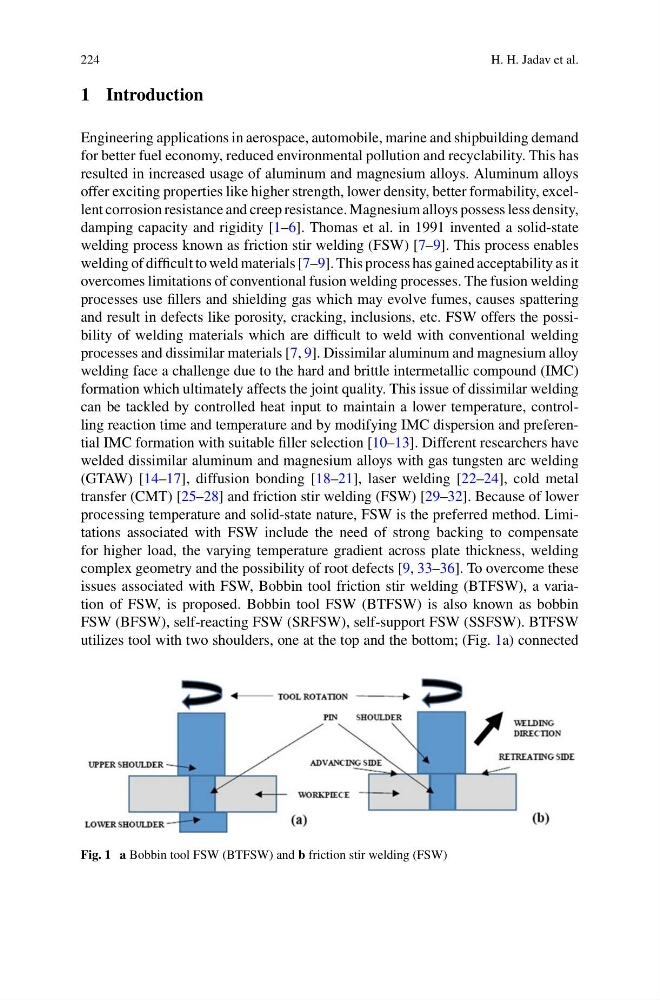
utilizes tool with two shoulders, one at the top and the bottom; (Fig. 1a) connected
Fig. 1 a Bobbin tool FSW (BTFSW) and b friction stir welding (FSW)
H. H. Jadav et al.
1 Introduction
Engineering applications in aerospace, automobile, marine and shipbuilding demand
for better fuel economy, reduced environmental pollution and recyclability. This has
resulted in increased usage of aluminum and magnesium alloys. Aluminum alloys
offer exciting properties like higher strength, lower density, better formability, excellent corrosion resistance and creep resistance. Magnesium alloys possess less density,
damping capacity and rigidity [1–6]. Thomas et al. in 1991 invented a solid-state
welding process known as friction stir welding (FSW) [7–9]. This process enables
welding of difficult to weld materials [7–9]. This process has gained acceptability as it
overcomes limitations of conventional fusion welding processes. The fusion welding
processes use fillers and shielding gas which may evolve fumes, causes spattering
and result in defects like porosity, cracking, inclusions, etc. FSW offers the possibility of welding materials which are difficult to weld with conventional welding
processes and dissimilar materials [7, 9]. Dissimilar aluminum and magnesium alloy
welding face a challenge due to the hard and brittle intermetallic compound (IMC)
formation which ultimately affects the joint quality. This issue of dissimilar welding
can be tackled by controlled heat input to maintain a lower temperature, controlling reaction time and temperature and by modifying IMC dispersion and preferential IMC formation with suitable filler selection [10–13]. Different researchers have
welded dissimilar aluminum and magnesium alloys with gas tungsten arc welding
(GTAW) [14–17], diffusion bonding [18–21], laser welding [22–24], cold metal
transfer (CMT) [25–28] and friction stir welding (FSW) [29–32]. Because of lower
processing temperature and solid-state nature, FSW is the preferred method. Limitations associated with FSW include the need of strong backing to compensate
for higher load, the varying temperature gradient across plate thickness, welding
complex geometry and the possibility of root defects [9, 33–36]. To overcome these
issues associated with FSW, Bobbin tool friction stir welding (BTFSW), a variation of FSW, is proposed. Bobbin tool FSW (BTFSW) is also known as bobbin
FSW (BFSW), self-reacting FSW (SRFSW), self-support FSW (SSFSW). BTFSW
utilizes tool with two shoulders, one at the top and the bottom; (Fig. 1a) connected
Fig. 1 a Bobbin tool FSW (BTFSW) and b friction stir welding (FSW)