

220
N. Patel et al.
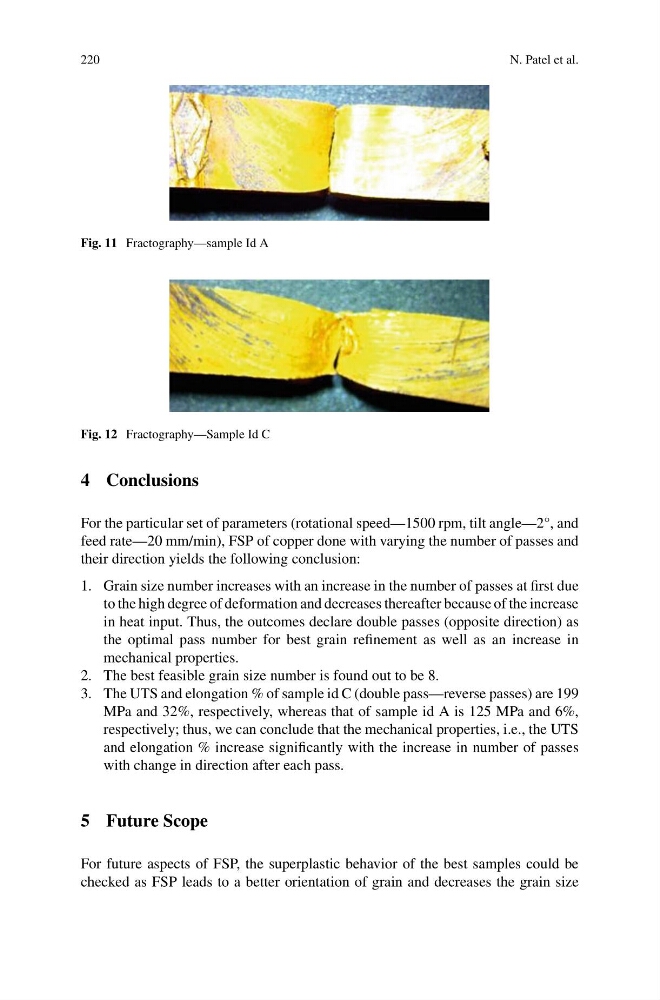
Fig. 11 Fractography—sample Id A
Fig. 12 Fractography—Sample Id C
4 Conclusions
For the particular set of parameters (rotational speed—1500 rpm, tilt angle—2°, and
feed rate—20 mm/min), FSP of copper done with varying the number of passes and
their direction yields the following conclusion:
1. Grain size number increases with an increase in the number of passes at first due
to the high degree of deformation and decreases thereafter because of the increase
in heat input. Thus, the outcomes declare double passes (opposite direction) as
the optimal pass number for best grain refinement as well as an increase in
mechanical properties.
2. The best feasible grain size number is found out to be 8.
3. The UTS and elongation % of sample id C (double pass—reverse passes) are 199
MPa and 32%, respectively, whereas that of sample id A is 125 MPa and 6%,
respectively; thus, we can conclude that the mechanical properties, i.e., the UTS
and elongation % increase significantly with the increase in number of passes
with change in direction after each pass.
5 Future Scope
For future aspects of FSP, the superplastic behavior of the best samples could be
checked as FSP leads to a better orientation of grain and decreases the grain size
N. Patel et al.
Fig. 11 Fractography—sample Id A
Fig. 12 Fractography—Sample Id C
4 Conclusions
For the particular set of parameters (rotational speed—1500 rpm, tilt angle—2°, and
feed rate—20 mm/min), FSP of copper done with varying the number of passes and
their direction yields the following conclusion:
1. Grain size number increases with an increase in the number of passes at first due
to the high degree of deformation and decreases thereafter because of the increase
in heat input. Thus, the outcomes declare double passes (opposite direction) as
the optimal pass number for best grain refinement as well as an increase in
mechanical properties.
2. The best feasible grain size number is found out to be 8.
3. The UTS and elongation % of sample id C (double pass—reverse passes) are 199
MPa and 32%, respectively, whereas that of sample id A is 125 MPa and 6%,
respectively; thus, we can conclude that the mechanical properties, i.e., the UTS
and elongation % increase significantly with the increase in number of passes
with change in direction after each pass.
5 Future Scope
For future aspects of FSP, the superplastic behavior of the best samples could be
checked as FSP leads to a better orientation of grain and decreases the grain size