

Grain Refinement and Improvement in Microhardness of AZ91 Mg …
201
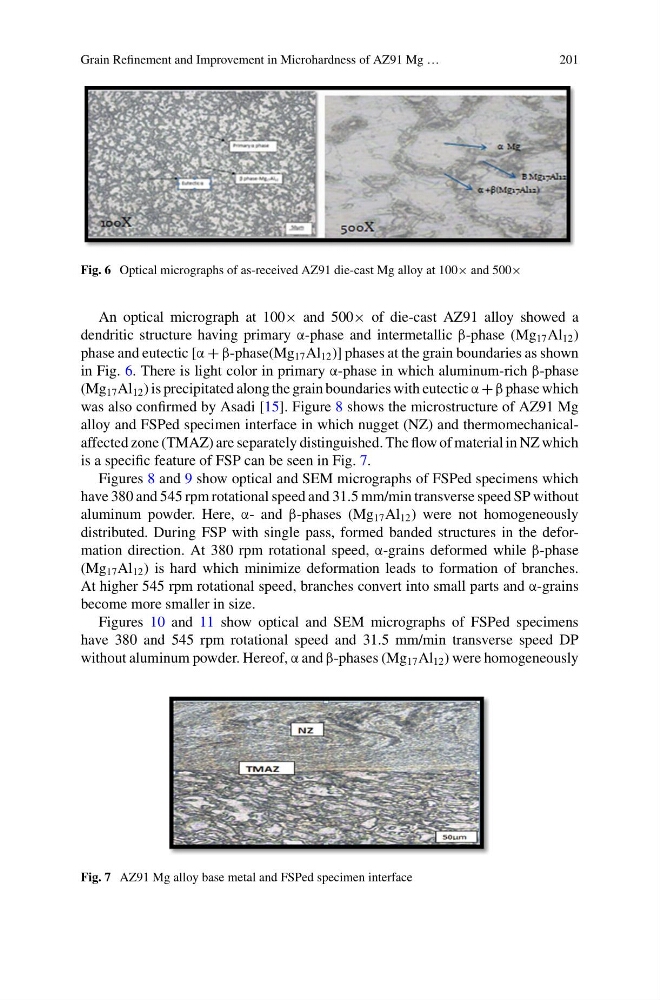
Fig. 6 Optical micrographs of as-received AZ91 die-cast Mg alloy at 100× and 500×
An optical micrograph at 100× and 500× of die-cast AZ91 alloy showed a
dendritic structure having primary α-phase and intermetallic β-phase (Mg 17 Al 12 )
phase and eutectic [α + β-phase(Mg 17 Al 12 )] phases at the grain boundaries as shown
in Fig. 6. There is light color in primary α-phase in which aluminum-rich β-phase
(Mg 17 Al 12 ) is precipitated along the grain boundaries with eutectic α + β phase which
was also confirmed by Asadi [15]. Figure 8 shows the microstructure of AZ91 Mg
alloy and FSPed specimen interface in which nugget (NZ) and thermomechanicalaffected zone (TMAZ) are separately distinguished. The flow of material in NZ which
is a specific feature of FSP can be seen in Fig. 7.
Figures 8 and 9 show optical and SEM micrographs of FSPed specimens which
have 380 and 545 rpm rotational speed and 31.5 mm/min transverse speed SP without
aluminum powder. Here, α- and β-phases (Mg 17 Al 12 ) were not homogeneously
distributed. During FSP with single pass, formed banded structures in the deformation direction. At 380 rpm rotational speed, α-grains deformed while β-phase
(Mg 17 Al 12 ) is hard which minimize deformation leads to formation of branches.
At higher 545 rpm rotational speed, branches convert into small parts and α-grains
become more smaller in size.
Figures 10 and 11 show optical and SEM micrographs of FSPed specimens
have 380 and 545 rpm rotational speed and 31.5 mm/min transverse speed DP
without aluminum powder. Hereof, α and β-phases (Mg 17 Al 12 ) were homogeneously
Fig. 7 AZ91 Mg alloy base metal and FSPed specimen interface
201
Fig. 6 Optical micrographs of as-received AZ91 die-cast Mg alloy at 100× and 500×
An optical micrograph at 100× and 500× of die-cast AZ91 alloy showed a
dendritic structure having primary α-phase and intermetallic β-phase (Mg 17 Al 12 )
phase and eutectic [α + β-phase(Mg 17 Al 12 )] phases at the grain boundaries as shown
in Fig. 6. There is light color in primary α-phase in which aluminum-rich β-phase
(Mg 17 Al 12 ) is precipitated along the grain boundaries with eutectic α + β phase which
was also confirmed by Asadi [15]. Figure 8 shows the microstructure of AZ91 Mg
alloy and FSPed specimen interface in which nugget (NZ) and thermomechanicalaffected zone (TMAZ) are separately distinguished. The flow of material in NZ which
is a specific feature of FSP can be seen in Fig. 7.
Figures 8 and 9 show optical and SEM micrographs of FSPed specimens which
have 380 and 545 rpm rotational speed and 31.5 mm/min transverse speed SP without
aluminum powder. Here, α- and β-phases (Mg 17 Al 12 ) were not homogeneously
distributed. During FSP with single pass, formed banded structures in the deformation direction. At 380 rpm rotational speed, α-grains deformed while β-phase
(Mg 17 Al 12 ) is hard which minimize deformation leads to formation of branches.
At higher 545 rpm rotational speed, branches convert into small parts and α-grains
become more smaller in size.
Figures 10 and 11 show optical and SEM micrographs of FSPed specimens
have 380 and 545 rpm rotational speed and 31.5 mm/min transverse speed DP
without aluminum powder. Hereof, α and β-phases (Mg 17 Al 12 ) were homogeneously
Fig. 7 AZ91 Mg alloy base metal and FSPed specimen interface