

A Review of Challenges to Hastelloy – C Series Weld Overlay
165
from transformation sequences given by Cieslak et al. as shown in Table 5 due to the
use of multi-component liquidus projections.
3.2 Physical Property and Mechanical Property of Hastelloy
– C Series
The physical property of material can have a marked effect on welding like distortion,
the quality of the weld, penetration of weld as well as dilution, so it is necessary
to understand the basic difference in the physical property of the Hastelloy – C
series. A property such as thermal conductivity directly associates with the dilution,
phase formation, and solidification rate. Research shows that how the difference in
thermal conductivity of stainless steel and carbon steel affects the phase formation
and dilution. Changes in phase formation and dilution significantly affect the cost
of the equipment and mechanical properties, too. [20, 29] Property such as thermal
coefficient of expansion has a significant effect on distortion; high thermal coefficient
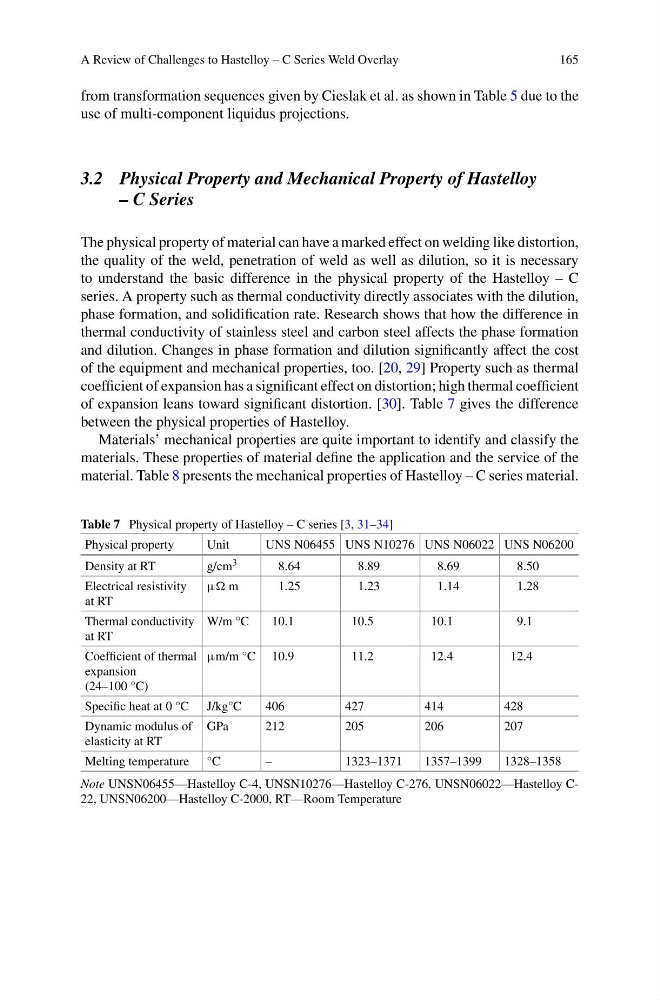
of expansion leans toward significant distortion. [30]. Table 7 gives the difference
between the physical properties of Hastelloy.
Materials’ mechanical properties are quite important to identify and classify the
materials. These properties of material define the application and the service of the
material. Table 8 presents the mechanical properties of Hastelloy – C series material.
Table 7 Physical property of Hastelloy – C series [3, 31–34]
Physical property
Unit
UNS N06455 UNS N10276 UNS N06022 UNS N06200
Density at RT
g/cm 3
8.64
8.89
8.69
8.50
Electrical resistivity
at RT
μ m
1.25
1.23
1.14
1.28
Thermal conductivity
at RT
W/m °C
10.1
10.5
10.1
9.1
Coefficient of thermal
expansion
(24–100 °C)
μm/m °C 10.9
11.2
12.4
12.4
Specific heat at 0 °C J/kg°C
406
427
414
428
Dynamic modulus of
elasticity at RT
GPa
212
205
206
207
Melting temperature °C
–
1323–1371
1357–1399
1328–1358
Note UNSN06455—Hastelloy C-4, UNSN10276—Hastelloy C-276, UNSN06022—Hastelloy C22, UNSN06200—Hastelloy C-2000, RT—Room Temperature
165
from transformation sequences given by Cieslak et al. as shown in Table 5 due to the
use of multi-component liquidus projections.
3.2 Physical Property and Mechanical Property of Hastelloy
– C Series
The physical property of material can have a marked effect on welding like distortion,
the quality of the weld, penetration of weld as well as dilution, so it is necessary
to understand the basic difference in the physical property of the Hastelloy – C
series. A property such as thermal conductivity directly associates with the dilution,
phase formation, and solidification rate. Research shows that how the difference in
thermal conductivity of stainless steel and carbon steel affects the phase formation
and dilution. Changes in phase formation and dilution significantly affect the cost
of the equipment and mechanical properties, too. [20, 29] Property such as thermal
coefficient of expansion has a significant effect on distortion; high thermal coefficient
of expansion leans toward significant distortion. [30]. Table 7 gives the difference
between the physical properties of Hastelloy.
Materials’ mechanical properties are quite important to identify and classify the
materials. These properties of material define the application and the service of the
material. Table 8 presents the mechanical properties of Hastelloy – C series material.
Table 7 Physical property of Hastelloy – C series [3, 31–34]
Physical property
Unit
UNS N06455 UNS N10276 UNS N06022 UNS N06200
Density at RT
g/cm 3
8.64
8.89
8.69
8.50
Electrical resistivity
at RT
μ m
1.25
1.23
1.14
1.28
Thermal conductivity
at RT
W/m °C
10.1
10.5
10.1
9.1
Coefficient of thermal
expansion
(24–100 °C)
μm/m °C 10.9
11.2
12.4
12.4
Specific heat at 0 °C J/kg°C
406
427
414
428
Dynamic modulus of
elasticity at RT
GPa
212
205
206
207
Melting temperature °C
–
1323–1371
1357–1399
1328–1358
Note UNSN06455—Hastelloy C-4, UNSN10276—Hastelloy C-276, UNSN06022—Hastelloy C22, UNSN06200—Hastelloy C-2000, RT—Room Temperature