

106
K. Badheka and V. J. Badheka
1 Introduction
Friction surfacing (FS) is a process of solid-state coating in the field of surface
engineering. Basically, the objective behind the development of the process is to alter
surface properties to improve the performance of components and its working life
[1]. Friction surfacing is first developed by Klopstock H. and Neelands A. R. which
is a machine tool based technology and adaptation of friction welding process [2].
Here the difference between the conventional friction welding and friction surfacing
process is that consumption of tool in friction surfacing [3, 4]. Friction surfacing has
a good benefit such as a good metallurgical bonding and forged microstructure, and
also, it can be performed in a verity of position due to the rapid cooling of deposit,
good reproducibility and a less operator skill is required in this process [5]. Here in
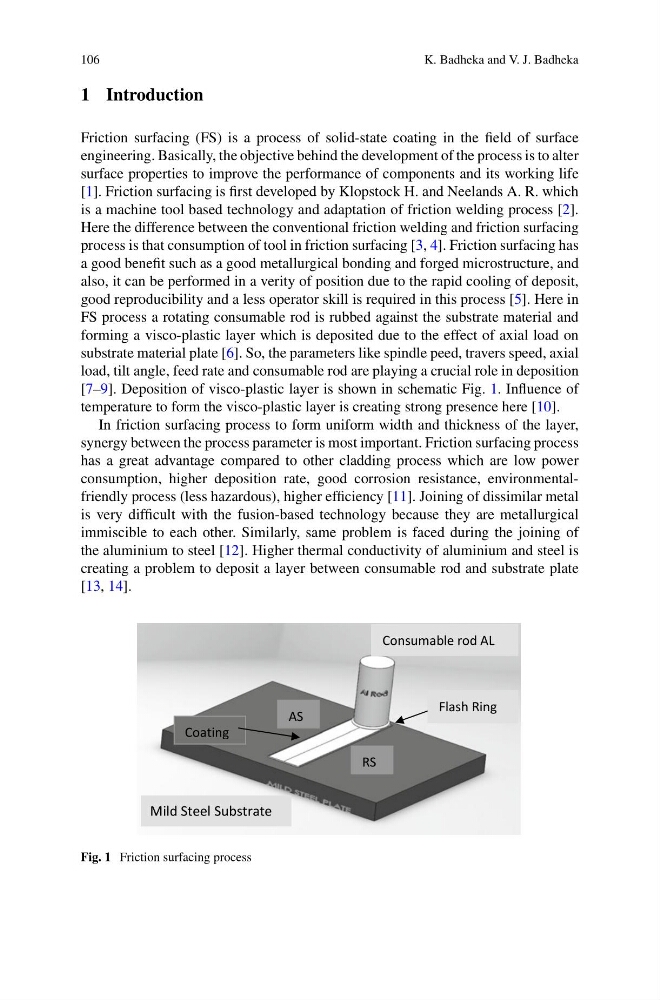
FS process a rotating consumable rod is rubbed against the substrate material and
forming a visco-plastic layer which is deposited due to the effect of axial load on
substrate material plate [6]. So, the parameters like spindle peed, travers speed, axial
load, tilt angle, feed rate and consumable rod are playing a crucial role in deposition
[7–9]. Deposition of visco-plastic layer is shown in schematic Fig. 1. Influence of
temperature to form the visco-plastic layer is creating strong presence here [10].
In friction surfacing process to form uniform width and thickness of the layer,
synergy between the process parameter is most important. Friction surfacing process
has a great advantage compared to other cladding process which are low power
consumption, higher deposition rate, good corrosion resistance, environmentalfriendly process (less hazardous), higher efficiency [11]. Joining of dissimilar metal
is very difficult with the fusion-based technology because they are metallurgical
immiscible to each other. Similarly, same problem is faced during the joining of
the aluminium to steel [12]. Higher thermal conductivity of aluminium and steel is
creating a problem to deposit a layer between consumable rod and substrate plate
[13, 14].
Consumable rod AL
AS
RS
Flash Ring
Coating
Mild Steel Substrate
Fig. 1 Friction surfacing process
K. Badheka and V. J. Badheka
1 Introduction
Friction surfacing (FS) is a process of solid-state coating in the field of surface
engineering. Basically, the objective behind the development of the process is to alter
surface properties to improve the performance of components and its working life
[1]. Friction surfacing is first developed by Klopstock H. and Neelands A. R. which
is a machine tool based technology and adaptation of friction welding process [2].
Here the difference between the conventional friction welding and friction surfacing
process is that consumption of tool in friction surfacing [3, 4]. Friction surfacing has
a good benefit such as a good metallurgical bonding and forged microstructure, and
also, it can be performed in a verity of position due to the rapid cooling of deposit,
good reproducibility and a less operator skill is required in this process [5]. Here in
FS process a rotating consumable rod is rubbed against the substrate material and
forming a visco-plastic layer which is deposited due to the effect of axial load on
substrate material plate [6]. So, the parameters like spindle peed, travers speed, axial
load, tilt angle, feed rate and consumable rod are playing a crucial role in deposition
[7–9]. Deposition of visco-plastic layer is shown in schematic Fig. 1. Influence of
temperature to form the visco-plastic layer is creating strong presence here [10].
In friction surfacing process to form uniform width and thickness of the layer,
synergy between the process parameter is most important. Friction surfacing process
has a great advantage compared to other cladding process which are low power
consumption, higher deposition rate, good corrosion resistance, environmentalfriendly process (less hazardous), higher efficiency [11]. Joining of dissimilar metal
is very difficult with the fusion-based technology because they are metallurgical
immiscible to each other. Similarly, same problem is faced during the joining of
the aluminium to steel [12]. Higher thermal conductivity of aluminium and steel is
creating a problem to deposit a layer between consumable rod and substrate plate
[13, 14].
Consumable rod AL
AS
RS
Flash Ring
Coating
Mild Steel Substrate
Fig. 1 Friction surfacing process