

Role of Surface Cracking and Recast Layer Deposition …
91
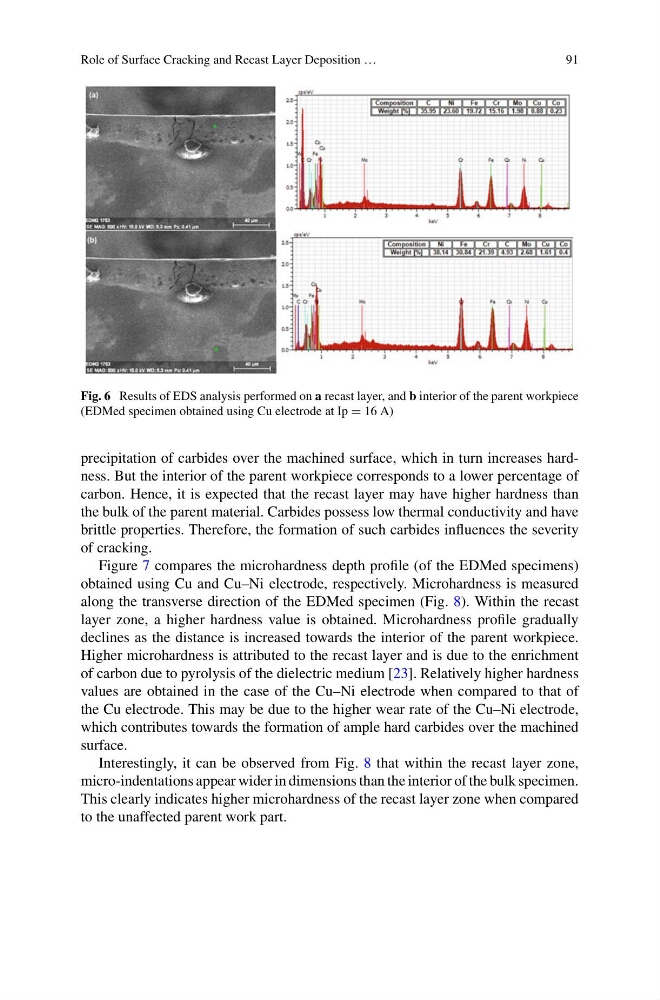
Fig. 6 Results of EDS analysis performed on a recast layer, and b interior of the parent workpiece
(EDMed specimen obtained using Cu electrode at Ip = 16 A)
precipitation of carbides over the machined surface, which in turn increases hardness. But the interior of the parent workpiece corresponds to a lower percentage of
carbon. Hence, it is expected that the recast layer may have higher hardness than
the bulk of the parent material. Carbides possess low thermal conductivity and have
brittle properties. Therefore, the formation of such carbides influences the severity
of cracking.
Figure 7 compares the microhardness depth profile (of the EDMed specimens)
obtained using Cu and Cu–Ni electrode, respectively. Microhardness is measured
along the transverse direction of the EDMed specimen (Fig. 8). Within the recast
layer zone, a higher hardness value is obtained. Microhardness profile gradually
declines as the distance is increased towards the interior of the parent workpiece.
Higher microhardness is attributed to the recast layer and is due to the enrichment
of carbon due to pyrolysis of the dielectric medium [23]. Relatively higher hardness
values are obtained in the case of the Cu–Ni electrode when compared to that of
the Cu electrode. This may be due to the higher wear rate of the Cu–Ni electrode,
which contributes towards the formation of ample hard carbides over the machined
surface.
Interestingly, it can be observed from Fig. 8 that within the recast layer zone,
micro-indentations appear wider in dimensions than the interior of the bulk specimen.
This clearly indicates higher microhardness of the recast layer zone when compared
to the unaffected parent work part.
91
Fig. 6 Results of EDS analysis performed on a recast layer, and b interior of the parent workpiece
(EDMed specimen obtained using Cu electrode at Ip = 16 A)
precipitation of carbides over the machined surface, which in turn increases hardness. But the interior of the parent workpiece corresponds to a lower percentage of
carbon. Hence, it is expected that the recast layer may have higher hardness than
the bulk of the parent material. Carbides possess low thermal conductivity and have
brittle properties. Therefore, the formation of such carbides influences the severity
of cracking.
Figure 7 compares the microhardness depth profile (of the EDMed specimens)
obtained using Cu and Cu–Ni electrode, respectively. Microhardness is measured
along the transverse direction of the EDMed specimen (Fig. 8). Within the recast
layer zone, a higher hardness value is obtained. Microhardness profile gradually
declines as the distance is increased towards the interior of the parent workpiece.
Higher microhardness is attributed to the recast layer and is due to the enrichment
of carbon due to pyrolysis of the dielectric medium [23]. Relatively higher hardness
values are obtained in the case of the Cu–Ni electrode when compared to that of
the Cu electrode. This may be due to the higher wear rate of the Cu–Ni electrode,
which contributes towards the formation of ample hard carbides over the machined
surface.
Interestingly, it can be observed from Fig. 8 that within the recast layer zone,
micro-indentations appear wider in dimensions than the interior of the bulk specimen.
This clearly indicates higher microhardness of the recast layer zone when compared
to the unaffected parent work part.