

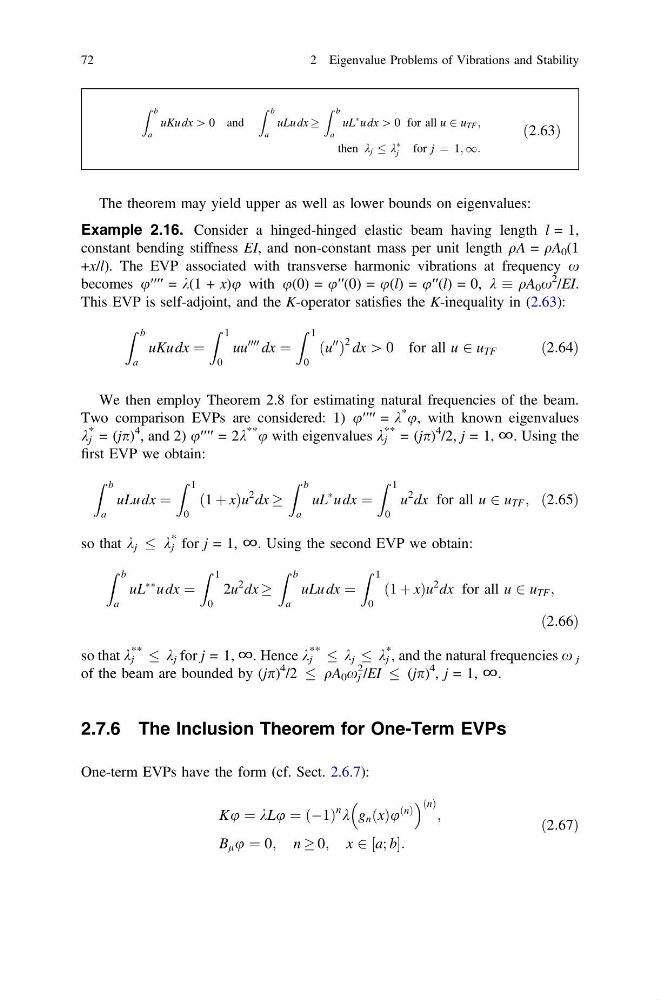
Z b
a
uKudx [ 0 and
Z b
a
uLudx !
Z b
a
uL
à udx [ 0 for all u 2 u TF ;
then k j k
Ã
j
for j ¼ 1; 1:
ð2:63Þ
The theorem may yield upper as well as lower bounds on eigenvalues:
Example 2.16. Consider a hinged-hinged elastic beam having length l = 1,
constant bending stiffness EI, and non-constant mass per unit length qA = qA 0 (1
+x/l). The EVP associated with transverse harmonic vibrations at frequency x
becomes u′′′′ = k(1 + x)u with u(0) = u′′(0) = u(l) = u′′(l) = 0, k qA 0 x
2 /EI.
This EVP is self-adjoint, and the K-operator satisfies the K-inequality in (2.63):
Z b
a
uKu dx ¼
Z 1
0
uu
0000 dx ¼
Z 1
0
ðu
00
Þ
2 dx [ 0 for all u 2 u TF
ð2:64Þ
We then employ Theorem 2.8 for estimating natural frequencies of the beam.
Two comparison EVPs are considered: 1) u′′′′ = k
* u, with known eigenvalues
k j
* = (jp)
4 , and 2) u′′′′ = 2k
** u with eigenvalues k j
** = (jp)
4 /2, j = 1, ∞. Using the
first EVP we obtain:
Z b
a
uLu dx ¼
Z 1
0
ð1 þ xÞu
2 dx !
Z b
a
uL
à udx ¼
Z 1
0
u
2 dx for all u 2 u TF ; ð2:65Þ
so that k j
k j
* for j = 1, ∞. Using the second EVP we obtain:
Z b
a
uL
ÃÃ udx ¼
Z 1
0
2u
2 dx !
Z b
a
uLu dx ¼
Z 1
0
ð1 þ xÞu
2 dx for all u 2 u TF ;
ð2:66Þ
so that k j
**
k j for j = 1, ∞. Hence k j
**
k j
k j
* , and the natural frequencies x j
of the beam are bounded by (jp)
4 /2
qA 0 x j
2 /EI
(jp)
4 , j = 1, ∞.
2.7.6 The Inclusion Theorem for One-Term EVPs
One-term EVPs have the form (cf. Sect. 2.6.7):
Ku ¼ kLu ¼ ðÀ1Þ
n k g n ðxÞu
ðnÞ
ðnÞ ;
B l u ¼ 0; n ! 0; x 2 a; b
½ :
ð2:67Þ
72
2 Eigenvalue Problems of Vibrations and Stability
a
uKudx [ 0 and
Z b
a
uLudx !
Z b
a
uL
à udx [ 0 for all u 2 u TF ;
then k j k
Ã
j
for j ¼ 1; 1:
ð2:63Þ
The theorem may yield upper as well as lower bounds on eigenvalues:
Example 2.16. Consider a hinged-hinged elastic beam having length l = 1,
constant bending stiffness EI, and non-constant mass per unit length qA = qA 0 (1
+x/l). The EVP associated with transverse harmonic vibrations at frequency x
becomes u′′′′ = k(1 + x)u with u(0) = u′′(0) = u(l) = u′′(l) = 0, k qA 0 x
2 /EI.
This EVP is self-adjoint, and the K-operator satisfies the K-inequality in (2.63):
Z b
a
uKu dx ¼
Z 1
0
uu
0000 dx ¼
Z 1
0
ðu
00
Þ
2 dx [ 0 for all u 2 u TF
ð2:64Þ
We then employ Theorem 2.8 for estimating natural frequencies of the beam.
Two comparison EVPs are considered: 1) u′′′′ = k
* u, with known eigenvalues
k j
* = (jp)
4 , and 2) u′′′′ = 2k
** u with eigenvalues k j
** = (jp)
4 /2, j = 1, ∞. Using the
first EVP we obtain:
Z b
a
uLu dx ¼
Z 1
0
ð1 þ xÞu
2 dx !
Z b
a
uL
à udx ¼
Z 1
0
u
2 dx for all u 2 u TF ; ð2:65Þ
so that k j
k j
* for j = 1, ∞. Using the second EVP we obtain:
Z b
a
uL
ÃÃ udx ¼
Z 1
0
2u
2 dx !
Z b
a
uLu dx ¼
Z 1
0
ð1 þ xÞu
2 dx for all u 2 u TF ;
ð2:66Þ
so that k j
**
k j for j = 1, ∞. Hence k j
**
k j
k j
* , and the natural frequencies x j
of the beam are bounded by (jp)
4 /2
qA 0 x j
2 /EI
(jp)
4 , j = 1, ∞.
2.7.6 The Inclusion Theorem for One-Term EVPs
One-term EVPs have the form (cf. Sect. 2.6.7):
Ku ¼ kLu ¼ ðÀ1Þ
n k g n ðxÞu
ðnÞ
ðnÞ ;
B l u ¼ 0; n ! 0; x 2 a; b
½ :
ð2:67Þ
72
2 Eigenvalue Problems of Vibrations and Stability