

that any two mode shapes u i and u j are orthogonal. To normalize these we require
that
R
u j Lu j dx ¼ 1, which yields B j
2 l/2 = 1. Thus u j ðxÞ ¼
ffiffiffiffiffiffi ffi
2=l
p
sinðx j x
cÞ are
orthonormal eigenfunctions (mode shapes) for the EVP.
2.7.4 Minimum Properties of the Eigenvalues
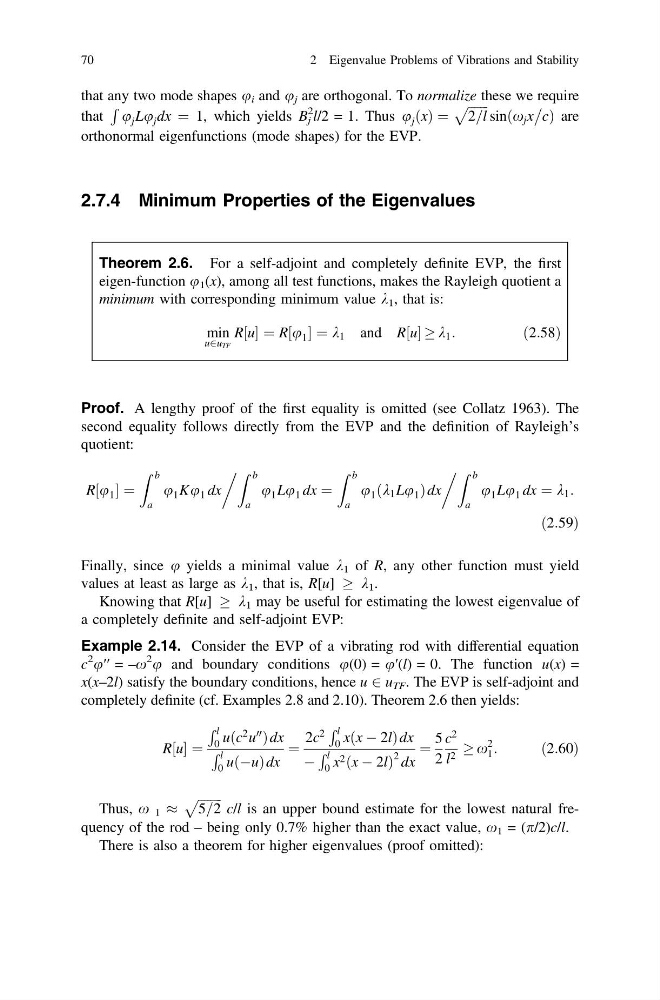
Theorem 2.6. For a self-adjoint and completely definite EVP, the first
eigen-function u 1 (x), among all test functions, makes the Rayleigh quotient a
minimum with corresponding minimum value k 1 , that is:
min
u2u TF
R½u ¼ R½u 1 ¼ k 1 and R½u ! k 1 :
ð2:58Þ
Proof. A lengthy proof of the first equality is omitted (see Collatz 1963). The
second equality follows directly from the EVP and the definition of Rayleigh’s
quotient:
R½u 1 ¼
Z b
a
u 1 Ku 1 dx
0Z b
a
u 1 Lu 1 dx ¼
Z b
a
u 1 k 1 Lu 1
ð
Þdx
0Z b
a
u 1 Lu 1 dx ¼ k 1 :
ð2:59Þ
Finally, since u yields a minimal value k 1 of R, any other function must yield
values at least as large as k 1 , that is, R[u] ! k 1 .
Knowing that R[u] ! k 1 may be useful for estimating the lowest eigenvalue of
a completely definite and self-adjoint EVP:
Example 2.14. Consider the EVP of a vibrating rod with differential equation
c
2 u′′ = –x
2 u and boundary conditions u(0) = u′(l) = 0. The function u(x) =
x(x–2l) satisfy the boundary conditions, hence u 2 u TF . The EVP is self-adjoint and
completely definite (cf. Examples 2.8 and 2.10). Theorem 2.6 then yields:
R u
½ ¼
R l
0 uðc
2 u
00
Þdx
R l
0 uðÀuÞ dx
¼
2c
2
R l
0 xðx À 2lÞdx
À
R l
0 x 2 ðx À 2lÞ
2 dx
¼
5
2
c
2
l 2 ! x
2
1 :
ð2:60Þ
Thus, x 1 %
ffiffiffiffiffiffiffi ffi
5=2
p
c/l is an upper bound estimate for the lowest natural frequency of the rod – being only 0.7% higher than the exact value, x 1 = (p/2)c/l.
There is also a theorem for higher eigenvalues (proof omitted):
70
2 Eigenvalue Problems of Vibrations and Stability
that
R
u j Lu j dx ¼ 1, which yields B j
2 l/2 = 1. Thus u j ðxÞ ¼
ffiffiffiffiffiffi ffi
2=l
p
sinðx j x
cÞ are
orthonormal eigenfunctions (mode shapes) for the EVP.
2.7.4 Minimum Properties of the Eigenvalues
Theorem 2.6. For a self-adjoint and completely definite EVP, the first
eigen-function u 1 (x), among all test functions, makes the Rayleigh quotient a
minimum with corresponding minimum value k 1 , that is:
min
u2u TF
R½u ¼ R½u 1 ¼ k 1 and R½u ! k 1 :
ð2:58Þ
Proof. A lengthy proof of the first equality is omitted (see Collatz 1963). The
second equality follows directly from the EVP and the definition of Rayleigh’s
quotient:
R½u 1 ¼
Z b
a
u 1 Ku 1 dx
0Z b
a
u 1 Lu 1 dx ¼
Z b
a
u 1 k 1 Lu 1
ð
Þdx
0Z b
a
u 1 Lu 1 dx ¼ k 1 :
ð2:59Þ
Finally, since u yields a minimal value k 1 of R, any other function must yield
values at least as large as k 1 , that is, R[u] ! k 1 .
Knowing that R[u] ! k 1 may be useful for estimating the lowest eigenvalue of
a completely definite and self-adjoint EVP:
Example 2.14. Consider the EVP of a vibrating rod with differential equation
c
2 u′′ = –x
2 u and boundary conditions u(0) = u′(l) = 0. The function u(x) =
x(x–2l) satisfy the boundary conditions, hence u 2 u TF . The EVP is self-adjoint and
completely definite (cf. Examples 2.8 and 2.10). Theorem 2.6 then yields:
R u
½ ¼
R l
0 uðc
2 u
00
Þdx
R l
0 uðÀuÞ dx
¼
2c
2
R l
0 xðx À 2lÞdx
À
R l
0 x 2 ðx À 2lÞ
2 dx
¼
5
2
c
2
l 2 ! x
2
1 :
ð2:60Þ
Thus, x 1 %
ffiffiffiffiffiffiffi ffi
5=2
p
c/l is an upper bound estimate for the lowest natural frequency of the rod – being only 0.7% higher than the exact value, x 1 = (p/2)c/l.
There is also a theorem for higher eigenvalues (proof omitted):
70
2 Eigenvalue Problems of Vibrations and Stability