

uðxÞ ¼ B sin xx=c þ w
ð
Þ ;
ð2:27Þ
to satisfy the boundary conditions (2.26). This gives the frequency equation:
cos xl=c
ð
Þ¼0;
ð2:28Þ
which is readily solved to yield:
x j ¼ ð2j À 1Þpc=ð2lÞ; j ¼ 1; 1:
ð2:29Þ
The corresponding eigenfunctions u j (x) are then given by (2.27):
u j ðxÞ ¼ B j sin x j x
c
À
Á ; j ¼ 1; 1:
ð2:30Þ
Hence, besides the trivial solution u(x, t) = 0 there are infinitely many nontrivial
solutions. These are oscillatory, with frequencies and mode shapes given by (2.29)
and (2.30) respectively.
2.5.2 Flexural Vibrations of Beams
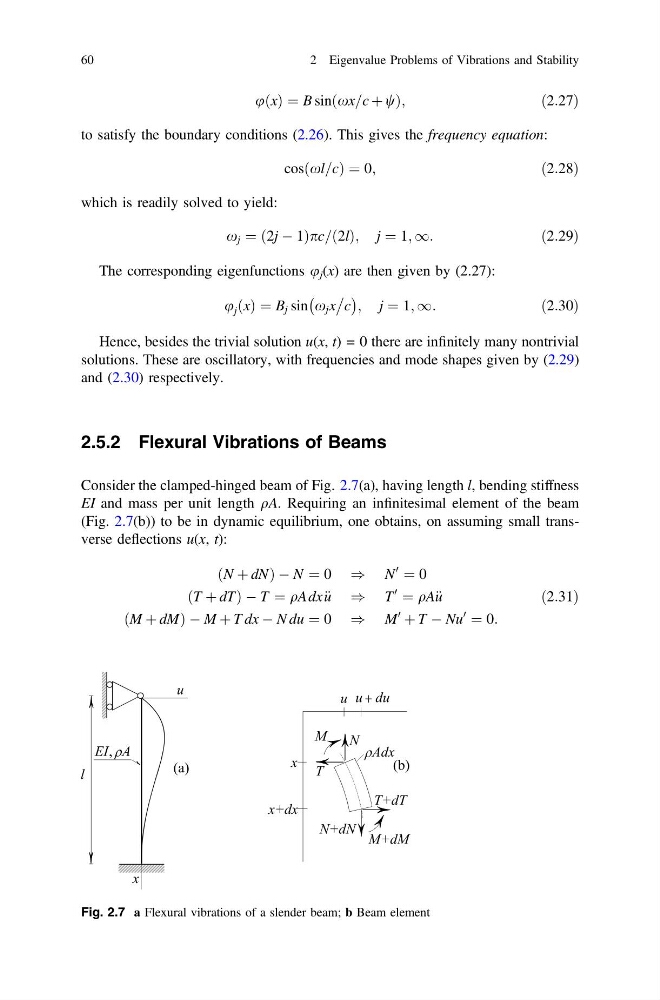
Consider the clamped-hinged beam of Fig. 2.7(a), having length l, bending stiffness
EI and mass per unit length qA. Requiring an infinitesimal element of the beam
(Fig. 2.7(b)) to be in dynamic equilibrium, one obtains, on assuming small transverse deflections u(x, t):
ðN þ dNÞ À N ¼ 0 ) N
0
¼ 0
ðT þ dTÞ À T ¼ qAdx€ u ) T
0
¼ qA€ u
ðM þ dMÞ À M þ T dx À N du ¼ 0 ) M
0
þ T À Nu
0
¼ 0:
ð2:31Þ
Fig. 2.7 a Flexural vibrations of a slender beam; b Beam element
60
2 Eigenvalue Problems of Vibrations and Stability
ð
Þ ;
ð2:27Þ
to satisfy the boundary conditions (2.26). This gives the frequency equation:
cos xl=c
ð
Þ¼0;
ð2:28Þ
which is readily solved to yield:
x j ¼ ð2j À 1Þpc=ð2lÞ; j ¼ 1; 1:
ð2:29Þ
The corresponding eigenfunctions u j (x) are then given by (2.27):
u j ðxÞ ¼ B j sin x j x
c
À
Á ; j ¼ 1; 1:
ð2:30Þ
Hence, besides the trivial solution u(x, t) = 0 there are infinitely many nontrivial
solutions. These are oscillatory, with frequencies and mode shapes given by (2.29)
and (2.30) respectively.
2.5.2 Flexural Vibrations of Beams
Consider the clamped-hinged beam of Fig. 2.7(a), having length l, bending stiffness
EI and mass per unit length qA. Requiring an infinitesimal element of the beam
(Fig. 2.7(b)) to be in dynamic equilibrium, one obtains, on assuming small transverse deflections u(x, t):
ðN þ dNÞ À N ¼ 0 ) N
0
¼ 0
ðT þ dTÞ À T ¼ qAdx€ u ) T
0
¼ qA€ u
ðM þ dMÞ À M þ T dx À N du ¼ 0 ) M
0
þ T À Nu
0
¼ 0:
ð2:31Þ
Fig. 2.7 a Flexural vibrations of a slender beam; b Beam element
60
2 Eigenvalue Problems of Vibrations and Stability