

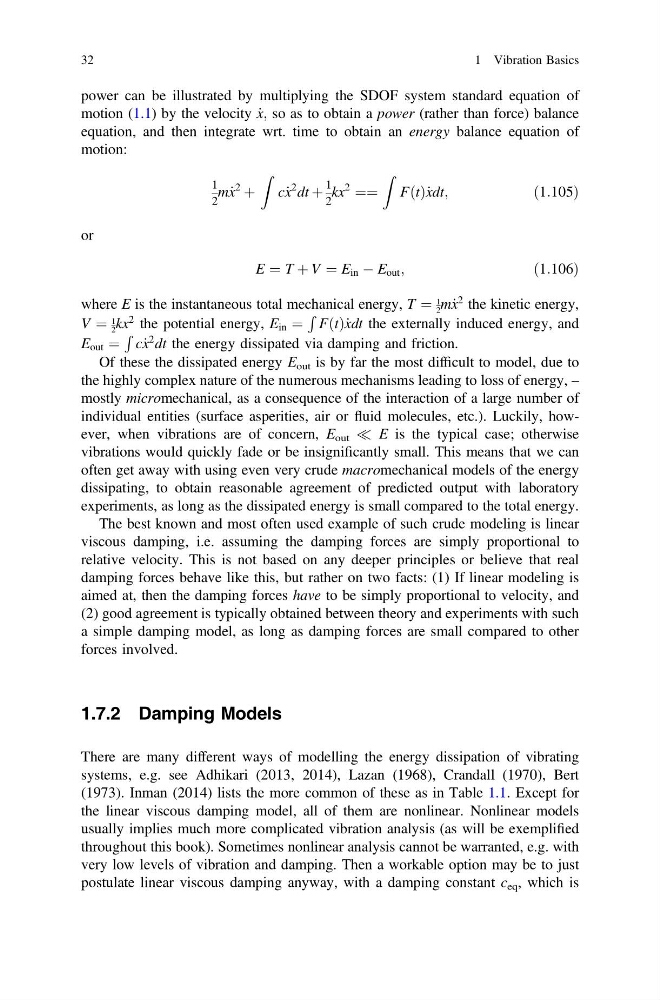
power can be illustrated by multiplying the SDOF system standard equation of
motion (1.1) by the velocity _
x; so as to obtain a power (rather than force) balance
equation, and then integrate wrt. time to obtain an energy balance equation of
motion:
1
2
m_ x
2
þ
Z
c_ x
2 dt þ
1
2
kx
2
¼¼
Z
FðtÞ_ xdt;
ð1:105Þ
or
E ¼ T þ V ¼ E in À E out ;
ð1:106Þ
where E is the instantaneous total mechanical energy, T ¼
1
2 m_ x
2 the kinetic energy,
V ¼
1
2 kx
2 the potential energy, E in ¼
R
FðtÞ_ xdt the externally induced energy, and
E out ¼
R
c_ x
2 dt the energy dissipated via damping and friction.
Of these the dissipated energy E out is by far the most difficult to model, due to
the highly complex nature of the numerous mechanisms leading to loss of energy, –
mostly micromechanical, as a consequence of the interaction of a large number of
individual entities (surface asperities, air or fluid molecules, etc.). Luckily, however, when vibrations are of concern, E out ( E is the typical case; otherwise
vibrations would quickly fade or be insignificantly small. This means that we can
often get away with using even very crude macromechanical models of the energy
dissipating, to obtain reasonable agreement of predicted output with laboratory
experiments, as long as the dissipated energy is small compared to the total energy.
The best known and most often used example of such crude modeling is linear
viscous damping, i.e. assuming the damping forces are simply proportional to
relative velocity. This is not based on any deeper principles or believe that real
damping forces behave like this, but rather on two facts: (1) If linear modeling is
aimed at, then the damping forces have to be simply proportional to velocity, and
(2) good agreement is typically obtained between theory and experiments with such
a simple damping model, as long as damping forces are small compared to other
forces involved.
1.7.2 Damping Models
There are many different ways of modelling the energy dissipation of vibrating
systems, e.g. see Adhikari (2013, 2014), Lazan (1968), Crandall (1970), Bert
(1973). Inman (2014) lists the more common of these as in Table 1.1. Except for
the linear viscous damping model, all of them are nonlinear. Nonlinear models
usually implies much more complicated vibration analysis (as will be exemplified
throughout this book). Sometimes nonlinear analysis cannot be warranted, e.g. with
very low levels of vibration and damping. Then a workable option may be to just
postulate linear viscous damping anyway, with a damping constant c eq , which is
32
1 Vibration Basics
motion (1.1) by the velocity _
x; so as to obtain a power (rather than force) balance
equation, and then integrate wrt. time to obtain an energy balance equation of
motion:
1
2
m_ x
2
þ
Z
c_ x
2 dt þ
1
2
kx
2
¼¼
Z
FðtÞ_ xdt;
ð1:105Þ
or
E ¼ T þ V ¼ E in À E out ;
ð1:106Þ
where E is the instantaneous total mechanical energy, T ¼
1
2 m_ x
2 the kinetic energy,
V ¼
1
2 kx
2 the potential energy, E in ¼
R
FðtÞ_ xdt the externally induced energy, and
E out ¼
R
c_ x
2 dt the energy dissipated via damping and friction.
Of these the dissipated energy E out is by far the most difficult to model, due to
the highly complex nature of the numerous mechanisms leading to loss of energy, –
mostly micromechanical, as a consequence of the interaction of a large number of
individual entities (surface asperities, air or fluid molecules, etc.). Luckily, however, when vibrations are of concern, E out ( E is the typical case; otherwise
vibrations would quickly fade or be insignificantly small. This means that we can
often get away with using even very crude macromechanical models of the energy
dissipating, to obtain reasonable agreement of predicted output with laboratory
experiments, as long as the dissipated energy is small compared to the total energy.
The best known and most often used example of such crude modeling is linear
viscous damping, i.e. assuming the damping forces are simply proportional to
relative velocity. This is not based on any deeper principles or believe that real
damping forces behave like this, but rather on two facts: (1) If linear modeling is
aimed at, then the damping forces have to be simply proportional to velocity, and
(2) good agreement is typically obtained between theory and experiments with such
a simple damping model, as long as damping forces are small compared to other
forces involved.
1.7.2 Damping Models
There are many different ways of modelling the energy dissipation of vibrating
systems, e.g. see Adhikari (2013, 2014), Lazan (1968), Crandall (1970), Bert
(1973). Inman (2014) lists the more common of these as in Table 1.1. Except for
the linear viscous damping model, all of them are nonlinear. Nonlinear models
usually implies much more complicated vibration analysis (as will be exemplified
throughout this book). Sometimes nonlinear analysis cannot be warranted, e.g. with
very low levels of vibration and damping. Then a workable option may be to just
postulate linear viscous damping anyway, with a damping constant c eq , which is
32
1 Vibration Basics