

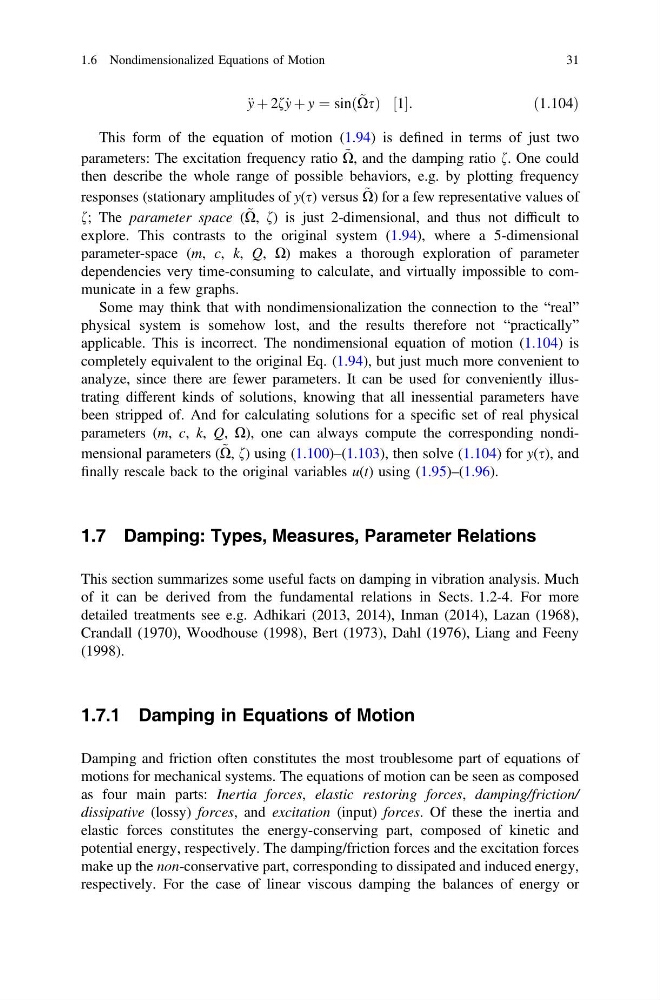
€ y þ 2f_ y þ y ¼ sinð ~
XsÞ 1
½ :
ð1:104Þ
This form of the equation of motion (1.94) is defined in terms of just two
parameters: The excitation frequency ratio ~
X, and the damping ratio f. One could
then describe the whole range of possible behaviors, e.g. by plotting frequency
responses (stationary amplitudes of y(s) versus ~
X) for a few representative values of
f; The parameter space ( ~
X, f) is just 2-dimensional, and thus not difficult to
explore. This contrasts to the original system (1.94), where a 5-dimensional
parameter-space (m, c, k, Q, X) makes a thorough exploration of parameter
dependencies very time-consuming to calculate, and virtually impossible to communicate in a few graphs.
Some may think that with nondimensionalization the connection to the “real”
physical system is somehow lost, and the results therefore not “practically”
applicable. This is incorrect. The nondimensional equation of motion (1.104) is
completely equivalent to the original Eq. (1.94), but just much more convenient to
analyze, since there are fewer parameters. It can be used for conveniently illustrating different kinds of solutions, knowing that all inessential parameters have
been stripped of. And for calculating solutions for a specific set of real physical
parameters (m, c, k, Q, X), one can always compute the corresponding nondimensional parameters ( ~
X, f) using (1.100)–(1.103), then solve (1.104) for y(s), and
finally rescale back to the original variables u(t) using (1.95)–(1.96).
1.7 Damping: Types, Measures, Parameter Relations
This section summarizes some useful facts on damping in vibration analysis. Much
of it can be derived from the fundamental relations in Sects. 1.2-4. For more
detailed treatments see e.g. Adhikari (2013, 2014), Inman (2014), Lazan (1968),
Crandall (1970), Woodhouse (1998), Bert (1973), Dahl (1976), Liang and Feeny
(1998).
1.7.1 Damping in Equations of Motion
Damping and friction often constitutes the most troublesome part of equations of
motions for mechanical systems. The equations of motion can be seen as composed
as four main parts: Inertia forces, elastic restoring forces, damping/friction/
dissipative (lossy) forces, and excitation (input) forces. Of these the inertia and
elastic forces constitutes the energy-conserving part, composed of kinetic and
potential energy, respectively. The damping/friction forces and the excitation forces
make up the non-conservative part, corresponding to dissipated and induced energy,
respectively. For the case of linear viscous damping the balances of energy or
1.6 Nondimensionalized Equations of Motion
31
XsÞ 1
½ :
ð1:104Þ
This form of the equation of motion (1.94) is defined in terms of just two
parameters: The excitation frequency ratio ~
X, and the damping ratio f. One could
then describe the whole range of possible behaviors, e.g. by plotting frequency
responses (stationary amplitudes of y(s) versus ~
X) for a few representative values of
f; The parameter space ( ~
X, f) is just 2-dimensional, and thus not difficult to
explore. This contrasts to the original system (1.94), where a 5-dimensional
parameter-space (m, c, k, Q, X) makes a thorough exploration of parameter
dependencies very time-consuming to calculate, and virtually impossible to communicate in a few graphs.
Some may think that with nondimensionalization the connection to the “real”
physical system is somehow lost, and the results therefore not “practically”
applicable. This is incorrect. The nondimensional equation of motion (1.104) is
completely equivalent to the original Eq. (1.94), but just much more convenient to
analyze, since there are fewer parameters. It can be used for conveniently illustrating different kinds of solutions, knowing that all inessential parameters have
been stripped of. And for calculating solutions for a specific set of real physical
parameters (m, c, k, Q, X), one can always compute the corresponding nondimensional parameters ( ~
X, f) using (1.100)–(1.103), then solve (1.104) for y(s), and
finally rescale back to the original variables u(t) using (1.95)–(1.96).
1.7 Damping: Types, Measures, Parameter Relations
This section summarizes some useful facts on damping in vibration analysis. Much
of it can be derived from the fundamental relations in Sects. 1.2-4. For more
detailed treatments see e.g. Adhikari (2013, 2014), Inman (2014), Lazan (1968),
Crandall (1970), Woodhouse (1998), Bert (1973), Dahl (1976), Liang and Feeny
(1998).
1.7.1 Damping in Equations of Motion
Damping and friction often constitutes the most troublesome part of equations of
motions for mechanical systems. The equations of motion can be seen as composed
as four main parts: Inertia forces, elastic restoring forces, damping/friction/
dissipative (lossy) forces, and excitation (input) forces. Of these the inertia and
elastic forces constitutes the energy-conserving part, composed of kinetic and
potential energy, respectively. The damping/friction forces and the excitation forces
make up the non-conservative part, corresponding to dissipated and induced energy,
respectively. For the case of linear viscous damping the balances of energy or
1.6 Nondimensionalized Equations of Motion
31