

managers of your department, who are uninterested in equations and only wants to
know what you think they mean, – and skilled senior scientists, whom the managers
might call up in case your calculations and conclusions needs revision.
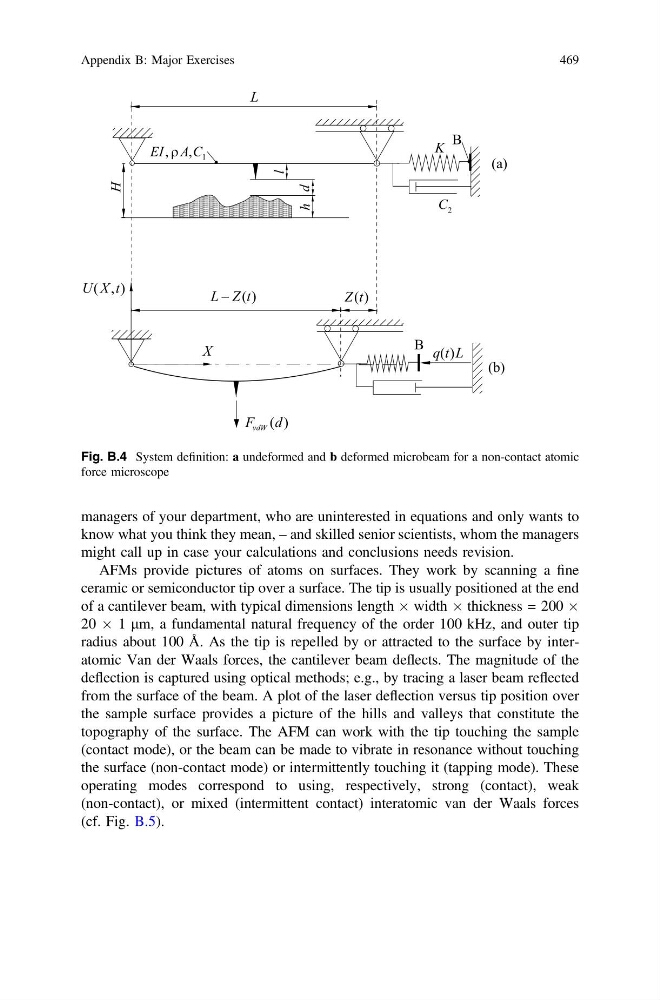
AFMs provide pictures of atoms on surfaces. They work by scanning a fine
ceramic or semiconductor tip over a surface. The tip is usually positioned at the end
of a cantilever beam, with typical dimensions length  width  thickness = 200 Â
20 Â 1 lm, a fundamental natural frequency of the order 100 kHz, and outer tip
radius about 100 Å. As the tip is repelled by or attracted to the surface by interatomic Van der Waals forces, the cantilever beam deflects. The magnitude of the
deflection is captured using optical methods; e.g., by tracing a laser beam reflected
from the surface of the beam. A plot of the laser deflection versus tip position over
the sample surface provides a picture of the hills and valleys that constitute the
topography of the surface. The AFM can work with the tip touching the sample
(contact mode), or the beam can be made to vibrate in resonance without touching
the surface (non-contact mode) or intermittently touching it (tapping mode). These
operating modes correspond to using, respectively, strong (contact), weak
(non-contact), or mixed (intermittent contact) interatomic van der Waals forces
(cf. Fig. B.5).
Fig. B.4 System definition: a undeformed and b deformed microbeam for a non-contact atomic
force microscope
Appendix B: Major Exercises
469
know what you think they mean, – and skilled senior scientists, whom the managers
might call up in case your calculations and conclusions needs revision.
AFMs provide pictures of atoms on surfaces. They work by scanning a fine
ceramic or semiconductor tip over a surface. The tip is usually positioned at the end
of a cantilever beam, with typical dimensions length  width  thickness = 200 Â
20 Â 1 lm, a fundamental natural frequency of the order 100 kHz, and outer tip
radius about 100 Å. As the tip is repelled by or attracted to the surface by interatomic Van der Waals forces, the cantilever beam deflects. The magnitude of the
deflection is captured using optical methods; e.g., by tracing a laser beam reflected
from the surface of the beam. A plot of the laser deflection versus tip position over
the sample surface provides a picture of the hills and valleys that constitute the
topography of the surface. The AFM can work with the tip touching the sample
(contact mode), or the beam can be made to vibrate in resonance without touching
the surface (non-contact mode) or intermittently touching it (tapping mode). These
operating modes correspond to using, respectively, strong (contact), weak
(non-contact), or mixed (intermittent contact) interatomic van der Waals forces
(cf. Fig. B.5).
Fig. B.4 System definition: a undeformed and b deformed microbeam for a non-contact atomic
force microscope
Appendix B: Major Exercises
469