

DZ %
1
2
Z L
0
U
0
ð Þ
2 dX for U
0
ð Þ
2 \\1:
ðB:11Þ
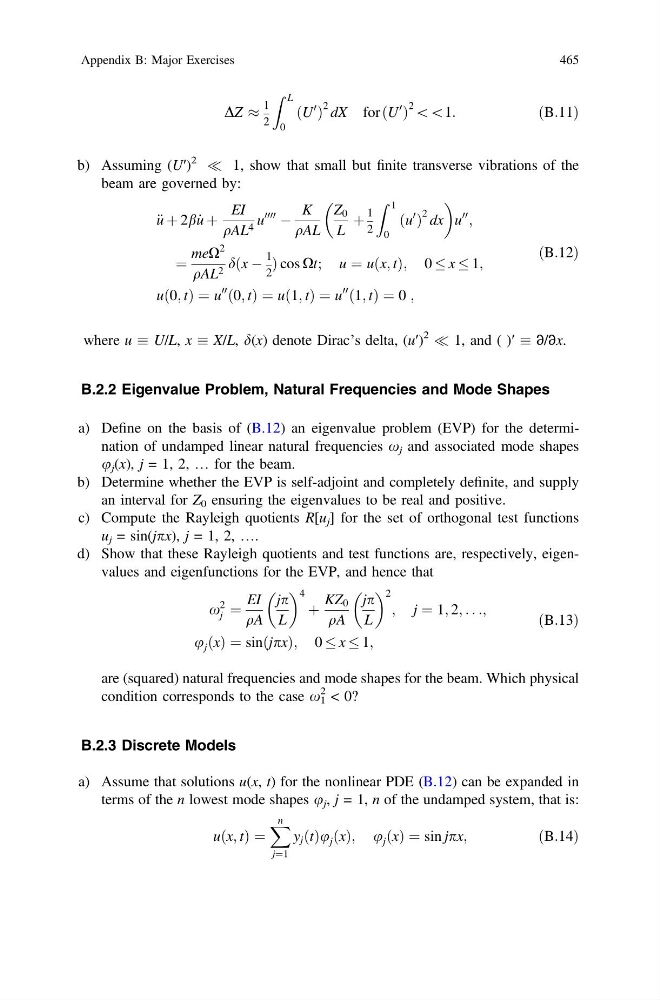
b) Assuming (U′)
2
( 1, show that small but finite transverse vibrations of the
beam are governed by:
€ u þ 2b _
u þ
EI
qAL 4 u
0000
À
K
qAL
Z 0
L
þ
1
2
Z 1
0
u
0
ð Þ
2 dx
u
00
;
¼
meX
2
qAL 2 dðx À
1
2
Þ cos Xt; u ¼ uðx; tÞ; 0 x 1;
uð0; tÞ ¼ u
00
ð0; tÞ ¼ uð1; tÞ ¼ u
00
ð1; tÞ ¼ 0 ;
ðB:12Þ
where u U/L, x X/L, d(x) denote Dirac’s delta, (u′)
2
( 1, and ( )′ ∂/∂x.
B.2.2 Eigenvalue Problem, Natural Frequencies and Mode Shapes
a) Define on the basis of (B.12) an eigenvalue problem (EVP) for the determination of undamped linear natural frequencies x j and associated mode shapes
u j (x), j = 1, 2, … for the beam.
b) Determine whether the EVP is self-adjoint and completely definite, and supply
an interval for Z 0 ensuring the eigenvalues to be real and positive.
c) Compute the Rayleigh quotients R[u j ] for the set of orthogonal test functions
u j = sin(jpx), j = 1, 2, ….
d) Show that these Rayleigh quotients and test functions are, respectively, eigenvalues and eigenfunctions for the EVP, and hence that
x
2
j ¼
EI
qA
jp
L
4
þ
KZ 0
qA
jp
L
2
; j ¼ 1; 2; . . .;
u j ðxÞ ¼ sinðjpxÞ; 0 x 1;
ðB:13Þ
are (squared) natural frequencies and mode shapes for the beam. Which physical
condition corresponds to the case x 1
2 < 0?
B.2.3 Discrete Models
a) Assume that solutions u(x, t) for the nonlinear PDE (B.12) can be expanded in
terms of the n lowest mode shapes u j , j = 1, n of the undamped system, that is:
uðx; tÞ ¼
X n
j¼1
y j ðtÞu j ðxÞ; u j ðxÞ ¼ sin jpx;
ðB:14Þ
Appendix B: Major Exercises
465
1
2
Z L
0
U
0
ð Þ
2 dX for U
0
ð Þ
2 \\1:
ðB:11Þ
b) Assuming (U′)
2
( 1, show that small but finite transverse vibrations of the
beam are governed by:
€ u þ 2b _
u þ
EI
qAL 4 u
0000
À
K
qAL
Z 0
L
þ
1
2
Z 1
0
u
0
ð Þ
2 dx
u
00
;
¼
meX
2
qAL 2 dðx À
1
2
Þ cos Xt; u ¼ uðx; tÞ; 0 x 1;
uð0; tÞ ¼ u
00
ð0; tÞ ¼ uð1; tÞ ¼ u
00
ð1; tÞ ¼ 0 ;
ðB:12Þ
where u U/L, x X/L, d(x) denote Dirac’s delta, (u′)
2
( 1, and ( )′ ∂/∂x.
B.2.2 Eigenvalue Problem, Natural Frequencies and Mode Shapes
a) Define on the basis of (B.12) an eigenvalue problem (EVP) for the determination of undamped linear natural frequencies x j and associated mode shapes
u j (x), j = 1, 2, … for the beam.
b) Determine whether the EVP is self-adjoint and completely definite, and supply
an interval for Z 0 ensuring the eigenvalues to be real and positive.
c) Compute the Rayleigh quotients R[u j ] for the set of orthogonal test functions
u j = sin(jpx), j = 1, 2, ….
d) Show that these Rayleigh quotients and test functions are, respectively, eigenvalues and eigenfunctions for the EVP, and hence that
x
2
j ¼
EI
qA
jp
L
4
þ
KZ 0
qA
jp
L
2
; j ¼ 1; 2; . . .;
u j ðxÞ ¼ sinðjpxÞ; 0 x 1;
ðB:13Þ
are (squared) natural frequencies and mode shapes for the beam. Which physical
condition corresponds to the case x 1
2 < 0?
B.2.3 Discrete Models
a) Assume that solutions u(x, t) for the nonlinear PDE (B.12) can be expanded in
terms of the n lowest mode shapes u j , j = 1, n of the undamped system, that is:
uðx; tÞ ¼
X n
j¼1
y j ðtÞu j ðxÞ; u j ðxÞ ¼ sin jpx;
ðB:14Þ
Appendix B: Major Exercises
465