

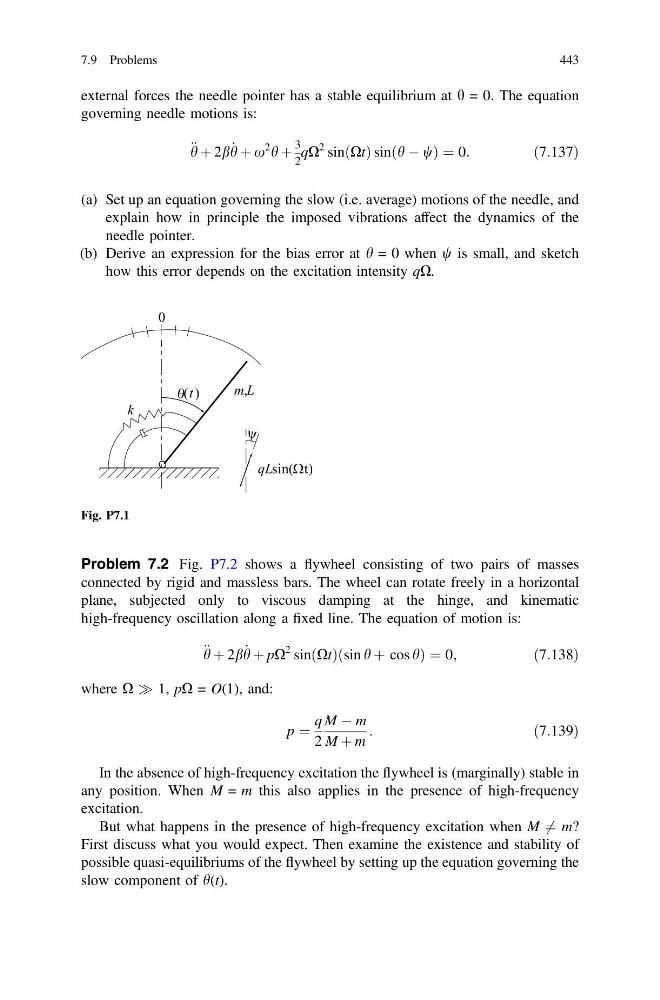
external forces the needle pointer has a stable equilibrium at h = 0. The equation
governing needle motions is:
€ h þ 2b _
h þ x
2 h þ
3
2
qX
2 sinðXtÞ sinðh À wÞ ¼ 0:
ð7:137Þ
(a) Set up an equation governing the slow (i.e. average) motions of the needle, and
explain how in principle the imposed vibrations affect the dynamics of the
needle pointer.
(b) Derive an expression for the bias error at h = 0 when w is small, and sketch
how this error depends on the excitation intensity qX.
Problem 7.2 Fig. P7.2 shows a flywheel consisting of two pairs of masses
connected by rigid and massless bars. The wheel can rotate freely in a horizontal
plane, subjected only to viscous damping at the hinge, and kinematic
high-frequency oscillation along a fixed line. The equation of motion is:
€ h þ 2b _
h þ pX
2 sinðXtÞðsin h þ cos hÞ ¼ 0;
ð7:138Þ
where X ) 1, pX = O(1), and:
p ¼
q
2
M À m
M þ m
:
ð7:139Þ
In the absence of high-frequency excitation the flywheel is (marginally) stable in
any position. When M = m this also applies in the presence of high-frequency
excitation.
But what happens in the presence of high-frequency excitation when M 6 ¼ m?
First discuss what you would expect. Then examine the existence and stability of
possible quasi-equilibriums of the flywheel by setting up the equation governing the
slow component of h(t).
Fig. P7.1
7.9 Problems
443
governing needle motions is:
€ h þ 2b _
h þ x
2 h þ
3
2
qX
2 sinðXtÞ sinðh À wÞ ¼ 0:
ð7:137Þ
(a) Set up an equation governing the slow (i.e. average) motions of the needle, and
explain how in principle the imposed vibrations affect the dynamics of the
needle pointer.
(b) Derive an expression for the bias error at h = 0 when w is small, and sketch
how this error depends on the excitation intensity qX.
Problem 7.2 Fig. P7.2 shows a flywheel consisting of two pairs of masses
connected by rigid and massless bars. The wheel can rotate freely in a horizontal
plane, subjected only to viscous damping at the hinge, and kinematic
high-frequency oscillation along a fixed line. The equation of motion is:
€ h þ 2b _
h þ pX
2 sinðXtÞðsin h þ cos hÞ ¼ 0;
ð7:138Þ
where X ) 1, pX = O(1), and:
p ¼
q
2
M À m
M þ m
:
ð7:139Þ
In the absence of high-frequency excitation the flywheel is (marginally) stable in
any position. When M = m this also applies in the presence of high-frequency
excitation.
But what happens in the presence of high-frequency excitation when M 6 ¼ m?
First discuss what you would expect. Then examine the existence and stability of
possible quasi-equilibriums of the flywheel by setting up the equation governing the
slow component of h(t).
Fig. P7.1
7.9 Problems
443